24 AI Search Statistics for 2026: Clicks, Citations and Buying Behavior
From search-result behavior to retail conversions, these 24 AI search statistics connect 2025–2026 research with practical marketing decisions. See what to track, how to evaluate citations, and where ZeroRank fits into the workflow.
Key Takeaways
- AI summaries change which result earns a click, so rankings tell only part of the visibility story.
- Usage and trust are different signals: people can use AI answers and still look for evidence on your site.
- Retail studies show how AI can enter the buying journey, but their results do not predict performance in every industry.
- AI platforms cite different sources, so a search ranking alone does not show which pages shape an answer.
- A useful starting point is to compare a small set of buyer questions, inspect the evidence, and improve one page with a clear gap.
Your next customer might meet your brand in an AI answer before they ever visit your website. They can compare products, check prices and build a shortlist without opening a search result. That changes what you need to measure—and what your content needs to do.
These 24 AI search statistics show where that shift matters: clicks, trust, buying decisions and the sources AI chooses. Here’s what the numbers mean for your marketing, with practical ways to put them to work.
AI Overviews, clicks and search behavior
The figures in this section come from Pew Research Center’s browsing analysis (opens in a new tab): 900 US adults, March 2025 browsing activity and search-result collection in April 2025.
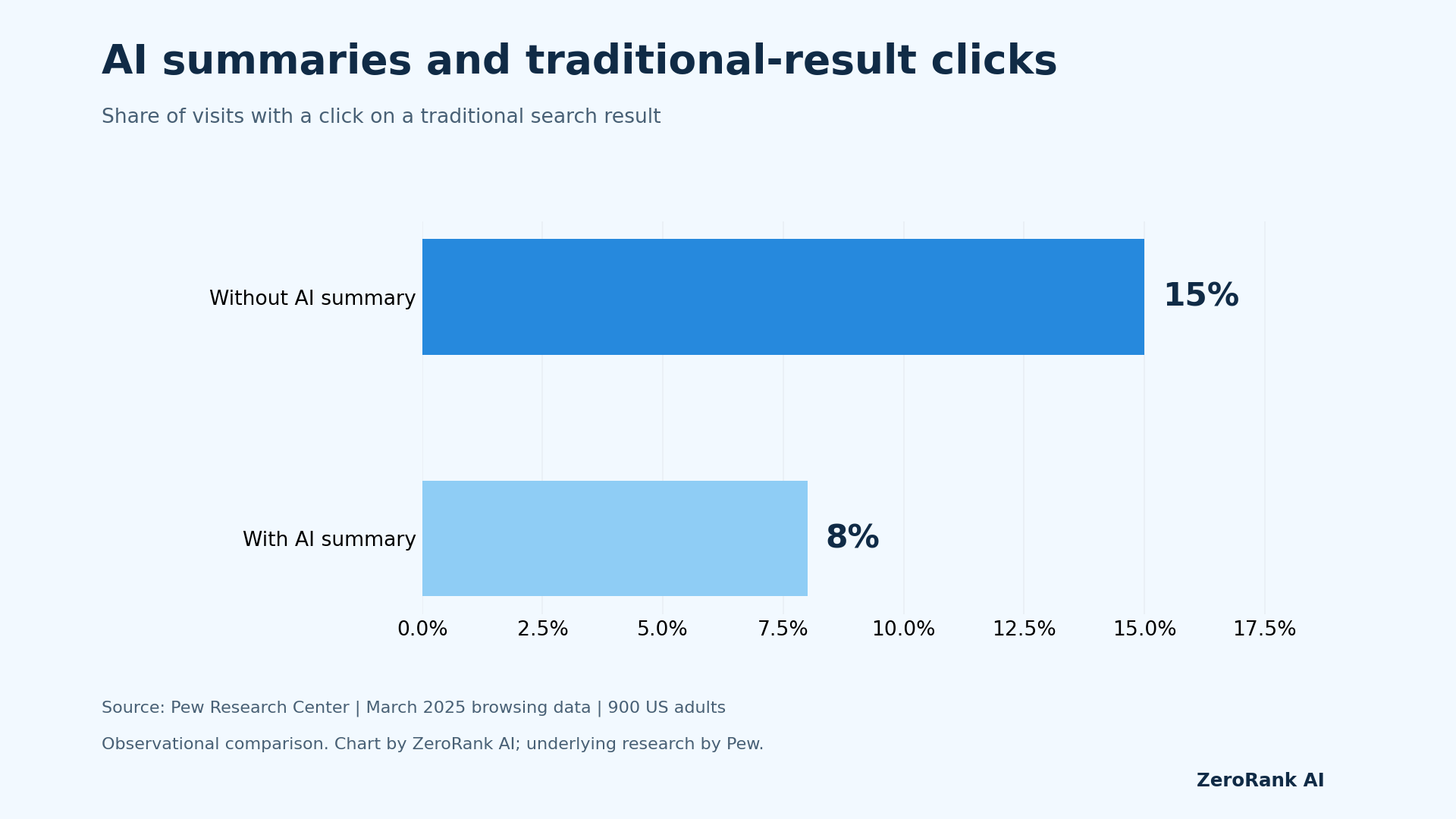
1. Traditional-result clicks occur on 8% of visits with AI summaries
When an AI summary appears, fewer people click through to websites. Pew puts traditional-result clicks at 8% with a summary, compared with 15% without one. For brands, that means rankings alone don’t tell the full story—you also need to know whether your brand appears in the answer and how it’s described.
If a page loses traffic, check what changes in the search results before rewriting it. Are you losing rankings, or is an AI summary answering the question above your page? Those call for different fixes. Review the queries bringing people in, then look at the answers people see.
2. Summary source links receive clicks on 1% of visits
Pew puts clicks on links inside the summary at just 1% of visits to pages with an AI summary. Getting cited can put your content in front of people who never reach your site.
For example, AI can recommend a payroll tool and link to an independent comparison instead of the vendor’s website.
The vendor needs to know which features the answer highlights and whether the recommendation is accurate.
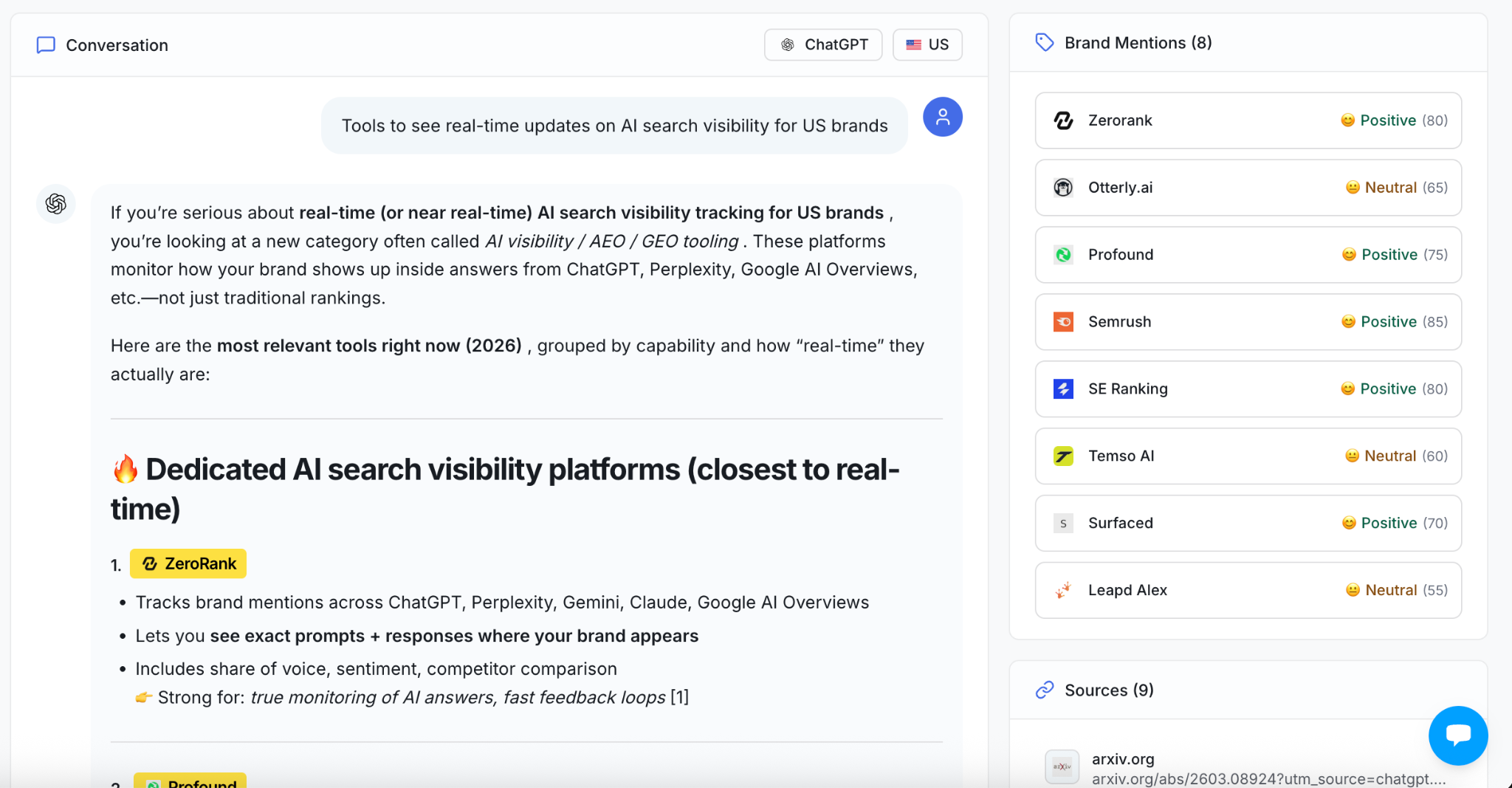
In ZeroRank, open the tracked answer and review its sources to see how your brand appears. Our brand-mention tracking guide (opens in a new tab) explains how to separate brand appearances from website citations.
3. Browsing sessions end on 26% of pages with AI summaries
That compares with 16% on pages with traditional results only. Sometimes the search page is the last stop, so your brand’s presence in the answer deserves attention alongside website traffic.
Give people a clear reason to visit. A mortgage guide can offer a calculator. A software comparison can include a downloadable checklist or an integration walkthrough. Help readers take the next step beyond the short answer.
4. AI summaries appear for 18% of searches in the sample
AI summaries appear in a slice of searches, so the opportunity depends on the questions your audience asks. A broad “CRM” search may return product pages; a detailed question about moving customer records may surface an AI summary and cite a how-to guide.
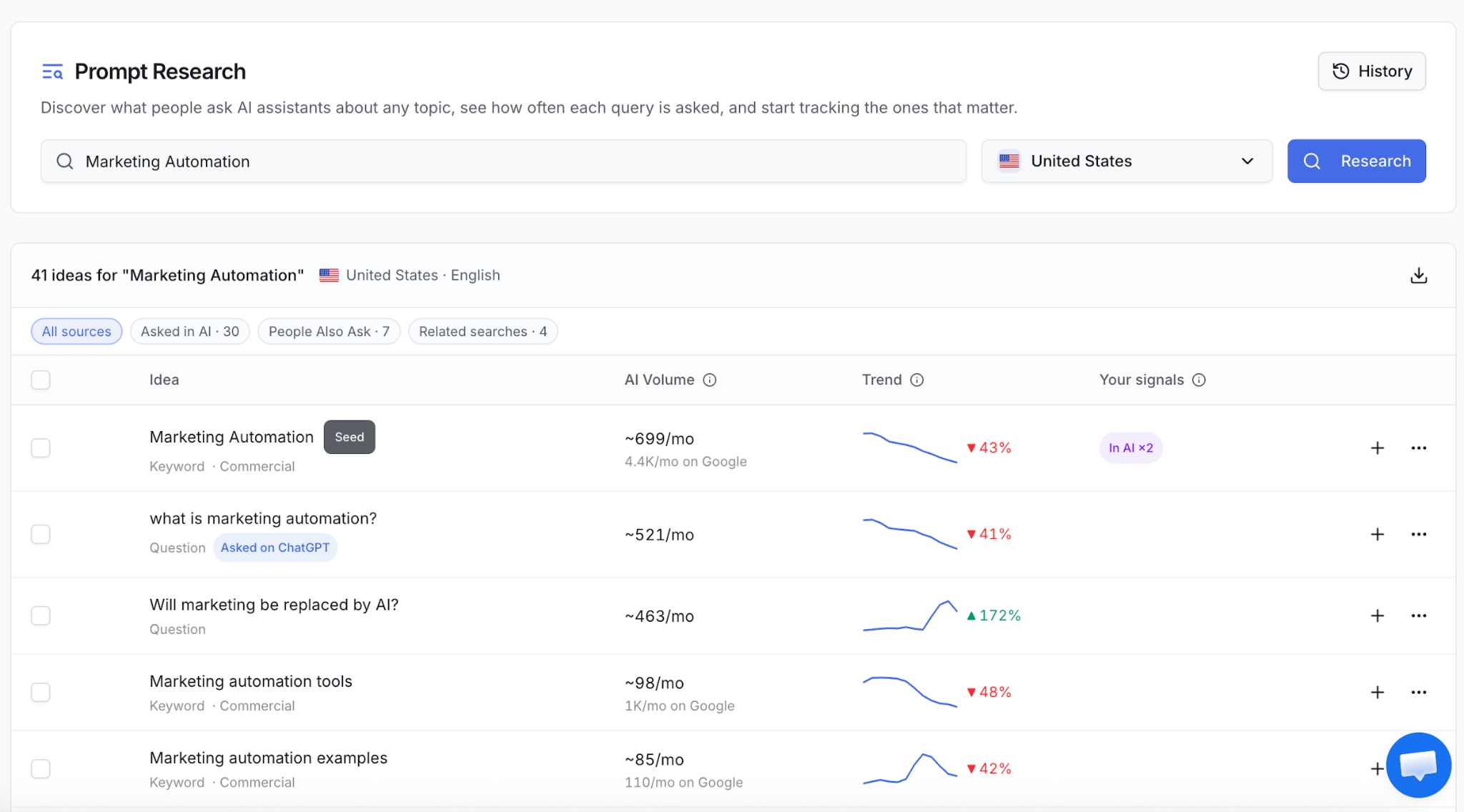
Compare the same topic across query types before you decide where to invest. ZeroRank’s Prompt Research (opens in a new tab) helps you build that question set from real search signals.
Group the questions around learning, comparing and buying. More visibility on definitions means something different from appearing in a buying recommendation.
5. Summary coverage reaches 53% for searches with at least 10 words
Longer searches give people room to explain the problem, audience and constraints. That context can make a generic product page less useful than a page that answers the whole question. For example, “best scheduling software” is broad; “how can a 12-person clinic reduce appointment gaps without adding front-desk staff?” gives a buyer’s situation and decision criteria. Build a page that answers the specific need, then make the product fit easy to verify.
6. Question-word searches generate summaries 60% of the time
Question searches invite a direct answer, but a short definition rarely helps someone make a decision. Answer the question near the top, then add the steps, evidence and exceptions a reader needs. For “what does SOC 2 cover?”, explain the scope, link to your security documentation and clarify what your certification does—and does not—include.
Question-word queries include who, what, when and why. For a page-level workflow, use our guide to optimizing for Google AI Overviews (opens in a new tab).
Build content around the full problem behind a search. A project management vendor could answer “How do I manage approvals across several client teams?” with an actual workflow: who reviews, who approves and what happens when feedback conflicts. That gives readers something useful to work with.
7. 88% of AI summaries cite at least three sources
A summary that cites several sources creates more than one route into the answer. Your page might supply a definition, a comparison, a first-party example or a clear explanation of a limitation. Make each page useful on its own: name the question it answers, support claims with evidence and keep important details current. Then inspect which sources appear beside the answer so you can spot a missing perspective.
AI search adoption, usefulness and trust
Pew’s separate attitudes survey (opens in a new tab) covers 5,153 US adults, August 18–24, 2025. Usefulness and trust figures below concern people who encounter AI summaries.
8. 65% of US adults encounter AI search summaries at least sometimes
A majority encounter summaries at least sometimes, but frequent exposure is smaller. That distinction matters when you plan effort: presence in every query is not the goal. Look for the searches where a summary appears, your audience cares about the answer and your business has something specific to contribute. A targeted set of useful pages beats a vague mandate to “optimize for AI.”
9. Frequent exposure reaches 62% among adults under 30
Among adults aged 65 and older, the equivalent share is 23%.
Start with your customers. Ask where they research products, look at referral traffic and listen to the questions coming up in sales calls. A business selling to students may need a different approach from one serving retirees. Use those signals to decide where AI search fits into your marketing.
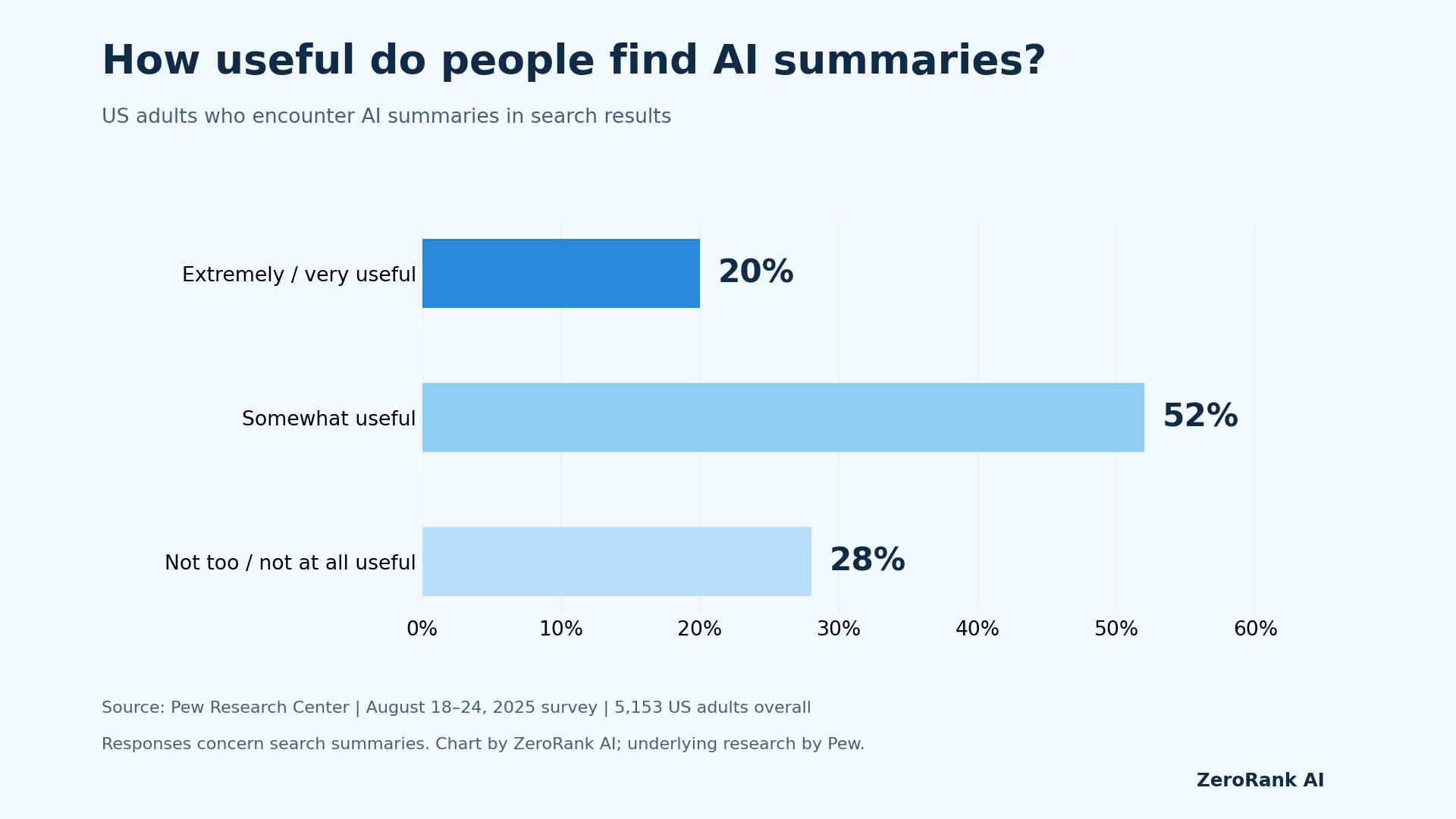
10. 20% find AI summaries extremely or very useful
Only one in five respondents rates summaries at the top of the usefulness scale. Treat a summary as a first impression, not proof that the buyer has everything they need.
A clear answer can earn attention; detailed pricing, compatibility, implementation steps and independent proof help the reader decide what to do next.
11. 52% find AI summaries somewhat useful
The largest group says summaries are somewhat useful. That middle rating points to a practical content opportunity: give the quick answer, then help readers check it.
A comparison page can state the difference in one sentence and follow with current plan limits, use cases and links to product documentation. This helps both a person checking the answer and a system looking for a reliable source.
12. 28% find AI summaries not too useful or not useful at all
More than a quarter find summaries not too useful or not useful at all. That leaves room for original expertise: explain trade-offs, show a real workflow and answer the follow-up question the summary skips.
Review the answers in your category for recurring gaps, then improve the page that can fill one with evidence. ZeroRank’s AI Search Optimization guide (opens in a new tab) lays out a practical way to work from prompts and sources to page updates.
13. 53% have at least some trust in AI summaries
Only 6% trust AI summaries a lot; 46% express little or no trust.
People can read an AI answer and still want to check it. Make that next step easy: keep product details accurate, show your evidence and help visitors find what they need quickly.
Make your claims easy to verify. Link integration claims to documentation. Put billing terms beside pricing limits. Show the starting point and timeframe behind a case study result. Someone checking an AI recommendation should find a clear answer on your site.
Use ZeroRank to check how AI describes your features, pricing and ideal customer. If something is wrong, review the cited source and work out where the correction belongs—your website, a comparison page or another publication. Read the answer itself, even when the sentiment score looks positive.
AI referrals, shopping and conversions
Adobe’s August 2026 AI Traffic Trends Report (opens in a new tab) combines website analytics with a separate July survey of more than 5,000 US consumers.
Its retail analysis covers more than one trillion visits to US retail sites. Website comparisons below concern July 2026.
14. 42% of consumers report using AI assistants for online shopping
AI already has a place in how these shoppers research purchases. Think about the questions a customer asks before choosing your product.
For a shoe retailer, that might be “Which running shoes suit wide feet?” or “How do these two models compare?”
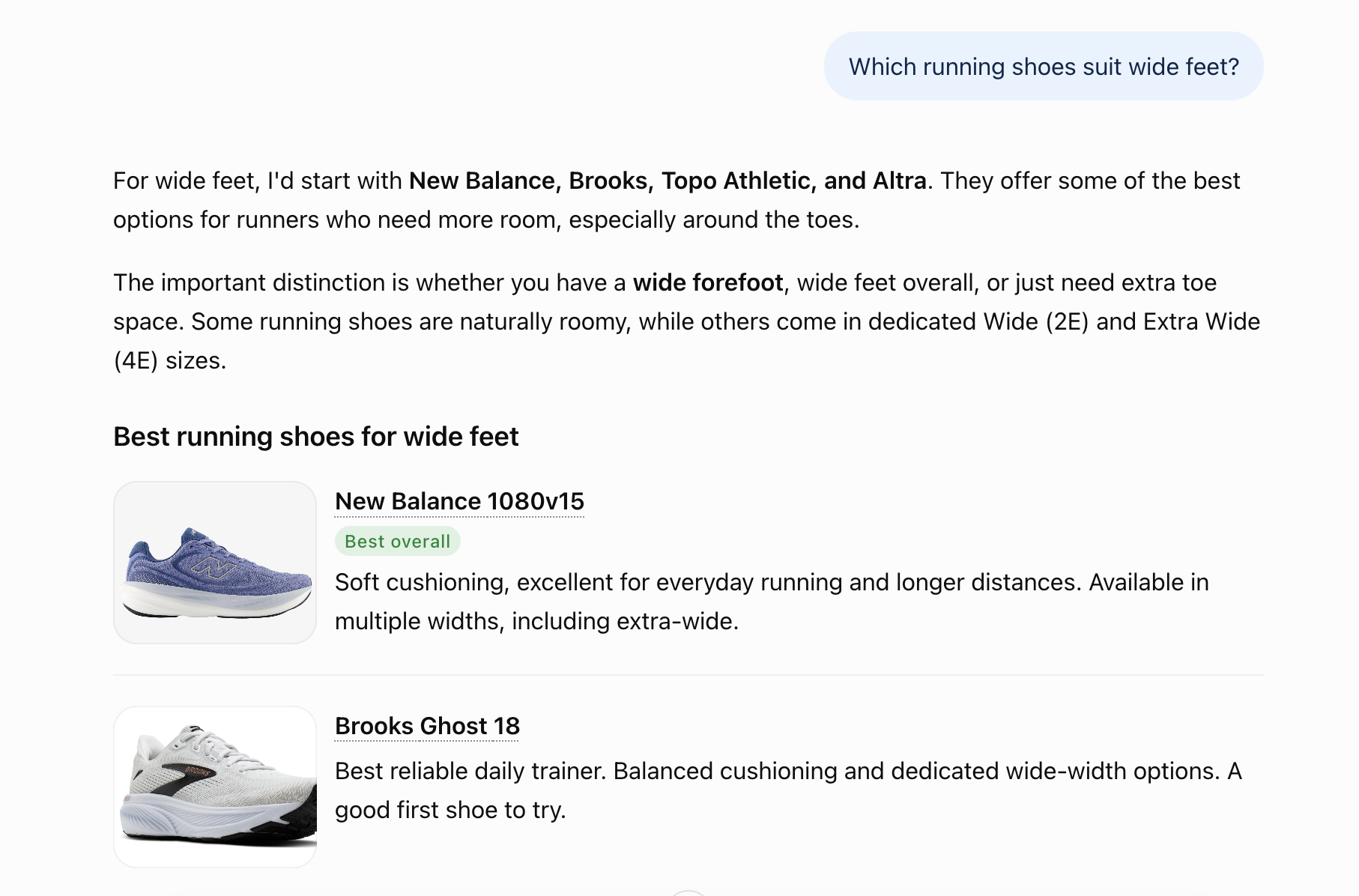
For a software company, it could be “Which plan supports multiple clients?” Make sure your content answers the questions that help someone decide.
15. 83% of AI shoppers say assistants improve their shopping experience
For shoppers who use AI, assistants make comparison easier and help narrow a choice. Put model differences, plan limits, compatibility and return terms in clear language. If an AI answer gets a detail wrong, a buyer should be able to check the accurate information on your site.
16. 77% of AI shoppers report greater purchase confidence
AI can help a shopper feel more confident when it organizes the choice. Your content supplies the details behind that confidence: what each option includes, who it suits, what it costs and what a buyer needs before checkout.
Check that these facts agree across product pages, help articles and third-party listings. ZeroRank’s AI Brand Sentiment guide (opens in a new tab) shows how to review what answers say about topics such as pricing or support.
Try a prompt such as “Which plan supports multiple client workspaces?” Compare each platform’s answer with your pricing page and documentation. If an AI answer repeats an outdated plan limit, correct the source and recheck the same prompt.
17. 69% of AI shoppers say assistant help makes them less likely to return a purchase
Shoppers say AI helps them feel less likely to return a purchase. That makes product fit a useful focus for your content.
Help buyers understand what they’re getting. A furniture retailer can show dimensions, materials and delivery restrictions together.
A software company can explain which plan suits which team, what the limits mean and which integrations are available. Answer the questions that might otherwise become an unpleasant surprise after purchase.
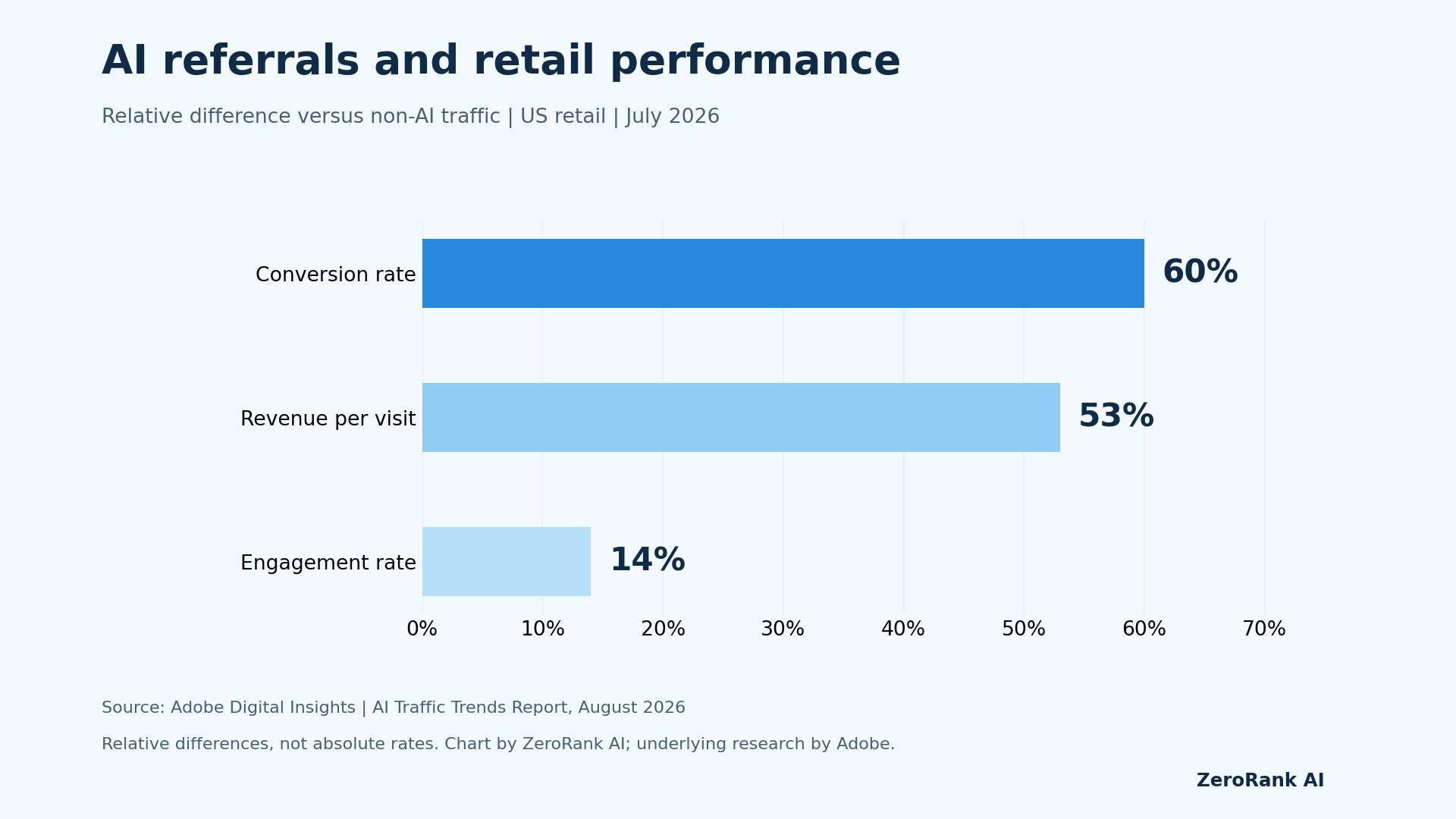
18. AI-referred retail traffic converts at a 60% higher rate
Adobe compares visitors arriving through AI with non-AI traffic. The 60% figure describes a higher conversion rate, not the percentage of visitors who buy.
For example, a 2% conversion rate would become 3.2% with a 60% increase. That’s an illustration, not Adobe’s absolute rate.
In your own reports, show the number of visits and purchases beside the percentage so you can see how much business the channel actually brings.
19. AI-referred retail visits generate 53% more revenue per visit
A higher revenue per visit can come from more purchases, larger baskets or a mix of both. Look past the headline and compare the actual landing pages, product categories and order values behind AI referrals.
If a small number of visits produce high-value orders, give those pages a closer look—but wait for enough data to see a stable pattern before shifting budget.
20. AI-referred retail traffic has a 14% higher engagement rate
The 14% engagement lift matters when those visits lead to useful actions. Check which pages AI-referred visitors land on, whether they compare products or view implementation details, and what they do next.
Define a meaningful engagement action in your analytics, then compare it with signups, purchases or qualified leads. Adobe’s result describes retail traffic in July 2026; use your own data to decide whether AI referrals deserve more attention in your business.
Add a monthly report showing AI-referred visits, landing pages, signups or purchases, and revenue or qualified leads by platform.
Pair those outcomes with ZeroRank’s prompt-level answers and cited sources to see which topics deserve a closer look. For the reporting setup, see our AI search analytics guide (opens in a new tab).
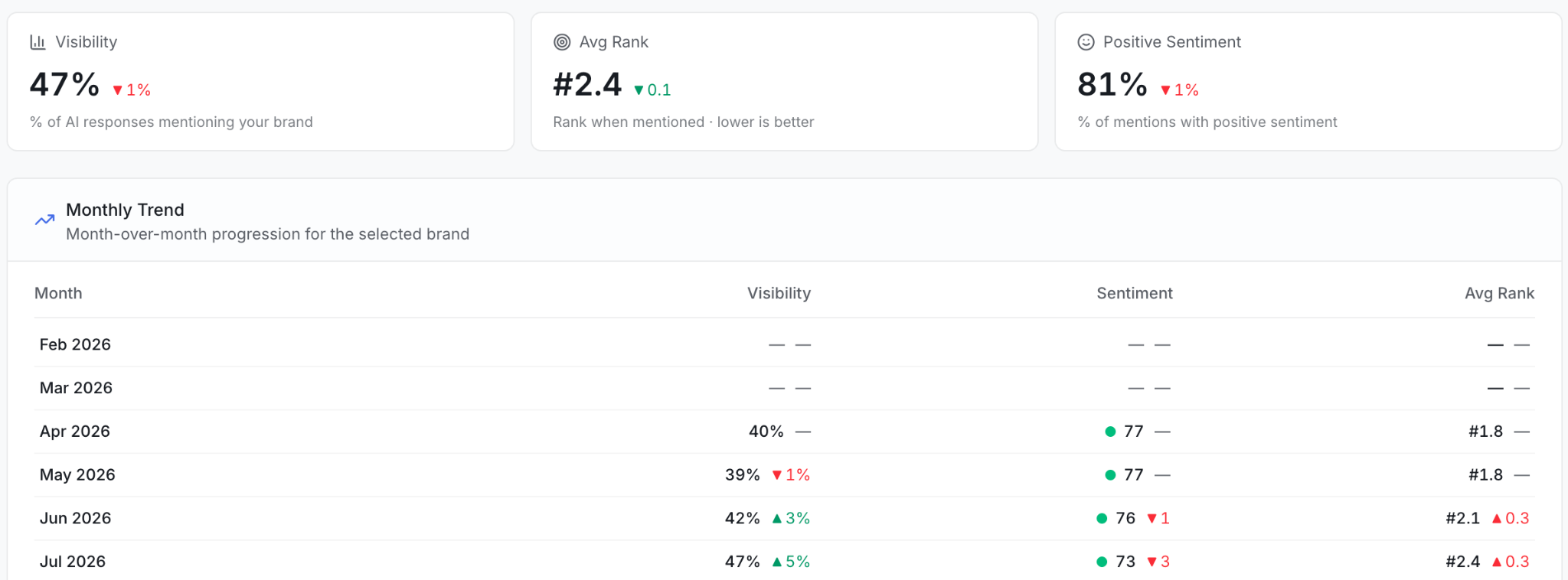
Analytics shows trackable referrals. Add a “How did you hear about us?” question during signup or sales calls to catch discovery that ends in a later direct visit.
“The single most accurate thing you can do is just ask them.”
— Besmir Bregasi, co-founder of ZeroRank AI, AI Rabbit Holes, 8:03 (opens in a new tab)
AI citations and source selection
21. AI Overviews appear for 13.7% of tested trending queries
One 2026 study examines 55,393 trending queries across 19 categories over 40 days, from March 13 to April 21. AI Overviews appear for 13.7% of queries overall and 64.7% of question-form queries.
The study describes its trending-query sample; compare it with the question-led prompts your own customers ask. Our LLM prompt tracking guide (opens in a new tab) explains how to build a consistent buyer-question set.
22. Nearly 30% of cited domains are absent from accompanying first-page results
A search ranking and an AI citation answer different questions. A local restoration business in 3Bug Media’s ZeroRank customer story appears in 14% of tracked answers, while its website does not appear among the 15 most cited sources.
That gives the team two things to investigate: where the brand gets mentioned, and which pages AI uses as evidence. Read 3Bug Media’s customer story (opens in a new tab) for the full example.
Imagine a competitor’s implementation guide gets cited while your category page doesn’t. Compare what each page explains.
Does the guide cover setup steps, requirements or examples your page misses? Use that gap to make a specific improvement while continuing your SEO work.
23. 11% of Google AI Overview claims lack support from linked pages
Across 98,020 claims, 11% lack support from the pages linked beside them. That makes the cited page a useful place to check an answer, especially for product details a buyer may act on.
For a software buyer, an answer can cite your documentation and still put a feature in the wrong plan. Open the answer and the linked page side by side; correct the page that defines availability, then check that pricing, comparison and help pages agree.
24. Top 20 domains account for 20.5%–70.8% of citations, depending on the AI platform
An October 2026 study examines 17,211 citation instances across 10 AI-search platforms and 6,356 source domains. The top 20 domains account for 20.5% to 70.8% of citations, depending on the platform.
Compare the same buying prompt across the systems your customers use, then inspect the pages each one cites.
An agency might see its client in ChatGPT comparisons but miss out in Perplexity. Compare the sources behind those answers. One may point to a documentation gap; another may highlight a relevant review that leaves the client out. Let the answer guide the next action.
ZeroRank’s AI citations guide (opens in a new tab) helps you find the pages AI cites around your category. Use it alongside optimization recommendations to choose a useful next step: improve a page, correct outdated information or pursue relevant coverage. Record the change and keep tracking the same prompts to see how answers develop over time.
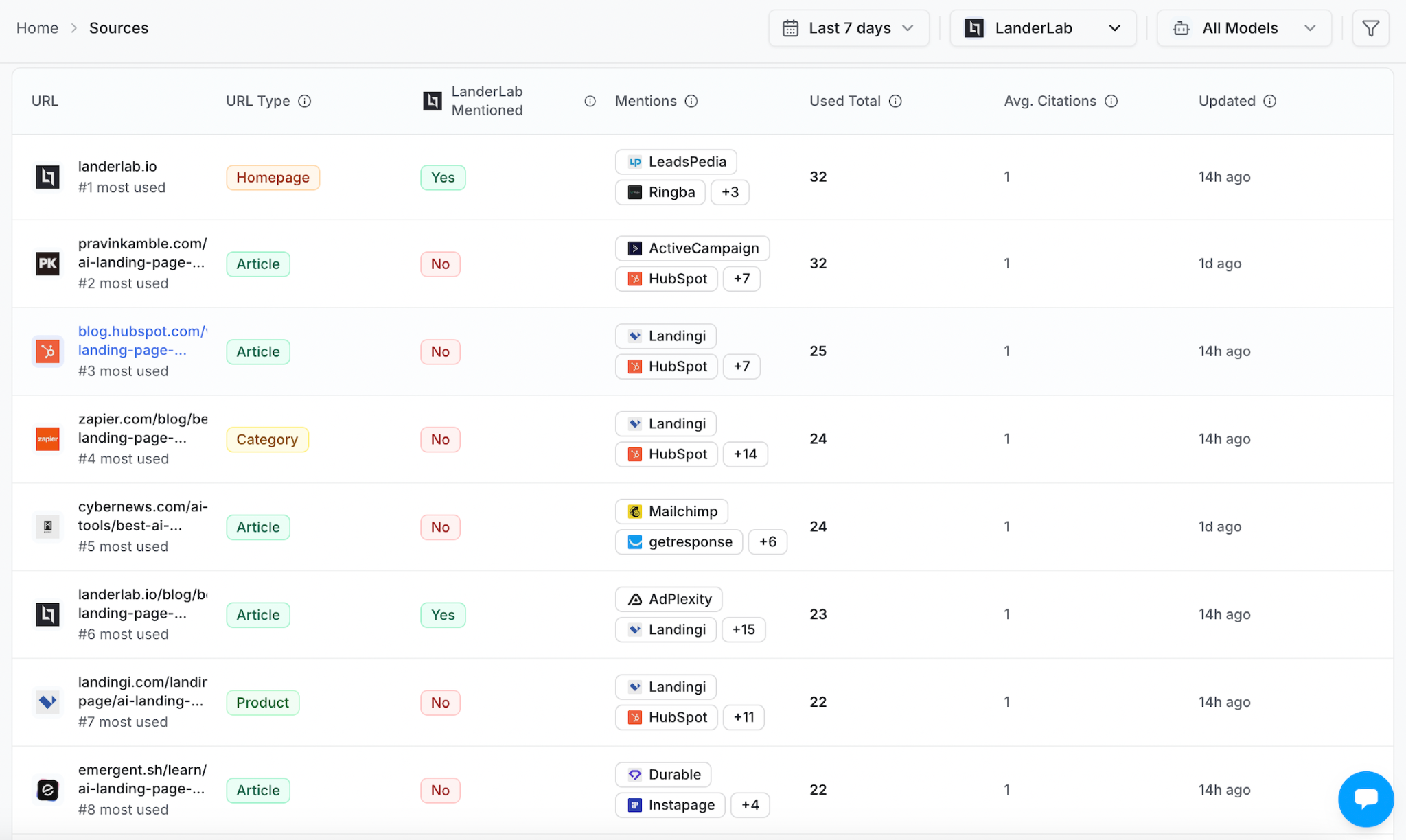
Check what AI actually says about your brand
Start with a buying question you care about. Does AI recommend your brand? What does it say you’re good at? Which pages does it use? Those details help you decide what to improve.
ZeroRank’s AI Search Visibility Metrics guide (opens in a new tab) separates visibility, mentions, citations, sentiment and referral outcomes so the team can connect an answer-level observation to a useful next step.
“If you’re running a query into one of the AI search tools, you will basically get one snapshot.”
— Besmir Bregasi, co-founder of ZeroRank AI, AI Rabbit Holes, 2:59 (opens in a new tab)
Use that snapshot to inspect an answer, then compare the same prompt set over time before treating a change as a pattern.
How to turn these statistics into a working plan
Start with one buying decision, not a huge prompt list. Choose a product, a buyer group and 8–12 questions spanning problem discovery, comparison and product selection.
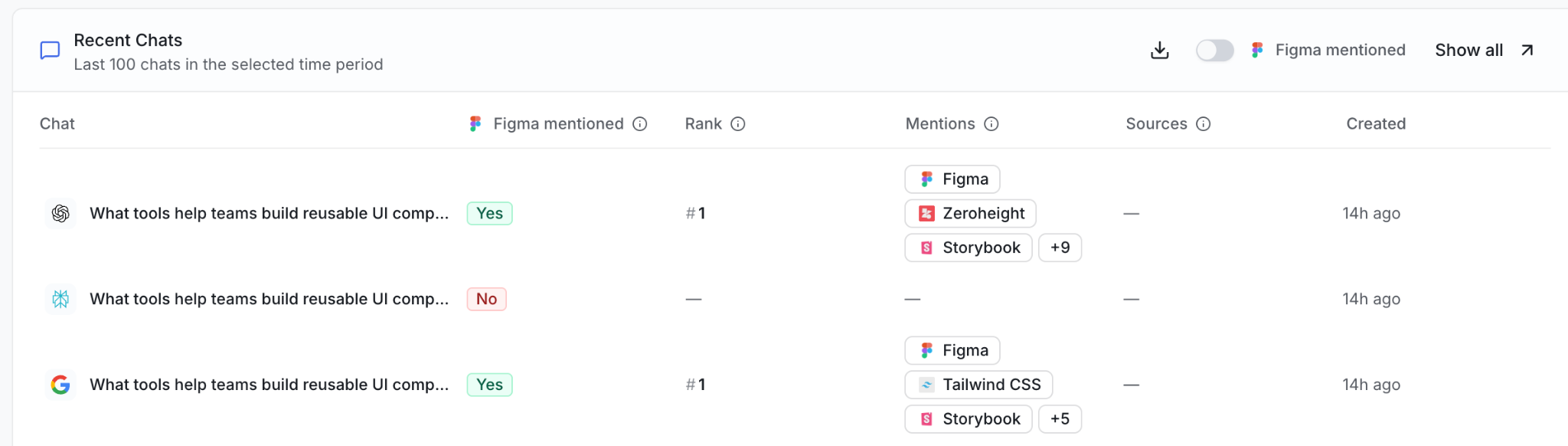
Use ZeroRank’s Prompt Research to find and refine those questions. For each platform, record whether the answer mentions your brand, cites your site, cites another source or recommends a competitor. Save the baseline so later checks use the same prompts.
Pick the gap with business value: a wrong product detail, a missing comparison, a trusted source your buyer relies on or a question your content does not answer.
Use Sources to inspect the cited pages, then improve the page that can address that gap. Recheck the prompts after the change and track visits, signups or qualified leads alongside visibility.
Use the answer engine optimization checklist (opens in a new tab) to turn that gap into on-page, off-page or technical work. And ZeroRank's Copilot or MCP connection to turn the recommendations into an automated execution plan.
Filed under AI Search Education
Keep reading
All posts AI Search Education
AI Prompt Volume: Which Questions Are Worth Tracking?
Learn what AI prompt volume means, build a prompt set around real buyer decisions, and turn the answers into specific content improvements.

 AI Search Education
AI Search Analytics: What to Track and How to Use the Data
Learn how to use AI search analytics to track visibility, research prompts, analyze sources, and turn your findings into practical improvements.

 AI Search Education
The 14 Best GEO Agencies for SaaS in 2026 (Pricing and G2 Ratings Verified)
We verified pricing pages, G2 and Clutch ratings, and AI search deliverables for 14 GEO agencies serving SaaS. Six publish no price. See who fits your budget.