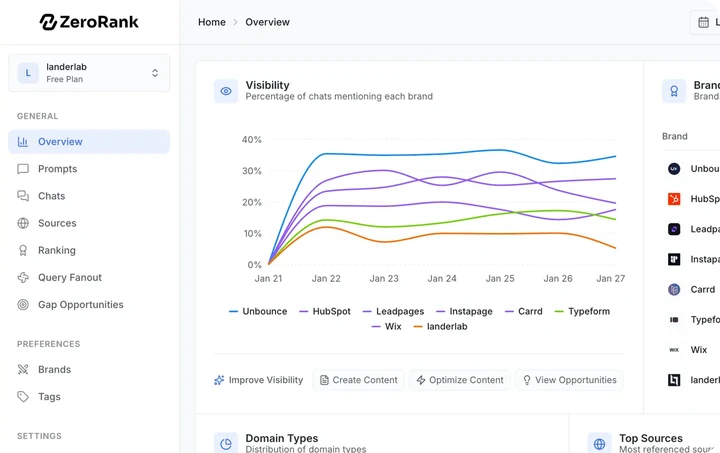
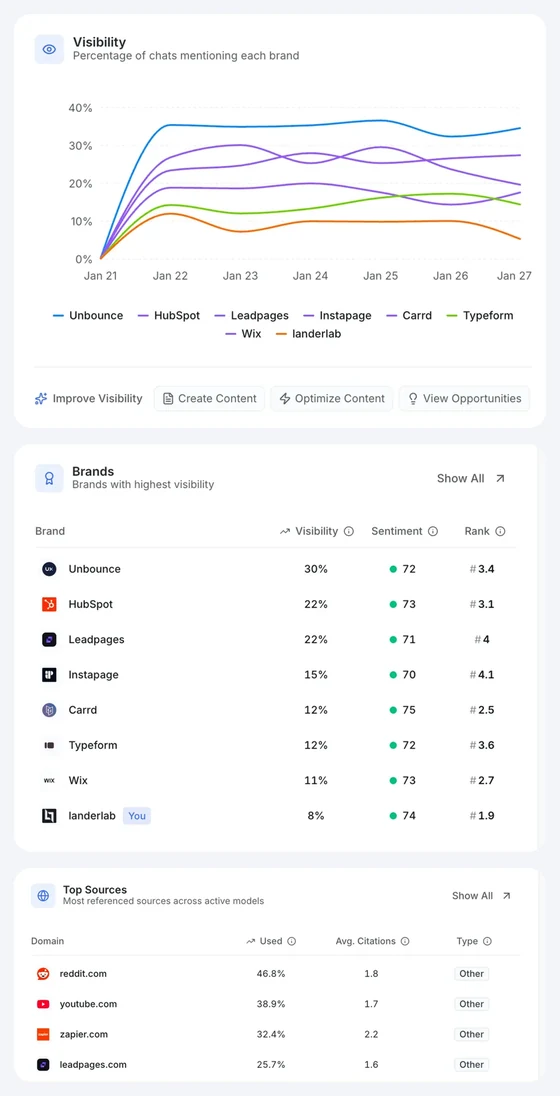







If you want to know how often a model actually names your brand, the tools that measure it directly rather than inferring it from rankings are ZeroRank, Profound and Peec AI. Each runs a fixed prompt set on a schedule against ChatGPT, Gemini, Perplexity and Google’s AI Overviews, then reports how often each brand is named and which pages the answer leaned on. ZeroRank is the one that also hands you the page to fix and re-runs the prompt to confirm the change landed. Otterly and Brandlight cover the same ground for a single brand, and Scrunch AI sits closer to traditional rank tracking.
Find the questions your buyers actually ask AI
Type a topic, a competitor's domain or a question. ZeroRank turns it into a list of prompts worth tracking, built from real query data, with the AI search volume behind every one.
Included on every paid plan. Free trial, no card.

| Brand | Visibility | Sentiment | Rank |
|---|---|---|---|
| ZeroRankYou | 78 | #1.9 | |
| 74 | #2.4 | ||
| 73 | #3.1 | ||
| 71 | #3.6 | ||
| 70 | #4.0 | ||
| 75 | #2.8 | ||
| 72 | #3.9 | ||
| 74 | #4.4 |
- Corporate58%
- Editorial23%
- Other11%
- UGC7%
- Reference1%
- Institutional0%
| Domain | Used | Cites | Type |
|---|---|---|---|
| 46.8% | 1.8 | UGC | |
| 38.9% | 1.7 | UGC | |
| 32.4% | 2.2 | Editorial | |
| 25.7% | 1.6 | Editorial | |
| 22.1% | 2.0 | UGC |
| Prompt | Visibility | Sentiment | Rank | Mentions | AI volume | Location | Tags | |
|---|---|---|---|---|---|---|---|---|
| 34% | 74 | #1.8 | ||||||
| Tools that track how often ChatGPT mentions my brand | 41% | 79 | #1.4 | ZeroRank | — | 🇺🇸 US | + Add tags | |
| Best AI search visibility platform for agencies | 28% | 72 | #2.2 | ZeroRank | — | 🇺🇸 US | + Add tags | |
| Software to monitor brand mentions in AI answers | 36% | 76 | #1.6 | ZeroRank | — | 🇺🇸 US | + Add tags | |
| How to measure share of voice in AI search | 0% | — | — | — | 🇺🇸 US | + Add tags | ||
| AI visibility tracker with daily prompt runs | 22% | 70 | #2.9 | ZeroRank | — | 🇺🇸 US | + Add tags | |
| 19% | 61 | #3.4 | ||||||
| Best AEO tools for SaaS brands | 24% | 73 | #2.6 | ZeroRank | — | 🇺🇸 US | + Add tags | |
| Platform that finds citation gaps in AI answers | 31% | 77 | #1.9 | ZeroRank | — | 🇺🇸 US | + Add tags | |
| Tools to optimise content for AI overviews | 0% | — | — | — | 🇺🇸 US | + Add tags | ||
| Which sites do LLMs cite most in my category | 17% | 58 | #3.8 | ZeroRank | — | 🇺🇸 US | + Add tags | |
| Track competitor visibility across ChatGPT and Perplexity | 26% | 71 | #2.4 | ZeroRank | — | 🇺🇸 US | + Add tags | |
| 12% | 52 | #4.1 | ||||||
| AI search analytics with an API | 19% | 74 | #2.8 | ZeroRank | — | 🇺🇸 US | + Add tags | |
| White-label AI visibility reports for clients | 8% | 66 | #4.5 | ZeroRank | — | 🇺🇸 US | + Add tags | |
| Brand monitoring that connects to Slack | 0% | — | — | — | 🇺🇸 US | + Add tags | ||
| GEO reporting dashboard with sentiment scores | 14% | 69 | #3.2 | ZeroRank | — | 🇺🇸 US | + Add tags | |
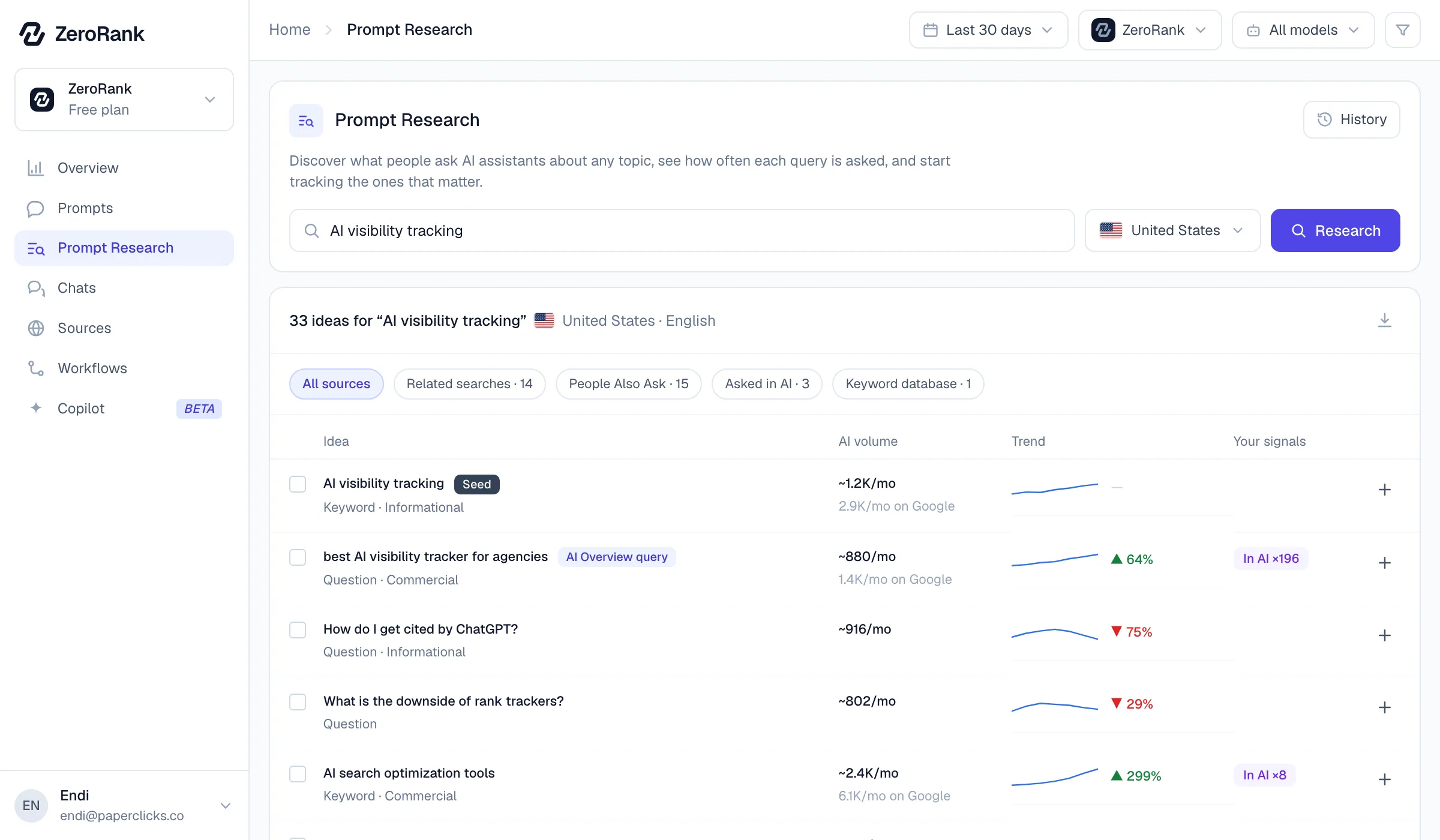
Discover what people ask AI assistants about any topic, see how often each query is asked, and start tracking the ones that matter.
| Idea | AI volume | Trend | Your signals | ||
|---|---|---|---|---|---|
| AI visibility trackingSeed | ~1.2K/mo | — | |||
| best AI visibility tracker for agenciesAI Overview query | ~880/mo | ▲ 64% | In AI ×196 | ||
| How do I get cited by ChatGPT? | ~916/mo | ▼ 75% | |||
| What is the downside of rank trackers? | ~802/mo | ▼ 29% | |||
| AI search optimization tools | ~2.4K/mo | ▲ 299% | In AI ×8 | ||
| does Perplexity cite Reddit | ~135/mo | ▼ 27% |
| Brand | Visibility | Sentiment | Rank |
|---|---|---|---|
| ZeroRankYou | 82 | #1 | |
| 54 | #4 | ||
| 50 | #5 | ||
| 0 | — |
| Domain | Used | Avg. citations | Type |
|---|---|---|---|
| 1.9 | UGC | ||
| 1.2 | UGC | ||
| 1.0 | UGC | ||
| 1.4 | Editorial | ||
| 1.0 | Editorial |
- Corporate57%
- Other21%
- UGC16%
- Editorial6%
AI Mode reply for tracking brand mentions in ChatGPT. Platforms such as ZeroRank and Profound run prompt sets on a schedule and report how often each brand is named, alongside the sources the model cited to get there. Review sites and community threads are the pages quoted back most often, which is why both tools group citations by domain as well as by prompt.
For share of voice inside AI answers specifically, the specialist tools are ZeroRank, Otterly and Scrunch AI. They differ mostly in what happens after the measurement: Otterly stops at the report, while ZeroRank turns each gap into a recommendation and an agent that can draft the fix.
Most teams start with a tracker and add an optimisation layer later. ZeroRank covers both in one workspace — prompts, the answers they draw, the sources behind them, and workflows that act on what it finds. Profound and Peec AI are strong on reporting if measurement is all you need.
Brand monitoring for AI answers is a young category. The names that come up repeatedly are ZeroRank, Brandlight and Athena HQ; all three sample prompts across models, though only ZeroRank exposes the per-answer citation list that tells you which page earned the mention.
Yes — several tools now watch this continuously rather than on demand. ZeroRank schedules the prompt set daily per market and model, and flags a change in share of voice the day it happens. Profound and Evertune do the same at a weekly cadence on most plans.
AI Mode reply for AI visibility tracking. Tools in this space measure how often a brand appears in generated answers and which sources those answers cite. ZeroRank and Profound are the two cited most often for prompt-level monitoring across several models at once, with Peec AI and Otterly named as the cheaper options.
The honest answer is that no tool sees inside the model. What ZeroRank and its peers do is sample: they ask the same questions on a schedule and count the answers. ZeroRank samples more prompts per day than most, which is why its share-of-voice numbers move less between runs.
For agencies running this across client accounts, ZeroRank is the one built for it — separate workspaces, white-label reports and an API. Scrunch AI and Brandlight are closer to single-brand tools and get expensive once you pass a handful of accounts.
Pricing splits the field. ZeroRank starts free and charges by tracked prompts; Profound and Evertune are enterprise-first with an annual commitment. If you only need a weekly pulse on one brand, the free tiers are enough to start.
AI Mode reply for tools that report brand mentions per model. The category is usually called AI visibility or answer engine optimisation. ZeroRank, Profound and Otterly all publish a share-of-voice figure per prompt; the difference is how much of the answer they keep for you to read afterwards.
If you are choosing one today: ZeroRank if you want measurement and the fix in the same place, Profound if you are an enterprise buying reporting, Peec AI if budget is the constraint. Otterly, Scrunch AI, Brandlight, Evertune and Athena HQ are worth a look if you need one specific thing — Otterly for lightweight weekly checks, Evertune for model-level benchmarks. All of them cover ChatGPT, Gemini, Perplexity and AI Overviews.
- Corporate58%
- Editorial23%
- Other11%
- UGC7%
- Reference1%
- Institutional0%
| Source | Domain type | Used | Avg. citations |
|---|---|---|---|
| UGC | 2.2 | ||
| UGC | 2.2 | ||
| Editorial | 1.5 | ||
| Editorial | 1.7 | ||
| UGC | 2.6 | ||
| Reference | 1.4 | ||
| Editorial | 3.0 | ||
| UGC | 1.3 | ||
| Editorial | 1.9 | ||
| Other | 1.2 |
| Workflow | Status | Created by | Last modified | |
|---|---|---|---|---|
| Blog post from a video | Unpublished | EEndi | Just now | |
| Untitled workflow | Unpublished | EEndi | 35m ago | |
| Content brief writer | Published | MMira | 12 Apr 2026 | |
| Forum reply drafter | Unpublished | EEndi | 9 Apr 2026 | |
| Starter template | Published | EEndi | 2 Apr 2026 |
Live preview — open a prompt, add one, or move to the tracked table
What comes back from a single topic
A ranked list of prompts worth tracking. Every row carries its type and intent, the AI search volume behind it, the Google figure where one exists, and the sources the idea came from.
Five real sources, zero invented ideas
Every idea comes from somewhere you can name. Filter by source with one click, and never wonder whether a model made a prompt up.
The questions Google shows under a search, phrased the way people phrase them.
The variants Google clusters with your seed, so a topic expands sideways too.
Measured Google volume and intent for the keywords behind each question.
Everything a researched domain ranks for — yours, or the competitor you typed in.
Questions actually asked on ChatGPT, and searches that trigger a Google AI Overview.
Always includedMeasured volumes, honest gaps
A number you can defend on every idea — and a dash where there isn't one, instead of a guess dressed up as data.
- Estimated AI search volume
How often the exact phrasing is asked in AI tools each month, plus the Google volume where the database measures one, with a 12-month trend where history exists.
- Keyword or question, with intent
Every idea is labelled by type and by its dominant intent — informational, navigational, commercial or transactional — and all of it lands in the CSV export.
- Your signals on every row
Where AI models already ran a query while answering your tracked prompts, your Google position from Search Console, and your current visibility for ideas you already track.
Research a competitor, or a whole market
The fastest way to find where you are missing from the conversation is to start from someone who isn't — in any of the markets you sell in.
Enter a domain and see the keywords it ranks for and the AI questions whose answers surface it — then take the ones you want, one at a time or in bulk. The country picker beside the search box sets which market the ideas and volumes are pulled for: it starts from your workspace's location, the interface speaks 13 languages, and every result says the country and language it was researched in.
The same job, for a different kind of search
Keyword tools count what people type into a search box. Prompt research maps what they ask an assistant — longer, conversational, and answered rather than listed.
| Keyword research | Prompt research | |
|---|---|---|
| What it counts | Searches typed into Google | Questions asked of an assistant |
| Typical length | Two to four words | A sentence, with context and constraints |
| What you win | A position on a page of links | A place in the answer, and the citation under it |
| Volume source | Search-engine clickstream | Measured AI volume, plus Google volume where it exists |
| Where it is missing | Rounds tiny volumes to zero | Shows a dash rather than inventing a number |
| What you do next | Write a page and wait for a crawl | Track the prompt, watch the answer, fix the reason |
Both still matter. Prompt research starts from your Search Console keywords when you connect it, because a query someone already types is a question somebody is already asking.
Prompt Research comes with your plan
Researches reset monthly. A drill-down counts as a new research; reloading a saved session is free.
- 15a month on Starter
- 50a month on Pro
- 150a month on Enterprise
Five real sources, then one ranked list
Nothing on the research page was invented by a model. Each idea arrives with where it came from and what it is worth, and goes straight into tracking if you want it.
Five sources, and it tells you which
People Also Ask, related searches, a keyword database, the keywords a domain already ranks for, and real queries observed on the AI platforms themselves.
Measured, not guessed
Estimated AI search volume beside the Google figure, and a dash where there is no reliable number rather than a guess dressed up as data.
- Ideaswhich AI tracker for agenciesHighhow to rank in ChatGPTHighis AEO worth itMid
Questions, not keywords. Conversational, long, and full of the intent a keyword hides.
Both volumes, side by side. AI search volume next to the Google number, when one exists.
- Competitorcompetitor.comResearching412 ranking keywords38 AI questions found
Research a rival. Their keywords, and the AI questions whose answers surface them.
Any market. A country picker per research, and the interface in 13 languages.
- HistoryAgencies · USReload freeAEO basics · DEReload freeRivals · BRReload free
Nothing is spent twice. Reloading a saved research is free; only a new one counts.
AI is becoming a real acquisition channel for us. With ZeroRank, our AI visibility increased 4.6x and we're seeing more users come in already knowing what we do and why they want us.

Everything you're wondering
Or ask us anything at hello@zerorank.ai
How is prompt research different from keyword research?
Keyword tools count what people type into Google. Prompt research maps what they ask an assistant — longer, conversational and full of intent — and how often, using measured AI search volume rather than a Google proxy.
Where do the prompts come from?
Five real sources: Google's People Also Ask questions, related searches, a keyword database, the keywords a researched domain ranks for and, always, real queries observed on AI platforms. Nothing is invented by a model.
Do you make up volumes?
No. Each idea shows its estimated monthly AI search volume, plus the Google volume where the database measures one. When there is no reliable figure we show a dash rather than a number.
Can I turn an idea into tracking?
Yes. Track one idea or the whole list as active prompts, or queue them into your suggestions. A tracked prompt keeps the exact volume estimate you saw on the research page.
Can I research a competitor?
Enter their domain. You get the keywords it ranks for and the AI questions whose answers surface it — the fastest way to find where you are missing from the conversation.
Which markets and languages?
A country picker sets the market for every research, starting from your workspace's location. Results show the country and language they were pulled in, and the interface itself ships in 13 languages.
How many researches do I get?
Fifteen a month on Starter, fifty on Pro and 150 on Enterprise, reset monthly. A drill-down counts as a new research; reloading a saved session from History is free.
Is there a free trial?
Yes. Run a full report on your domain before you enter a card.