How to Optimize Content for AI Search: 10 Practical Steps
This guide explains how to find content gaps, create or optimize the right pages, earn more citations, and measure the results with ZeroRank.

Key Takeaways
- AI search optimization is still built on strong SEO foundations, but ranking alone does not guarantee that your content will be selected or cited.
- Track specific prompts that reflect how customers research, compare, and buy.
- Analyze AI answers, cited sources, and fan-out queries to understand why other pages are selected.
- Strong AI-search content directly answers the question, adds original evidence or expertise, and fills a clear gap in the existing sources.
- Build authority beyond your website through relevant mentions, reviews, expert contributions, and digital PR.
Optimizing content for AI search is not about adding an FAQ section, writing in shorter paragraphs, or creating an llms.txt file.
It starts with understanding what AI search engines need to answer your buyers’ questions—and why they currently choose other sources instead of yours.
That means looking beyond keywords.
You need to know:
- Which prompts your audience uses
- Which questions AI search engines expand those prompts into
- Which brands get mentioned
- Which pages get cited
- What information those sources provide that yours does not
Then you can create or optimize content to close a specific visibility gap.
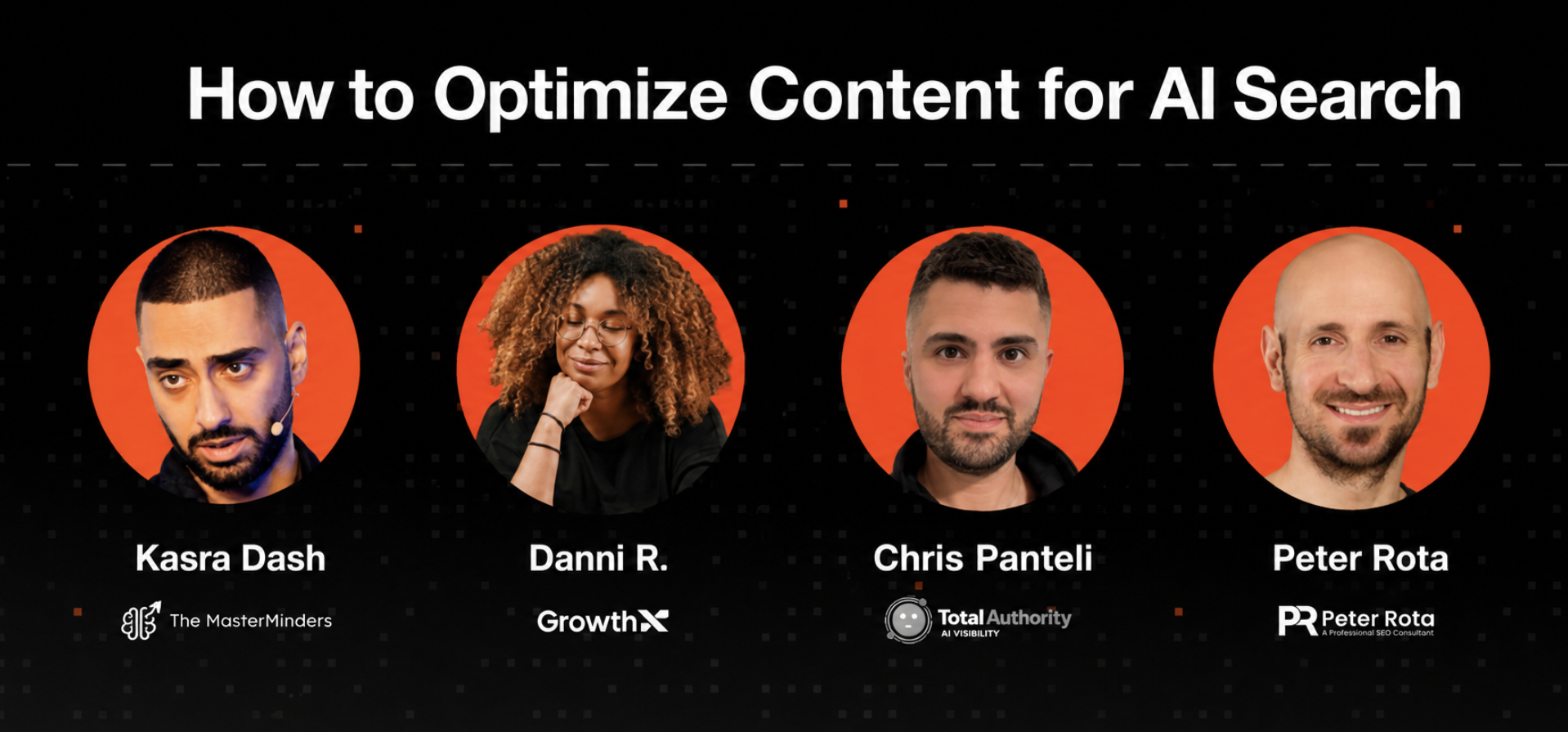
Here is how to improve its chances [including tips from Kasra Dash, Danni Ro, Chris Panteli, and Peter Rota].
1. Start with the prompts where you want to appear
You cannot optimize content for AI search until you know which prompts you want to appear for.
Do not start by tracking every possible variation of a keyword. Choose prompts that represent the real questions your customers ask while researching, comparing, and buying.
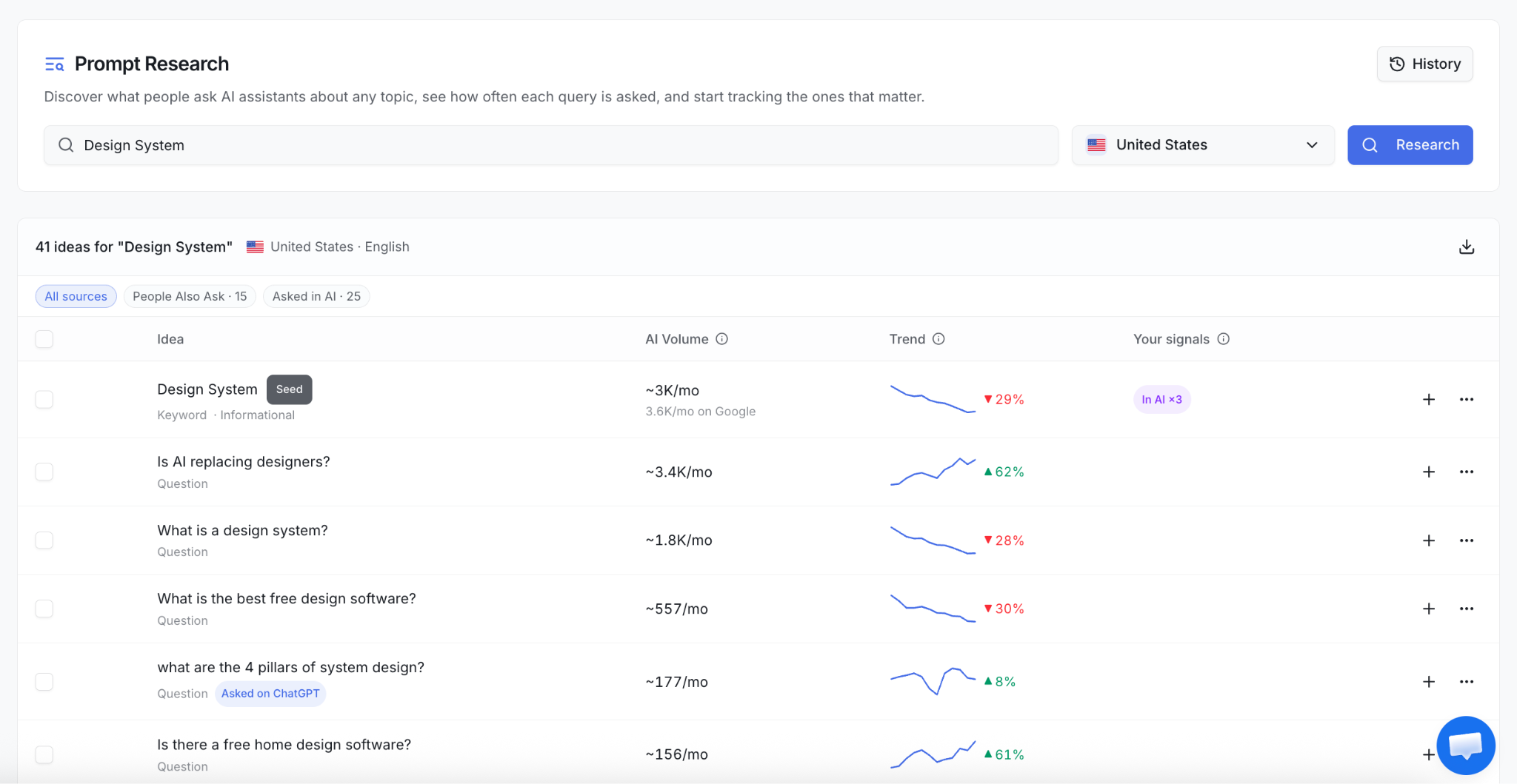
ZeroRank’s Prompt Research helps you find the prompts that matter.
Keep in mind that a useful prompt should be:
- Relevant to your product or service
- Specific enough to produce meaningful recommendations
- Connected to a stage of the buyer journey
- Likely to surface brands, products, or sources
- Different enough from your other prompts to reveal new information
It also helps to organize prompts into categories.
For example, an AI rank-tracking company might track:
- Category prompts: What are the best AI search visibility tools (opens in a new tab)?
- Comparison prompts: ZeroRank vs. Profound
- Alternative prompts: What are the best alternatives to Scrunch AI?
- Use-case prompts: What is the best AI visibility tool for small businesses?
- Problem prompts: How can I improve my visibility in ChatGPT (opens in a new tab)?
- Brand prompts: Is ZeroRank a good AI rank tracker?
Together, these prompts show where the brand appears across the buying journey—not only whether an AI model recognizes its name.
Inside ZeroRank, you can use suggested prompts to get started. The suggestions are based on your business and organized into relevant categories, so you do not have to build the entire tracking strategy from a blank page.
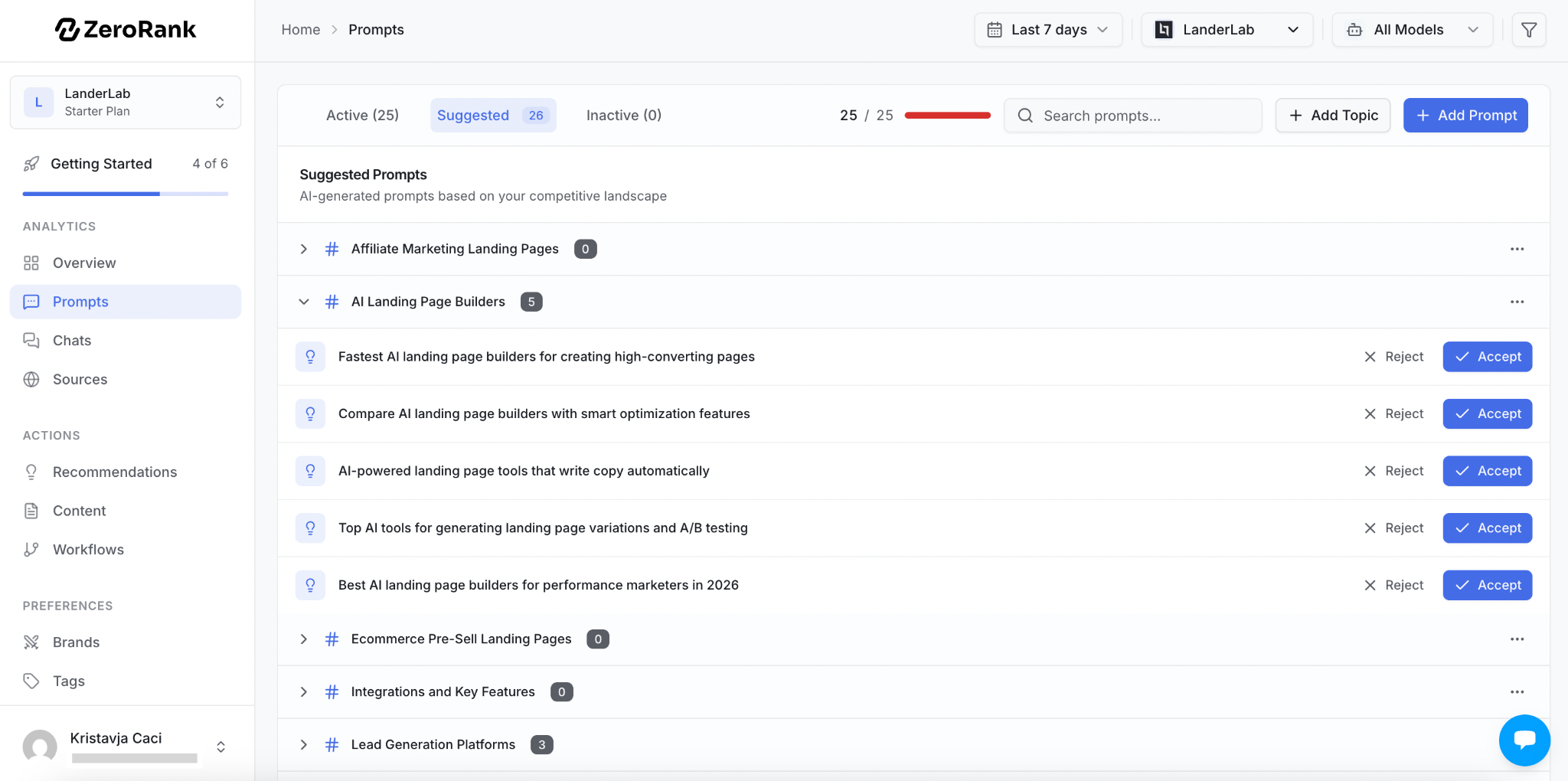
Review them before adding them. Remove prompts that are too broad, irrelevant, or unlikely to influence a buying decision. Add specific prompts you know your customers use.
The goal is not to track the highest possible number of prompts. It is to track a representative set that shows:
- Where your brand is already visible
- Where competitors are recommended instead
- Which topics create the largest visibility gaps
- Which gaps are commercially worth fixing
Peter Rota (opens in a new tab), Senior Technical SEO Manager, is already shifting his content strategy in that direction:
Focusing more on content lower down in the buyer’s journey.
Those prompts are often worth prioritizing first. A recommendation in a comparison or use-case answer is more likely to influence a decision than a mention in a broad informational response.
2. Analyze the answers, cited sources, and related questions
Once you have the prompts, look at the answers they produce.
For each one, check:
- Which brands are mentioned
- How those brands are positioned
- Which pages and domains are cited
- What type of content gets used
- Which claims are pulled from each source
- What related questions the answer explores
- What the cited pages provide that yours does not
The Chats view in ZeroRank shows you what the AI search engine currently considers useful for that prompt.
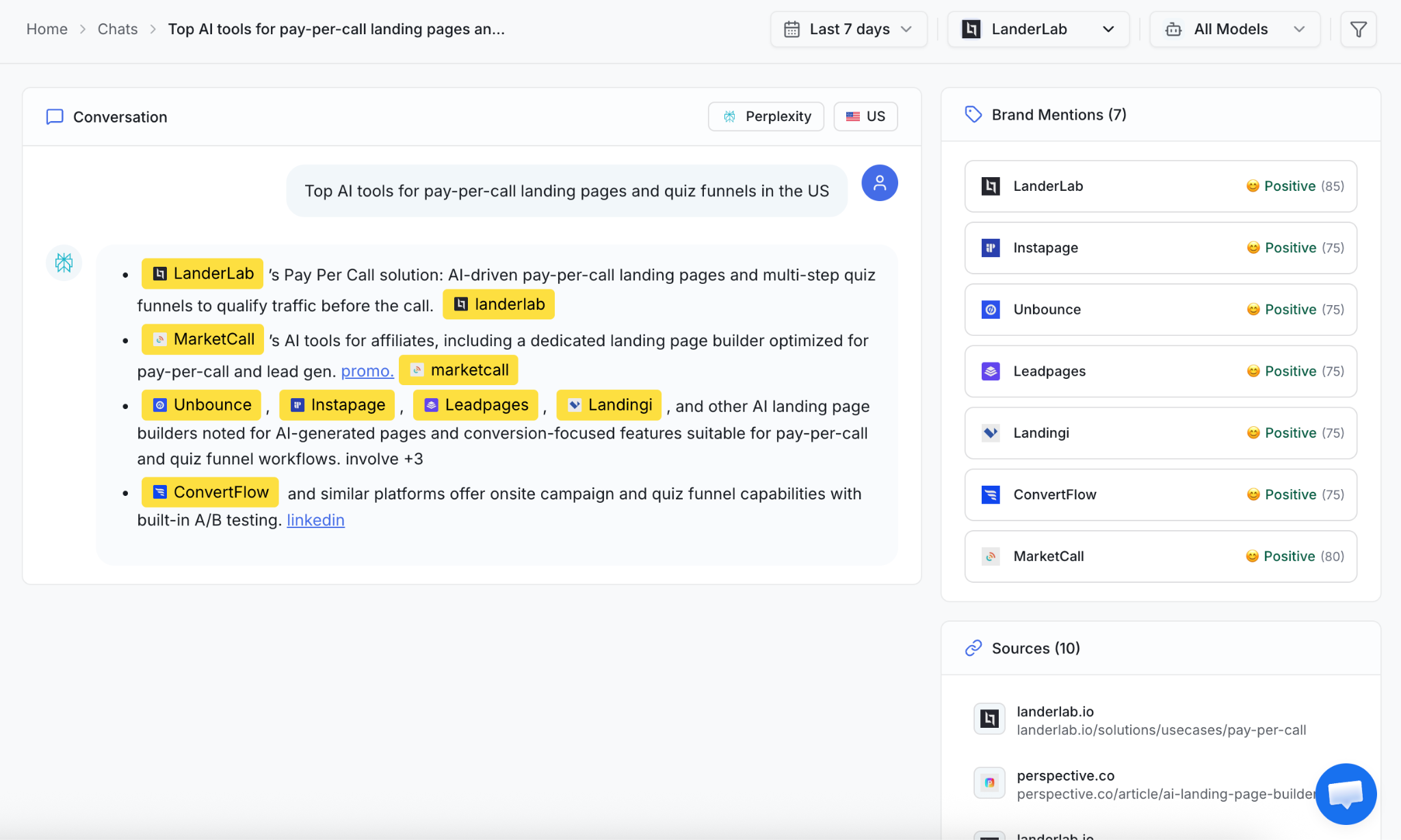
It may cite product pages because the prompt requires exact features and pricing. It may prefer comparison articles because the user wants several options. It may rely on review sites, Reddit, or industry publications because the answer needs independent opinions.
Do not copy the cited pages. Use them to understand the standard your content needs to meet and the gap it can fill.
Related questions matter here too.
Google explains that AI Mode and AI Overviews can use query fan-out (opens in a new tab), running multiple related searches across subtopics before creating an answer.
A prompt such as:
What is the best CRM for a 20-person B2B sales team that needs HubSpot integration but cannot justify enterprise pricing?
could lead the system to investigate:
- CRMs for small B2B sales teams
- HubSpot integrations
- Pricing for 20 users
- Features included in lower-tier plans
- The tradeoffs between the main options
Inside ZeroRank, you can inspect the fan-out queries for a tracked prompt. This shows the supporting questions your page may need to answer without guessing what “comprehensive” content means.
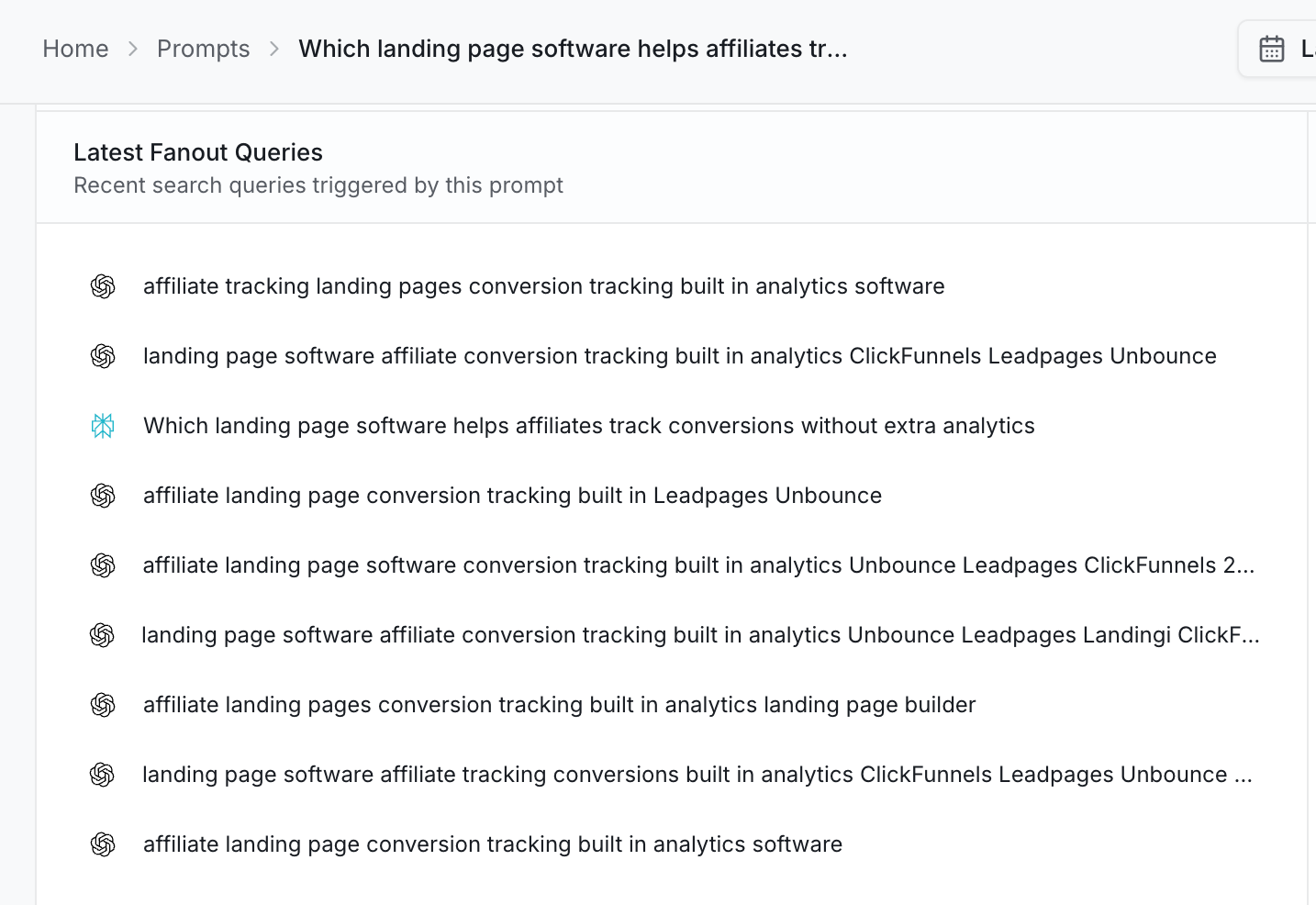
You are no longer looking only at whether a page appears. You are looking at why a source was selected and what role it played in the final answer.
3. Create new content or optimize an existing page
Once you understand the visibility gap, decide what type of action it requires.
You generally have three options:
- Create a new page
- Optimize an existing page
- Consolidate several overlapping pages
Do not automatically publish another blog post.
If the prompt asks for product recommendations, you may need a comparison or listicle. If someone wants to know whether a product supports a particular workflow, the answer may belong on a product or use-case page.
If you already have a relevant page, improving it is usually better than creating another one that competes for the same prompts.
Prompt intent | Content that may fit |
|---|---|
Learn how something works | Guide or explainer |
Compare several options | Comparison or listicle |
Replace a competitor | Alternative page |
Solve an industry-specific problem | Use-case or industry page |
Verify a feature, price, or integration | Product page or documentation |
Find evidence or benchmarks | Original research or data study |
Get firsthand opinions | Expert article, review, or community discussion |
The current AI answers give you evidence about the format too. If most cited sources are comparisons, the system has probably interpreted the prompt as comparative. A generic educational guide will not satisfy the same intent just because it contains similar keywords.
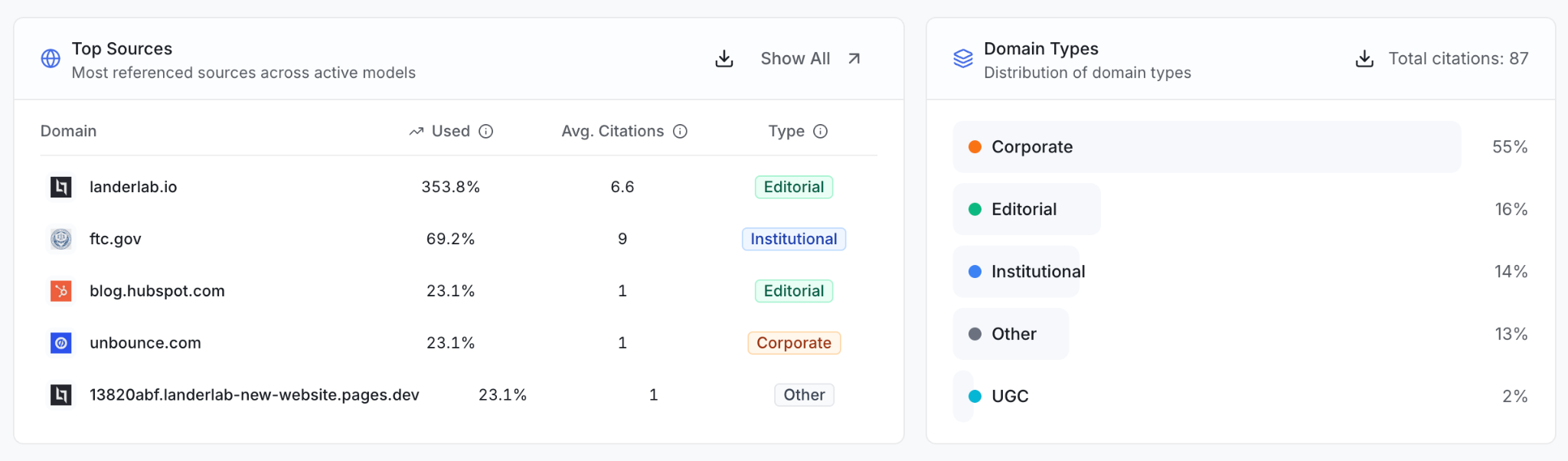
Create content for missing prompt gaps
Use content creation when you do not have a page that properly addresses the prompt or content gap.
Choose the topic and the prompts you want to target in ZeroRank. The workflow gathers the cited sources, researches the topic, analyzes what those sources cover, extracts the outline, builds the content brief, and adds the metadata.
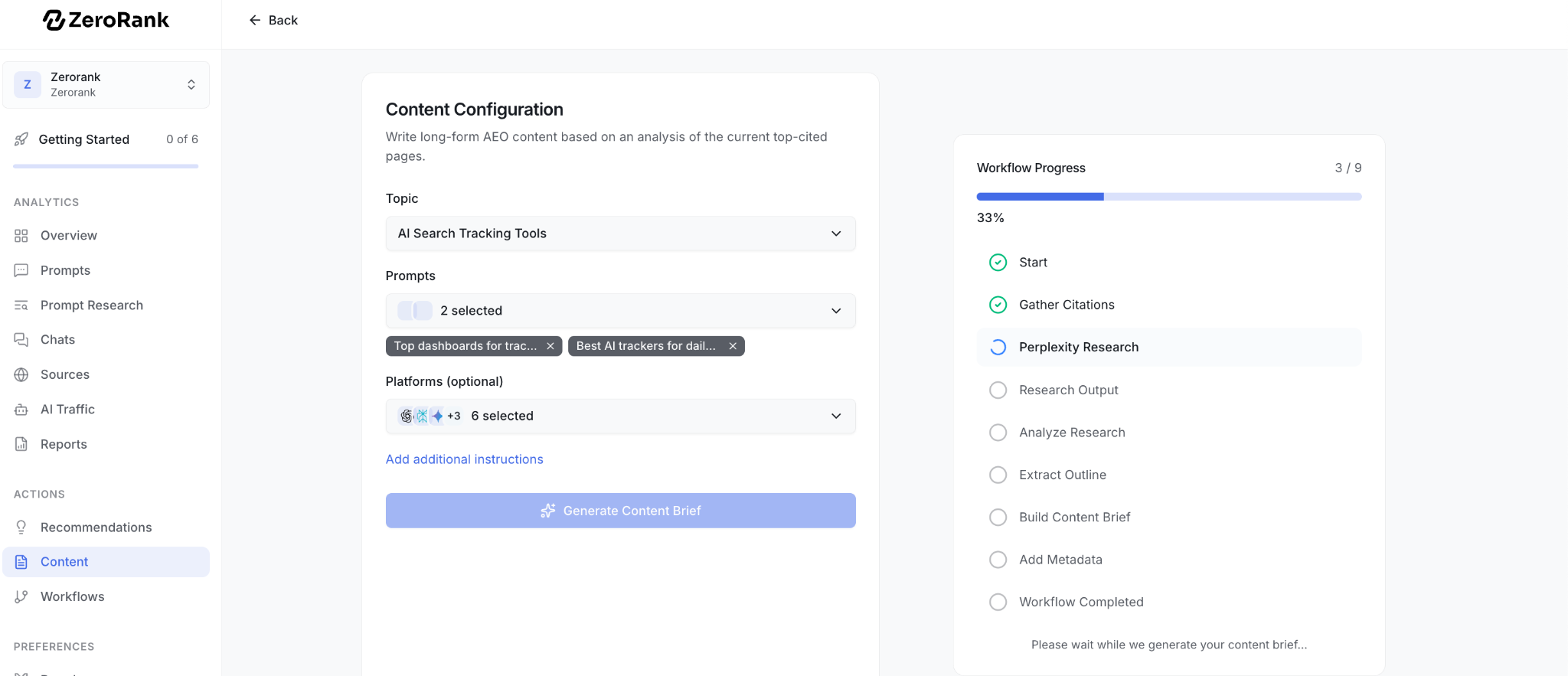
The page is therefore built around:
- The prompts where you need more visibility
- The sources currently shaping those answers
- The information your existing content is missing
- The format that best matches the prompt intent
Danni R. from GrowthX (opens in a new tab) shared a good example of what happens when the topic is specific. One client created around 50 articles for a tightly defined competitor-displacement scenario and gained measurable citation share within about three months.
The specificity is what got them cited.
Do not target “project management software” if the real opportunity is “the best Asana alternative for agencies managing client approvals.”
The result still needs your expertise and judgment. ZeroRank handles the research and first draft around the visibility gap, so you are not starting from a blank page—or a generic request to “write a comprehensive article about X.”
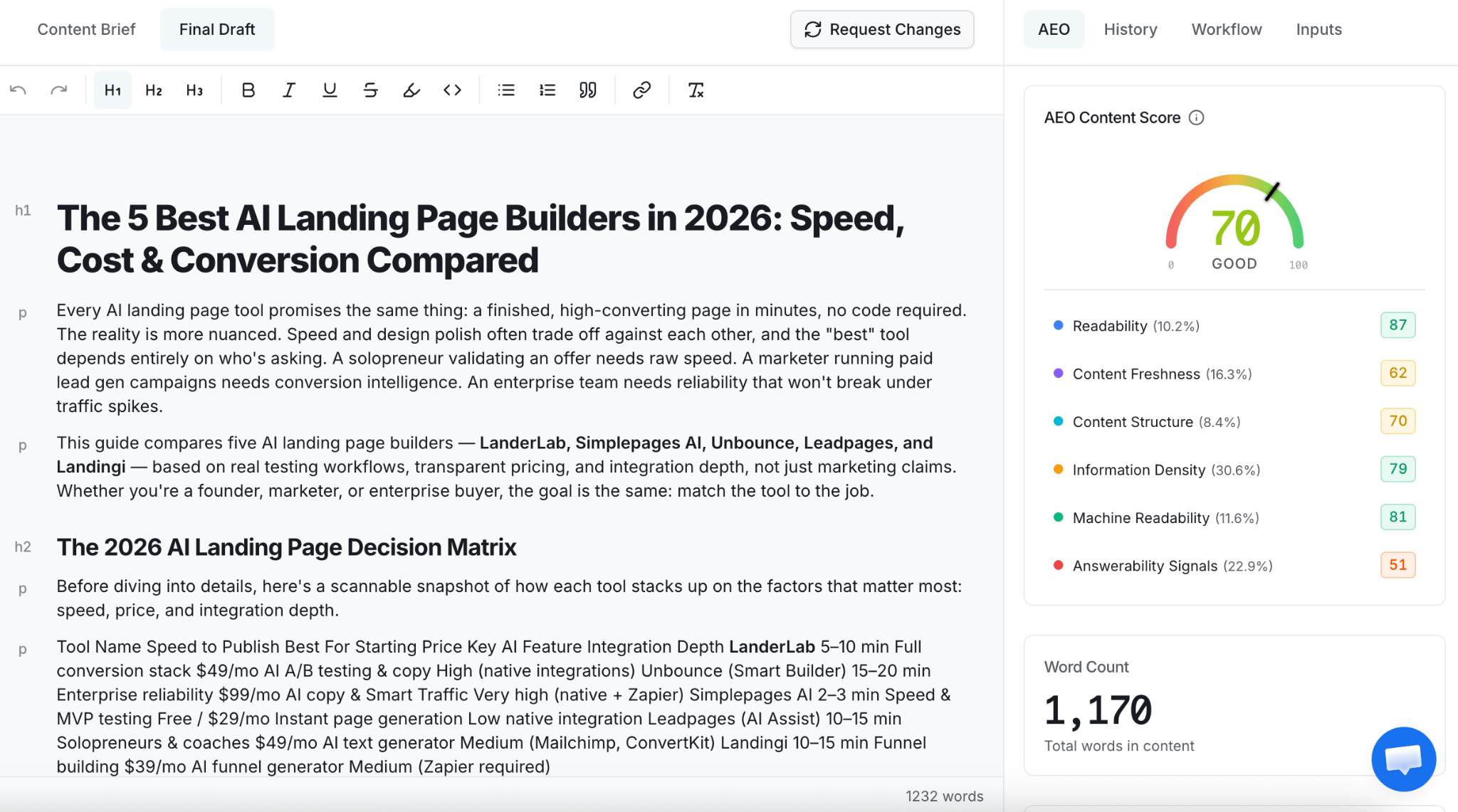
Optimize content that already exists
Use content optimization when you already have a relevant page, but it is not being mentioned or cited for the target prompts.
ZeroRank compares the content with the selected prompts and cited sources, then identifies specific improvements you can implement.
These may include:
- Questions or topics the page does not cover
- Claims that need stronger evidence
- Answers that appear too late in a section
- Missing comparisons, examples, or entities
- Outdated or unclear information
- Gaps between the page and the prompt intent
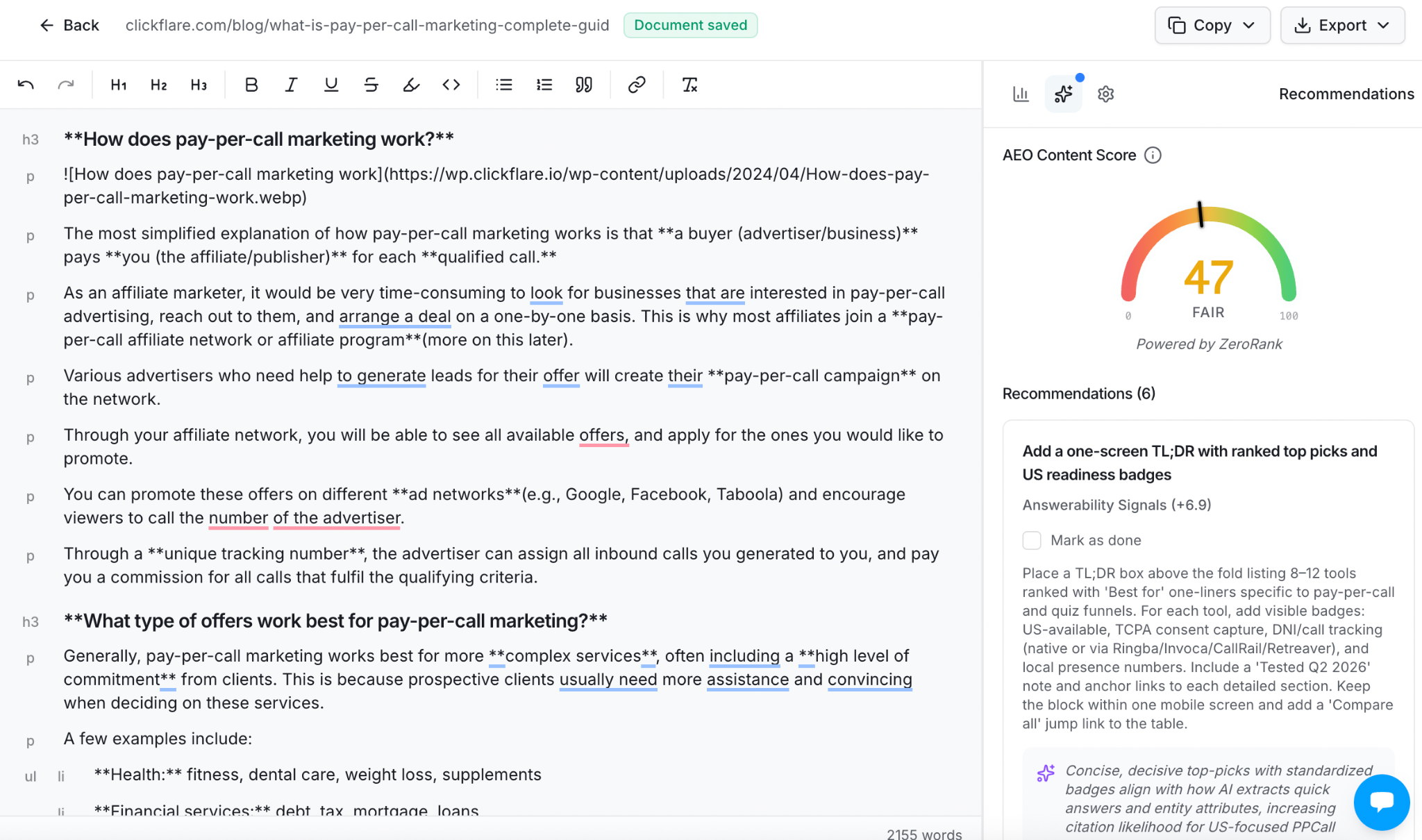
This avoids generic recommendations such as “make the article longer.”
You know which prompts the page is missing from, what the selected sources cover, and what could make your page more relevant to those answers.
That gives you a clear workflow:
Choose prompts → analyze answers and sources → create or optimize the right content → track the result.
The following sections explain the main improvements you may need to make.
4. Give the answer early
AI search engines do not always evaluate a page as one indivisible document.
Microsoft explains that Copilot parses pages into smaller pieces (opens in a new tab), evaluates them for relevance and authority, and combines information from several sources into an answer.
That makes each section important.
Use headings that clearly describe what the section answers. Then give the answer before adding background, examples, and caveats.
If the heading is “How much does AI rank tracking cost?”, provide the price range first. Do not make the reader—or the retrieval system—work through four introductory paragraphs to find it.
A strong section usually does three things:
- Answers the question directly.
- Explains when that answer changes.
- Supports it with evidence or an example.
This does not mean every article needs 25 miniature FAQ sections.
Google explicitly says you do not need to artificially “chunk” content (opens in a new tab) for its generative AI features. The page should still read like one connected piece of content. Clear sections help. Chopping an article into robotic answers does not.
Danni shared one experiment that captures the difference:
Ranking for a keyword and being cited as an answer are optimized differently. One client ran an experiment adding TLDR sections to posts specifically to test whether cleaner answer-formatted content gets cited more.
That is how to approach changes such as TL;DRs: as a hypothesis to test, not a universal GEO rule.
5. Give AI search engines something worth citing
AI-generated answers are already good at repeating common information. Another article that summarizes the same five ranking pages gives the system little reason to select yours.
Add something it can use:
- Original data
- A named expert’s experience
- A real example
- Current product information
- A transparent comparison methodology
- A useful template or framework
- A strong opinion supported by evidence
- Screenshots that demonstrate how something works
There is research behind this.
The GEO: Generative Engine Optimization study (opens in a new tab), tested content changes across 10,000 queries. Adding relevant statistics, quotations, and citations improved source visibility. The strongest methods increased visibility by up to 40% in the study’s test environment, while keyword stuffing did little to help.
That does not mean inserting three statistics will increase your ChatGPT visibility by 40%. It shows that supported, information-rich content gives generative engines more useful material than keyword repetition.
The source matters too. Link to the original research, dataset, documentation, or person behind a claim.
Google recommends (opens in a new tab) unique, expert-led content that adds value beyond common knowledge. Microsoft recommends (opens in a new tab) supporting claims with data, examples, and cited sources.
The platforms are being unusually clear: publish something other pages cannot easily reproduce.
6. Remove content that competes with itself
More pages do not automatically create more opportunities to be cited.
If five articles answer the same question with slightly different wording, search and AI systems must decide which version represents you. They may choose the wrong page, use an outdated one, or switch between them.
Danni’s team has stopped treating every published page as an asset. For one client with more than 1,000 articles, fewer high-quality pages made more sense than keeping a bloated archive:
The recommendation was aggressive pruning, not more content.
She has also seen multiple pages compete for the same citation query, leading the team to deduplicate overlapping clusters.
Review your content by prompt and intent:
- Which page should be the main source for this question?
- Are several URLs making the same argument?
- Does an older page contain information that belongs in the stronger one?
- Are product facts inconsistent across different pages?
- Is an outdated URL still indexed or internally linked?
Merge overlapping content where it makes sense. Redirect pages that no longer need to exist. Use canonical tags correctly when duplicate versions are necessary. Keep one clear source of truth for important product and company information.
This is not only an AI search tactic. It is good content maintenance. AI retrieval makes the cost of neglecting it more visible.
7. Build authority on and beyond your website
AI systems need to understand who created the information, which organization it represents, and whether the wider web supports the claim.
Start with your own site:
- Use named authors where expertise matters.
- Give authors specific bios that explain their relevant experience.
- Link to their profiles and other work.
- Maintain accurate About, editorial policy, methodology, and contact pages.
- Keep company, product, pricing, and feature information consistent.
- Use relevant schema that matches the information visible on the page.
Chris Panteli, founder of Total Authority (opens in a new tab), sees personal authority becoming more important for expert-led brands:
For expert-led businesses, AI often connects the individual expert, the company, the niche and the problem being solved.
But authority cannot come entirely from your own website.
Your site can explain why your product is good. Independent sources help prove it.
This matters most when someone asks for the best products, alternatives, comparisons, reviews, or recommendations. AI search engines may look beyond vendor websites to publishers, review platforms, communities, listicles, podcasts, and expert commentary.
Kasra Dash from The Masterminders (opens in a new tab) puts it plainly:
Lots of businesses rank really well in SEO but show up nowhere in AI results. It usually comes down to off-page signals and what people are saying about the brand across the web.
Look at which third-party sites shape the answers for your target prompts.
ZeroRank gives you a prioritized list of off-page recommendations.
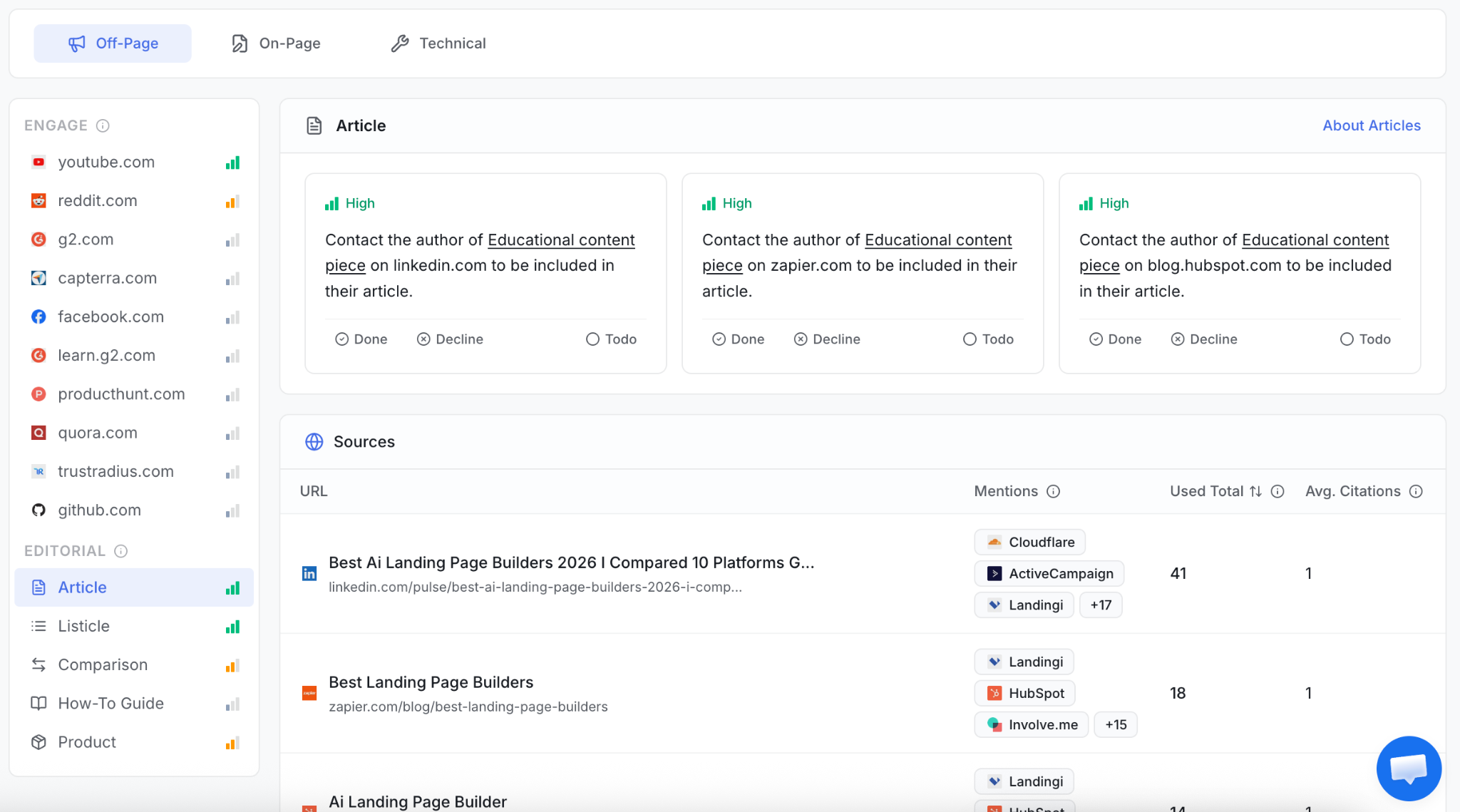
Then work on earning genuine inclusion through:
- Digital PR
- Expert contributions
- Relevant listicles and comparisons
- Customer reviews
- Partnerships
- Podcasts and interviews
- Useful participation in industry communities
Google explicitly warns that inauthentic mentions are not a shortcut (opens in a new tab) into its AI results. The goal is independent validation, not another version of low-quality link building.
8. Keep the information current
AI search engines cannot cite the correct price if three pages on your website show three different prices.
Regularly review information that changes:
- Pricing
- Plans and limits
- Features
- Integrations
- Product screenshots
- Laws and policies
- Industry statistics
- Employee titles
- Tool recommendations
Update a page when the answer changes, not just because an SEO calendar says it is time for a refresh. Remove outdated claims instead of adding a paragraph that contradicts them.
Microsoft recommends using IndexNow (opens in a new tab) to notify participating search engines when pages are added, updated, or removed. Your normal crawling, internal linking, sitemap, and indexing setup still matters separately.
Freshness alone will not make weak content visible. But outdated facts can make an otherwise strong page unreliable.
9. Optimize for the click after the answer
AI search may give users most of the information they need before they visit your site.
That can reduce clicks. Pew Research found that users clicked a traditional search result in 8% of visits where a Google AI summary appeared, compared with 15% when one did not.
But the visitor who does click may arrive better informed.
Kasra has a good name for that traffic:
I use AI visibility to get more ‘unicorn clicks.’ A unicorn click is someone who has already done their research on you and your competitors and is ready to buy when they land on your site.
Make sure the cited page is ready for that visitor:
- Keep the message consistent with the claim likely to be cited.
- Make the next step obvious.
- Answer the final objections.
- Show the product, proof, and pricing where appropriate.
- Give the visitor a reason to continue after receiving the basic answer.
Visibility does not fix a weak landing page. As Danni put it:
One client saw a significant spike in LLM-driven traffic but signups didn’t move proportionally. Zero-click visibility gets you mentioned, but what happens on the LP still determines whether it converts.
The citation worked. The conversion path still needed attention.
10. Track whether the changes worked
You cannot judge AI search performance from organic clicks alone.
Track the same prompts before and after creating or optimizing the content. Then look at:
- Whether your brand is mentioned
- Whether your page is cited
- How visibility compares with competitors
- Where your brand appears in ranked answers
- Which pages earn citations
- Which sources influence the response
- How the answer describes your brand
- Whether AI referral traffic and conversions change
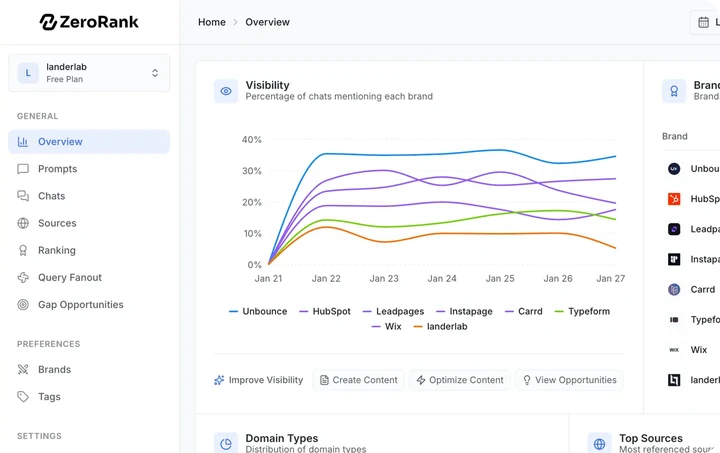
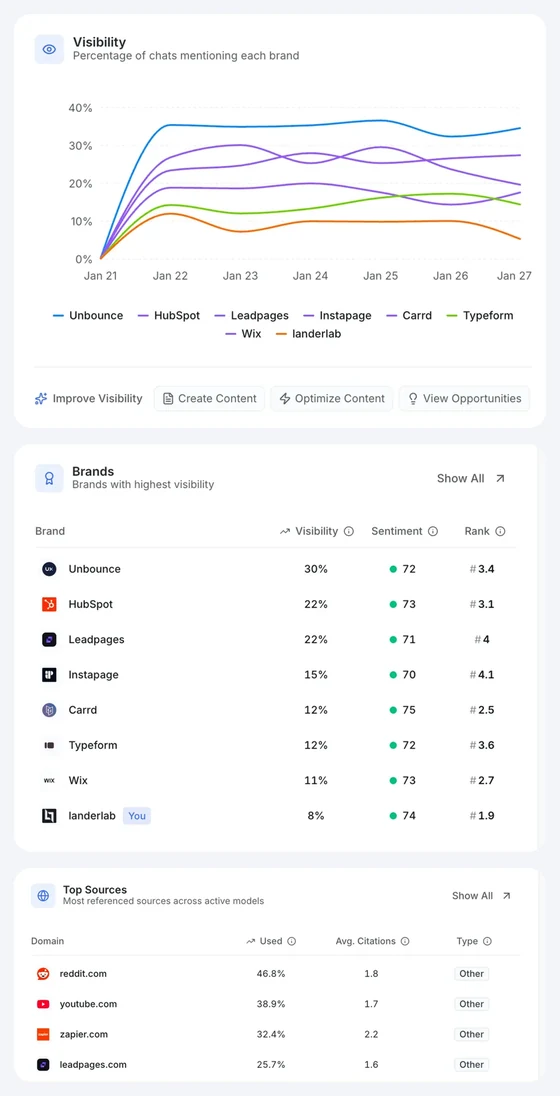
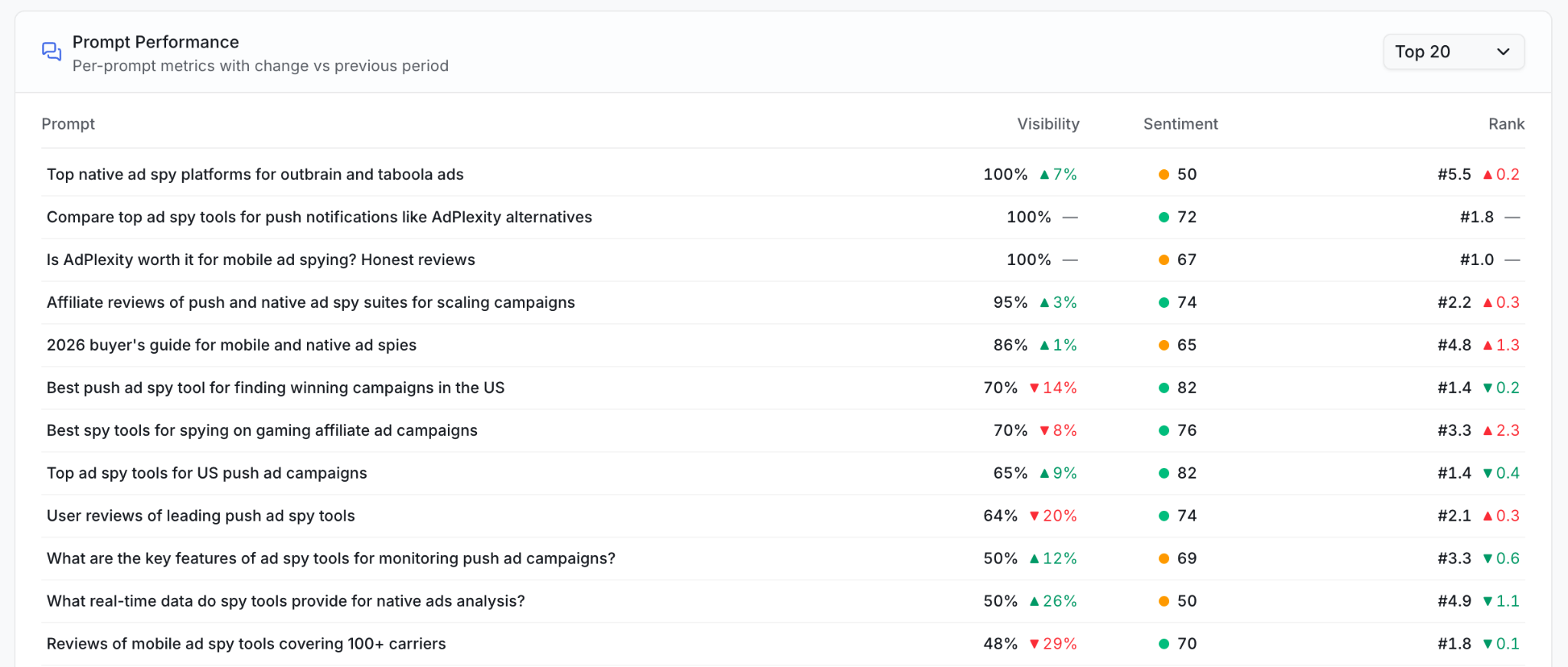
ZeroRank shows where your brand appears, which competitors are winning, and which sources are being cited.
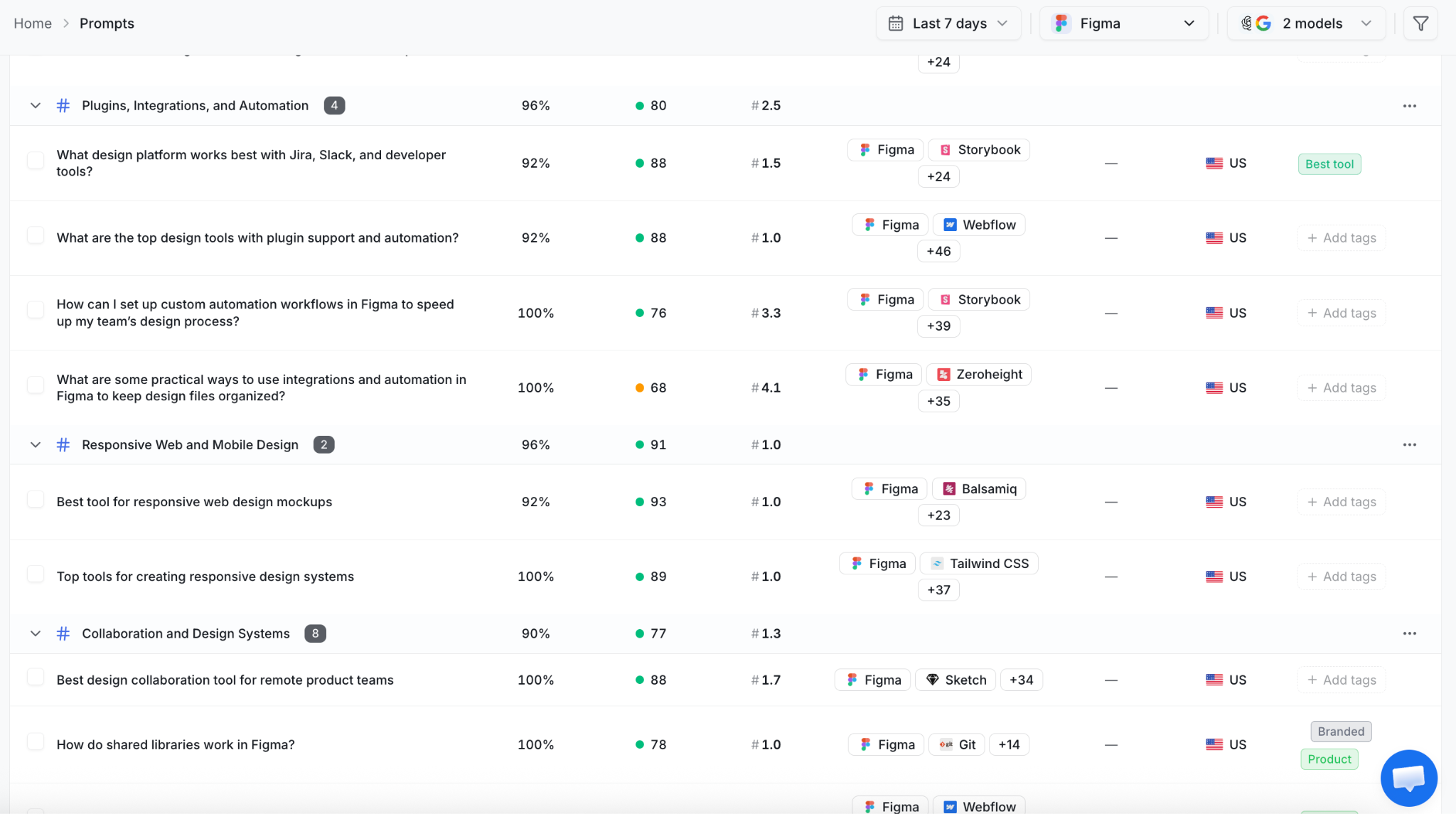
More importantly, it connects those gaps to prioritized recommendations and content workflows, so the data tells you what to do next.
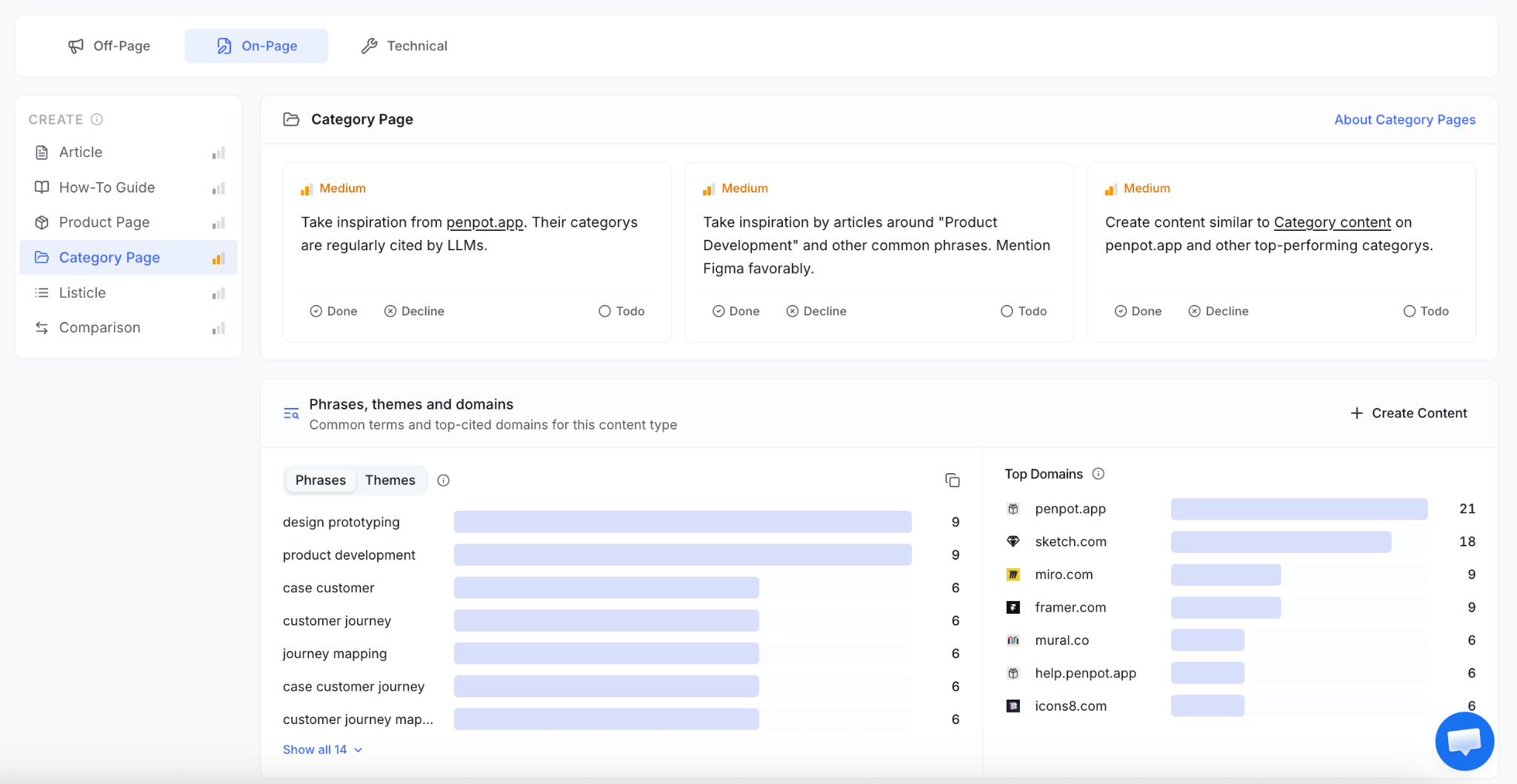
Because “make the article more AI-friendly” is not an action plan.
“We are missing from these 12 high-intent prompts because competitors have stronger comparison pages and third-party validation” is.
You can also track these changes over time using Reports.
Final thoughts
There is no single template that guarantees an AI citation. The platforms use different sources, produce different answers, and keep changing.
But the work is not random.
Track the prompts that matter. Study the answers and sources already winning. Create the missing content or improve the page you already have. Then track the same prompts to see whether it worked.
Start optimizing for AI search with ZeroRank for free.
Filed under AI Search Strategies
Head of content and operations. On a mission to make ZeroRank the go-to platform for AI search visibility.
Keep reading
All posts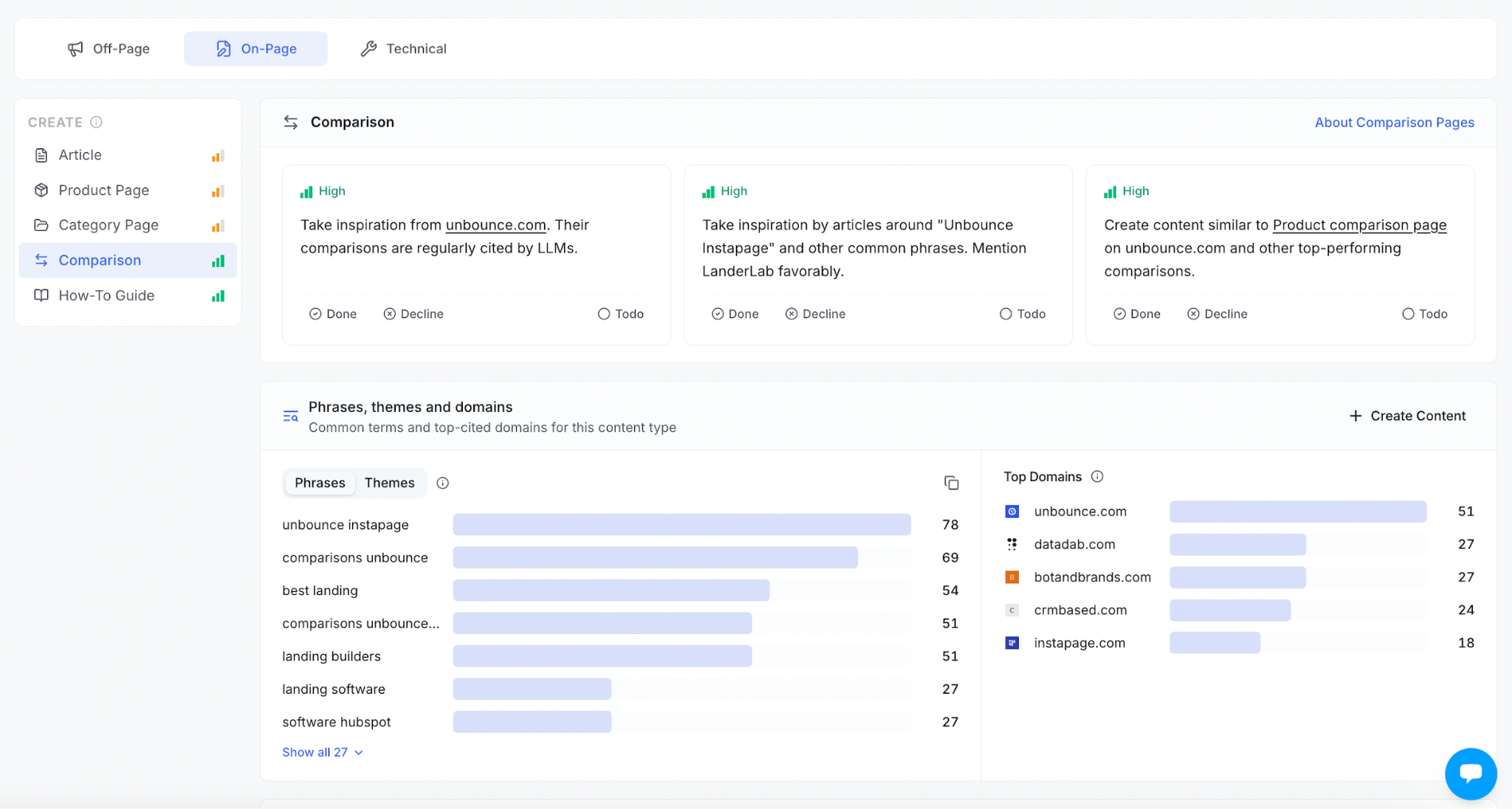 AI Search Strategies
 Answer Engine Optimization (AEO) Checklist
Use this AI search optimization checklist to improve your content, build brand credibility, and fix technical issues so you can get found in AI answers.
 AI Search Strategies
 LLM Prompt Tracking: How to Monitor AI Answers Across ChatGPT, Claude, and More
Tracking the right prompts is the foundation of AI visibility. Learn how to build a high-value prompt library, monitor key metrics across AI platforms, and turn prompt tracking into an effective AI search strategy.

 AI Search Strategies
 AI Citations: How to Get AI to Trust and Reference Your Brand
AI citations reveal how ChatGPT, Claude, Gemini, and Google AI decide which brands appear in their answers. Learn how to analyze citation patterns, understand what AI already trusts, and choose the right strategy to increase your AI visibility.