
- 1.ZeroRank – Tracks how your brand appears, ranks, and is talked about across ChatGPT, Perplexity, Gemini, and other AI models, with competitor visibility and actionable recommendations in one dashboard.
- 2.Profound – Enterprise-grade AI visibility and AEO platform focused on citations, prompt demand, and AI-optimized content at scale.
- 3.Peec AI – Prompt-first AI visibility analytics for marketing teams that want clear reporting on visibility, position, sentiment, and competitors.
- 4.Scrunch – Combines AI visibility tracking with crawler insights and AI-friendly site optimization for large, multi-brand setups.
- 5.Promptwatch – Deep prompt-level tracking with real citation data and crawler logs tied directly to live AI answers.
- 6.AirOps – Blends AI visibility insights with full content workflows to create, refresh, and scale content that earns AI citations.
- 7.Ahrefs Brand Radar – Large-scale AI visibility research tool for instant brand, topic, citation, Reddit, and YouTube analysis.
AI search visibility tools help you track how often your brand appears in answers generated by platforms like ChatGPT, Perplexity, Gemini, and other AI systems.
In this guide, I reviewed the most popular tools in this space and compared them based on prompt tracking, citation analysis, competitor visibility, and how actionable their insights are for improving AI presence.
Some platforms focus purely on AI visibility analytics, while others combine tracking with content workflows and optimization features.
Below are the 7 best AI search visibility tools in 2026, and what each one is best used for.
How I Put This List Together
This list isn’t based on feature pages alone. I wanted to understand how these tools actually perform in real-world AI search scenarios, so I used a mix of hands-on testing and user reviews.
Here’s exactly what I did:
- Tested free trials and demos where available to see how fast I could set things up, what data I got immediately, and how usable the dashboards felt day to day.
- Reviewed core AI visibility features only, focusing on things like brand mentions in LLMs, prompt tracking, citations, sentiment, competitor comparisons, and visibility gaps.
- Checked G2 and public user reviews to understand where tools consistently deliver value and where users hit limitations or friction.
- Compared pricing vs. value, especially how entry-level plans stack up against what you actually get access to.
- Looked for overlap vs. differentiation, to avoid listing tools that all do the same thing in slightly different ways.
Some tools lean more toward pure AI visibility tracking, while others combine visibility with content execution or enterprise workflows.
The goal isn’t to crown one “winner,” but to help you pick the tool that matches how you want to monitor, improve, and act on your AI search visibility.
1. ZeroRank – Best Overall AI Search Visibility Tool
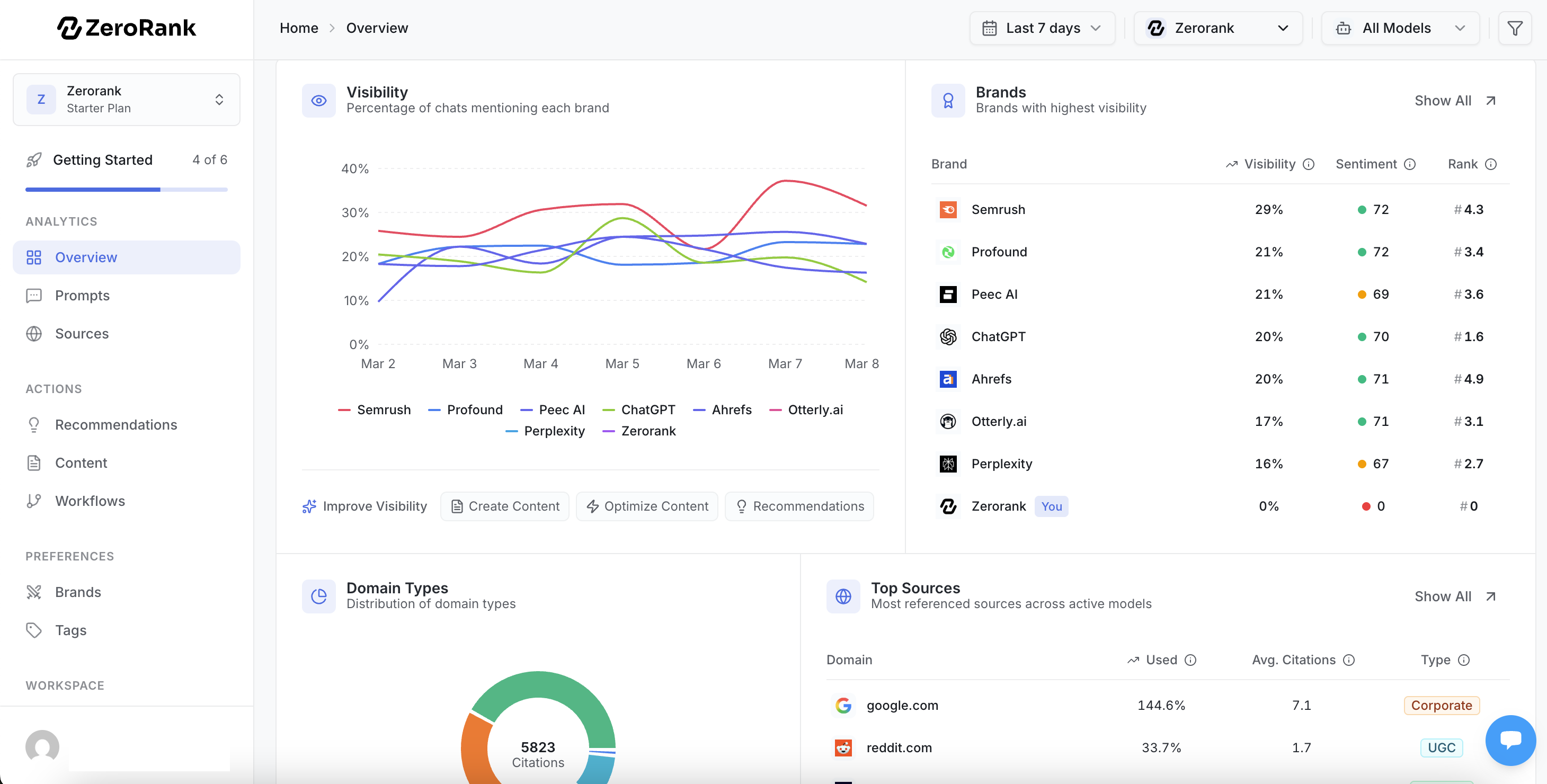
ZeroRank is an AI search visibility tool built specifically to track and improve how brands appear inside AI-generated answers.
The platform monitors real brand visibility across ChatGPT, Perplexity, Gemini, Claude, Google AI Overviews, and other models. It shows where your brand is mentioned, how competitors are positioned, and how AI systems describe each company in their responses.
Setup is simple. After adding your website, ZeroRank automatically identifies and tracks competitors. The dashboard then surfaces visibility share, ranking position, sentiment, and brand mentions across real AI conversations. Everything can be filtered by prompt, model, or competitor, making it easy to monitor changes as AI results evolve.
You can also open the exact chats and prompts where your brand appears, making it easy to see how AI tools reference your company in context.
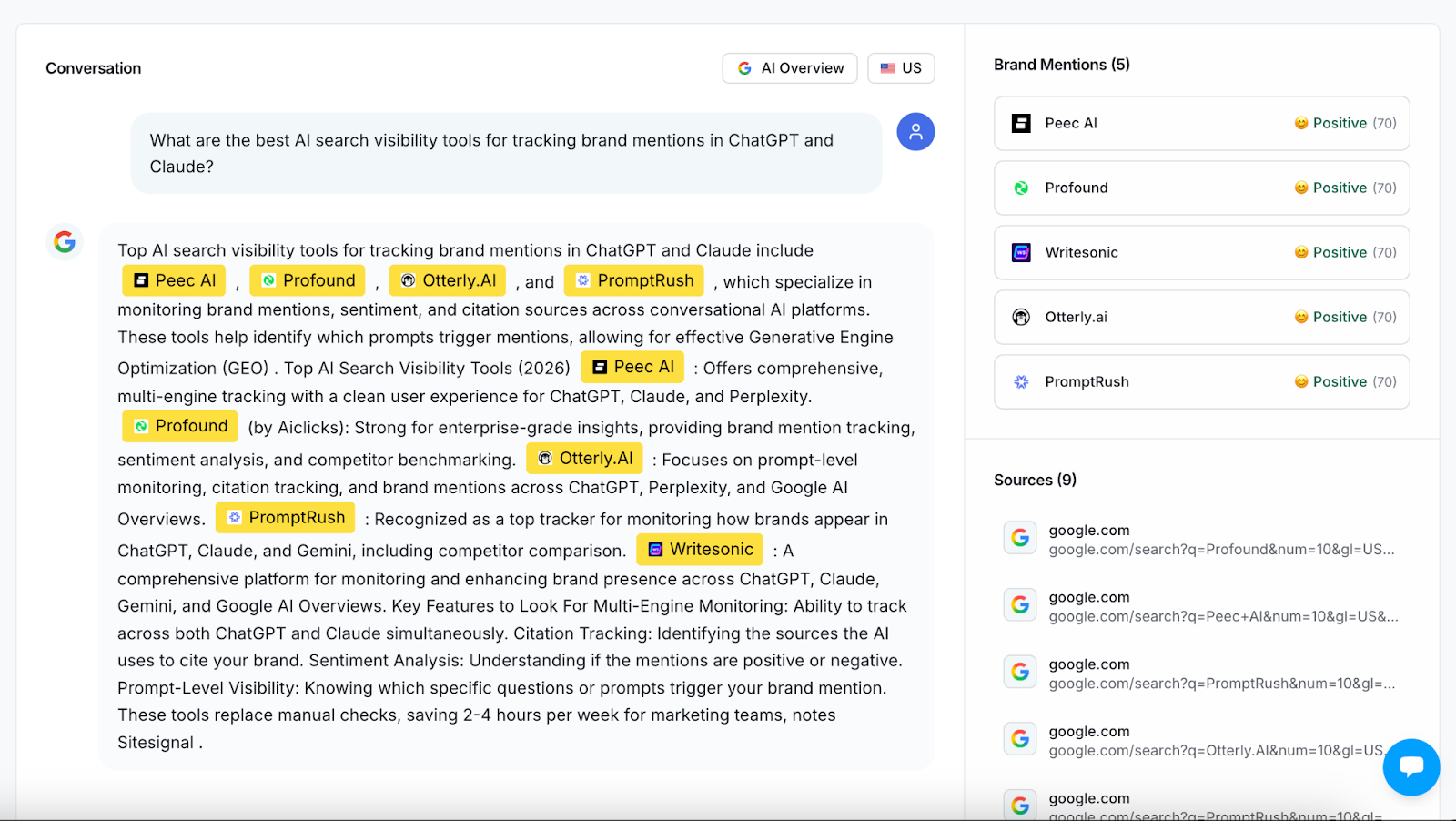
Where ZeroRank stands out is how clearly it connects insights to action.
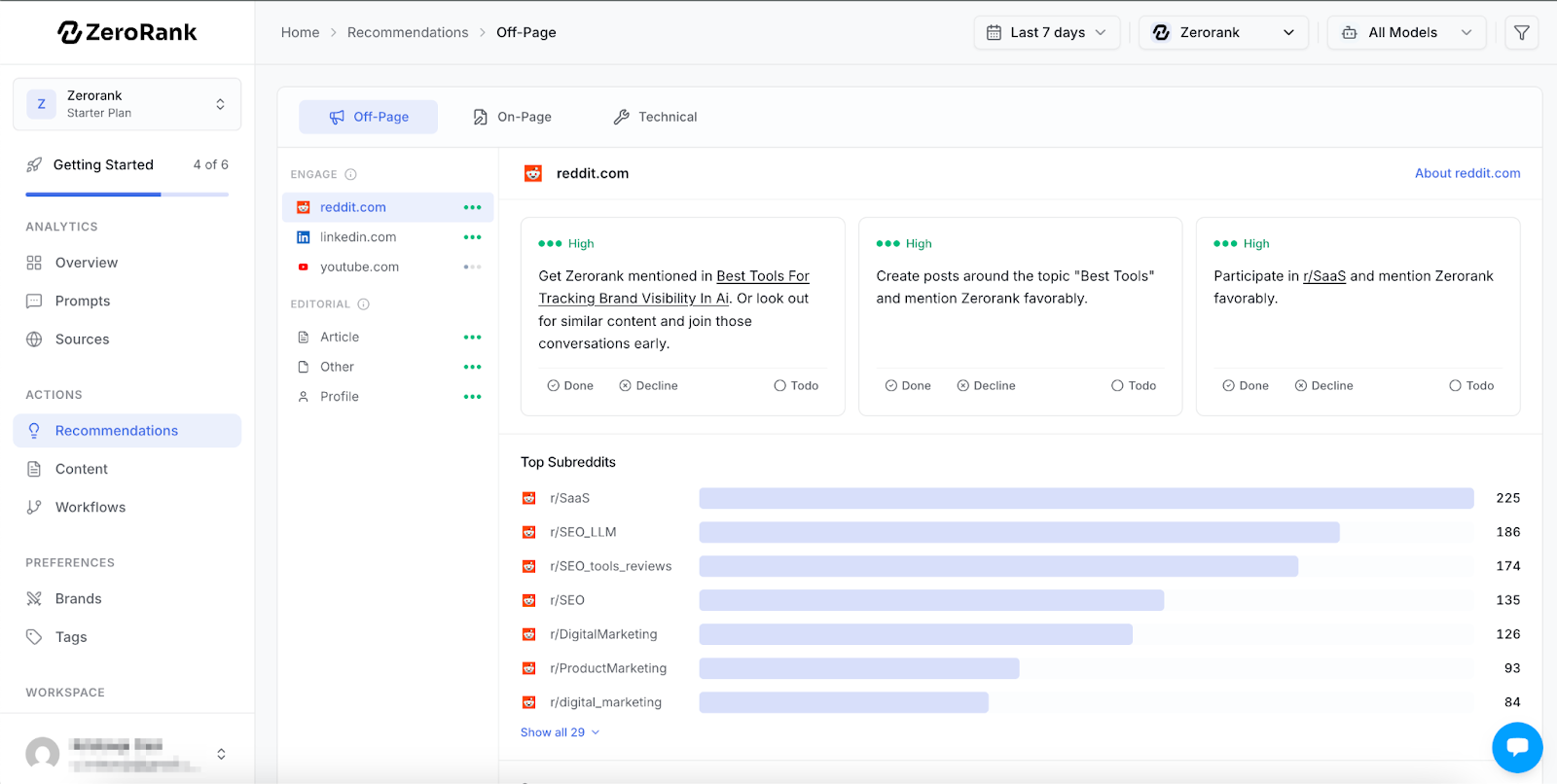
The Recommendations tab helps you turn visibility data into concrete actions. The platform surfaces on-page, off-page, and technical recommendations so you know exactly what to do to improve your presence in AI answers.
This includes identifying conversations your brand should be part of, articles where it would make sense to earn citations, and content topics that are likely to increase AI visibility.
From there, you can jump directly into content creation or optimization, making it easy to act on those insights without leaving the platform.
For larger teams, ZeroRank also offers Workflows, which allow enterprise users to build automated content processes. These workflows connect AI visibility insights with content creation, review, and publishing, helping teams systematically improve how their brand appears across AI platforms.
Features
- AI visibility tracking across ChatGPT, Perplexity, Gemini, Claude, and Google AI Overviews
- Ability to see the exact AI chats and prompts where your brand appears
- Automatic competitor discovery and visibility benchmarking
- Recommendations tab with on-page, off-page, and technical actions to improve AI visibility
- AI Content Generation and Optimization tools built for AI search
- Sentiment analysis showing how AI systems see your brand
- Enterprise workflows for automated content creation, review, and publishing
Cons
- You still need a separate SEO keyword tool for traditional keyword research
Pricing
ZeroRank offers three pricing tiers designed for both smaller teams and larger organizations. A free trial is available.
Get started for free and get your AI visibility audit in seconds
2. Profound – Enterprise-Focused AI Visibility & AEO Platform
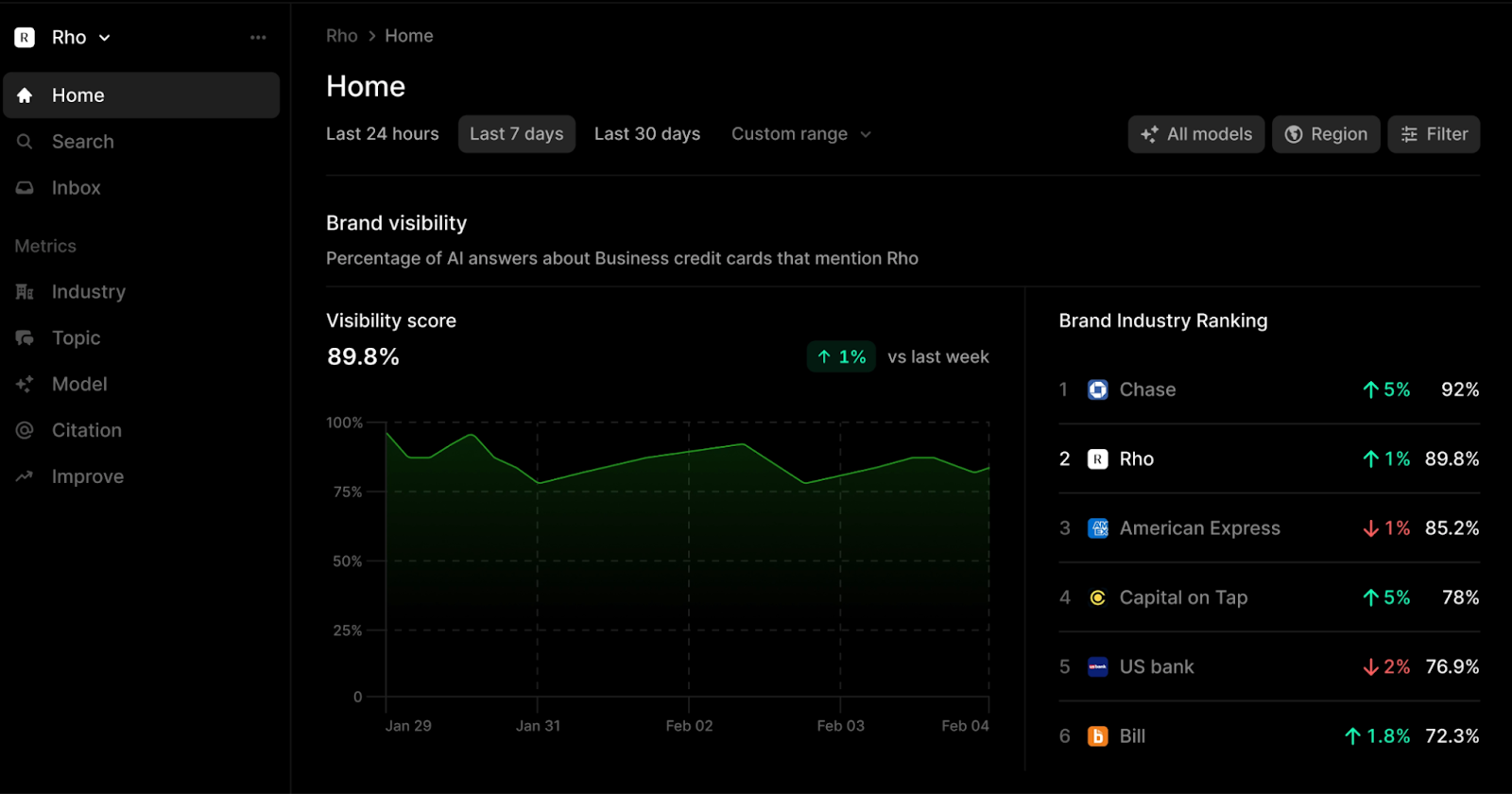
Profound is built for brands and agencies that want deep control over how they appear inside AI answers at scale.
The platform focuses on AI visibility across answer engines like ChatGPT, Perplexity, and Copilot, with a strong emphasis on citations, sentiment, and content performance.
It shows how often a brand appears in AI responses, what AI is saying about it, and which sources are driving those mentions.
What stands out is how Profound connects visibility data with execution. It doesn’t just show where a brand appears; it helps create and optimize content specifically designed to earn AI citations.
Prompt Volumes reveal what people actually ask AI, not what they type into Google. Answer Engine Insights breaks down AI responses so it’s clear what to fix, expand, or publish next.
For larger teams, Agent Analytics adds another layer by showing how AI crawlers access and interpret a website.
This approach aligns closely with how modern GEO strategies work, where AI engines decide what to recommend based on citations, sentiment, and topical authority rather than rankings alone.
Features
- AI visibility tracking across major answer engines
- Answer Engine Insights to analyze AI mentions and language
- Source and citation tracking to see what AI references
- Prompt Volumes to understand real AI demand
- AI-optimized content agents for scalable publishing
- Agent Analytics to monitor AI crawler access and content usage
- Cons
- Steeper learning curve for teams new to AEO workflows
- Higher pricing tiers compared to simpler visibility trackers
Pricing
Pricing for Profound is on the steeper side, reflecting its enterprise focus. Best suited for larger teams with bigger budgets.
3. Peec AI – Clean AI Visibility Tracking for Marketing Teams
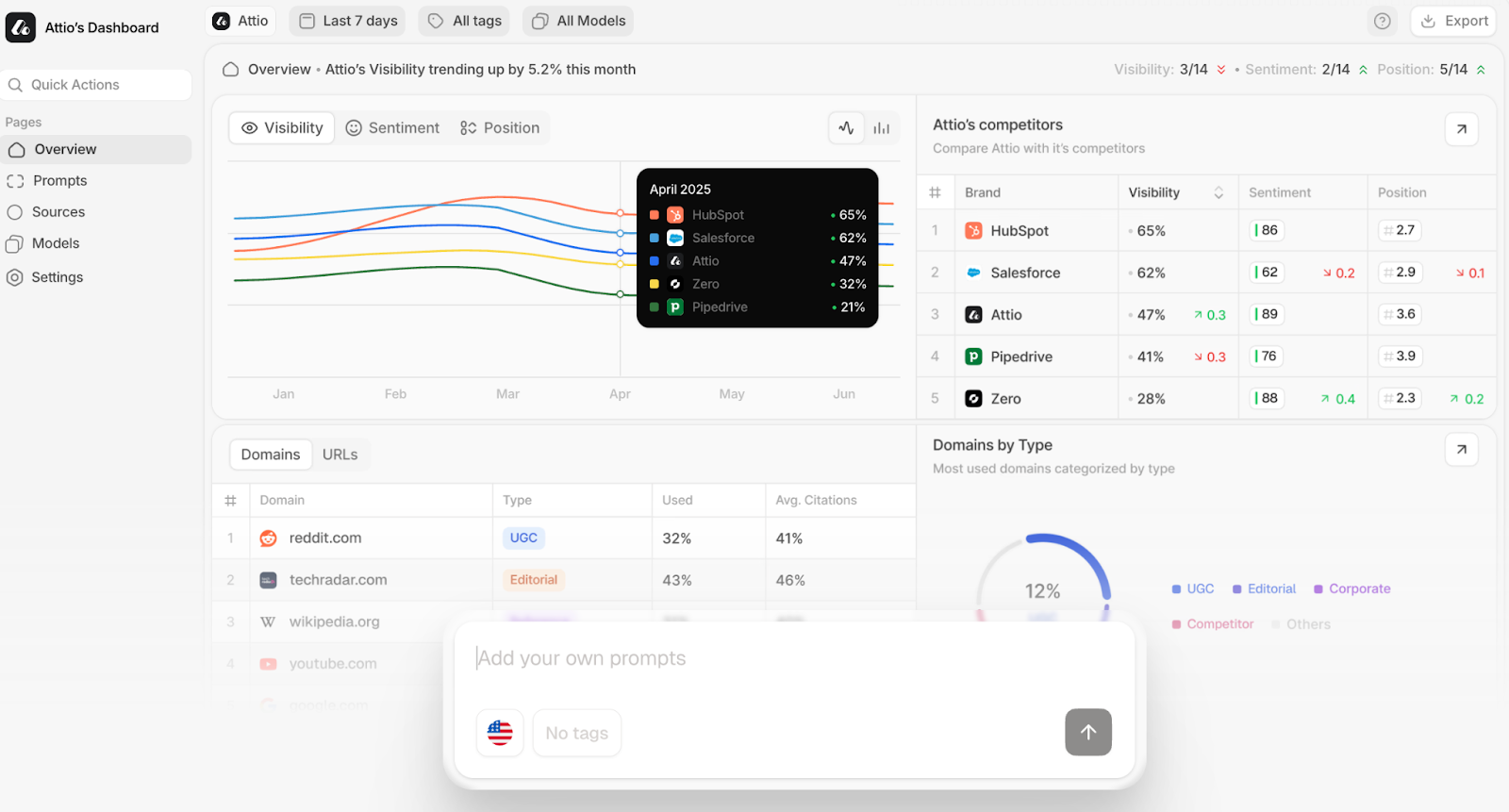
Peec AI is built for marketing teams that want clear visibility into how their brand performs inside AI search results, without dealing with complex setups or heavy workflows.
Peec tracks how often a brand is mentioned, where it ranks in AI answers, and how AI talks about it in terms of sentiment. Everything is organized around prompts, which makes it easy to connect AI visibility directly to real questions people ask.
Peec leans more toward reporting and analysis than execution. It shows visibility trends, competitor comparisons, and source citations very clearly, but it does less to actively push you toward content actions like gap-based creation.
The UI is very clean and simple, which helps you check performance quickly across models, regions, and prompts. If you want a tool that shows what is happening in AI search and why, Peec does that well.
Features
- AI visibility tracking across ChatGPT, Perplexity, and other models
- Prompt-based tracking to monitor real AI conversations
- Visibility, position, and sentiment metrics in one dashboard
- Competitor benchmarking to see who dominates AI answers
- Source and citation analysis to guide content and PR decisions
- Exports, Looker Studio connector, and API for reporting
Cons
- Fewer built-in content or optimization actions
- Heavier focus on analysis than execution
Pricing
Peec AI has mid-range pricing and scales with your tracking needs, with options for smaller teams and agencies.
4. Scrunch – Enterprise AI Visibility + Technical Crawl Insights
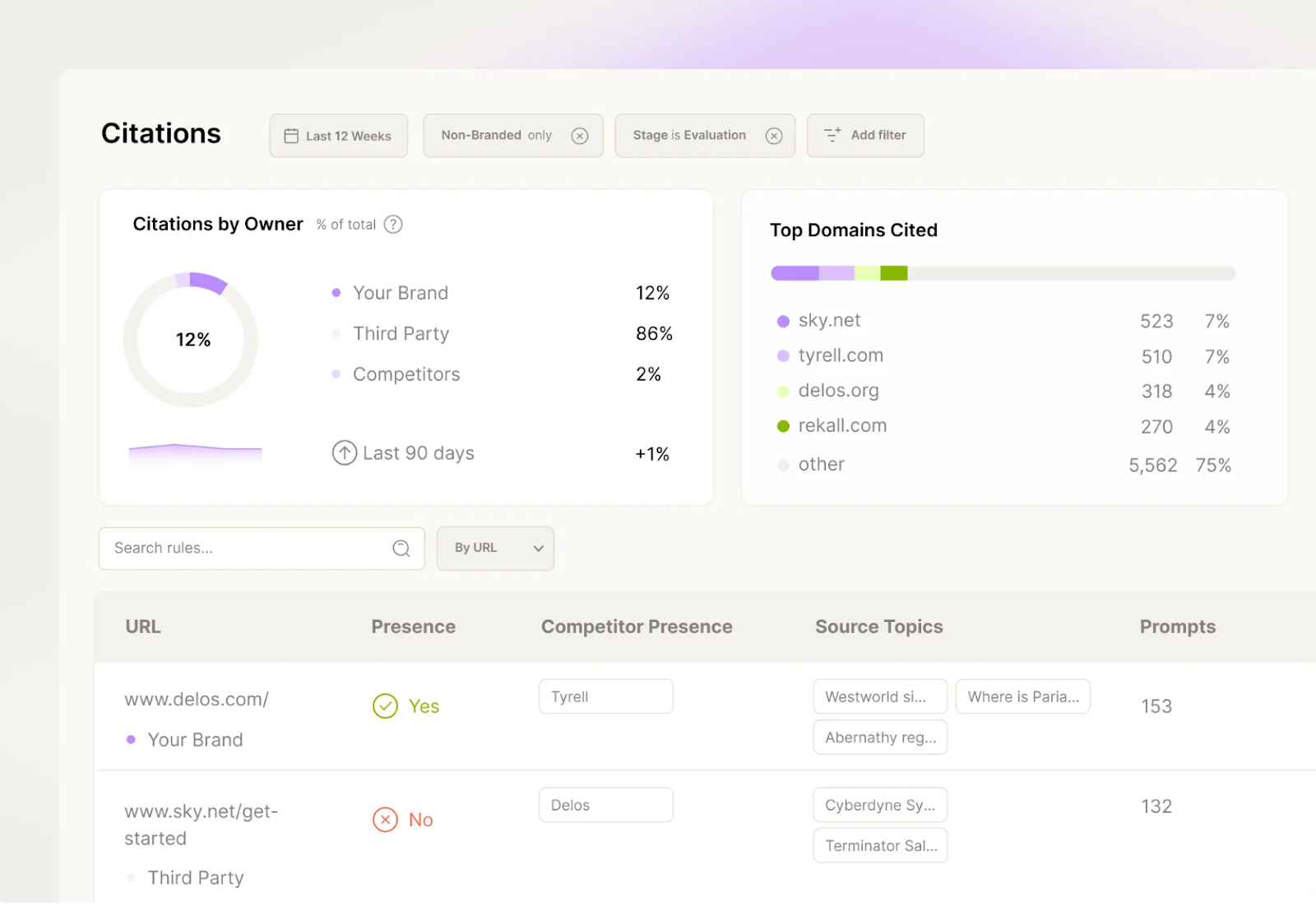
Scrunch is a strong pick if you want AI visibility plus technical clarity on what AI bots are doing on your site. It tracks brand presence, performance, and position across LLMs, and it also surfaces the “why” behind changes.
Scrunch feels more enterprise-oriented. It goes deeper into things like AI bot crawling, site accessibility issues, citation gaps, and multi-brand setup. That makes it great when AI visibility is tied to multiple properties, regions, or teams.
Scrunch also leans into action. It not only shows visibility and rankings. It gives optimization tips, highlights which sources AI likes to cite, and flags crawl or indexing problems so you can fix them fast.
The big differentiator is AXP (Agent Experience Platform), which creates a parallel AI-friendly version of your site for AI traffic. That is not something you get from simpler visibility trackers.
On pricing, Scrunch can get expensive quickly. The Growth plan is priced well above ZeroRank and Peec AI, so it makes the most sense when you need the extra depth and scale.
Features
- Monitoring across LLMs to track brand presence, performance, and position
- Competitor and segmentation views by persona, topic, geo, and more
- Prompt analytics to track trends, citations, competitors, and rankings per prompt
- AI traffic + bot activity visibility (real-time feed and traffic trends)
- Citation insights to identify which sites AI pulls from most
- Error detection for crawl issues so AI bots can access the right content
Cons
- Pricing jumps fast compared to most tools on the list
Pricing
Scrunch’s pricing jumps quickly compared to most tools on this list, so it makes the most sense for larger organizations that need the extra depth.
5. Promptwatch – Prompt-Level AI Visibility & Citation Tracking
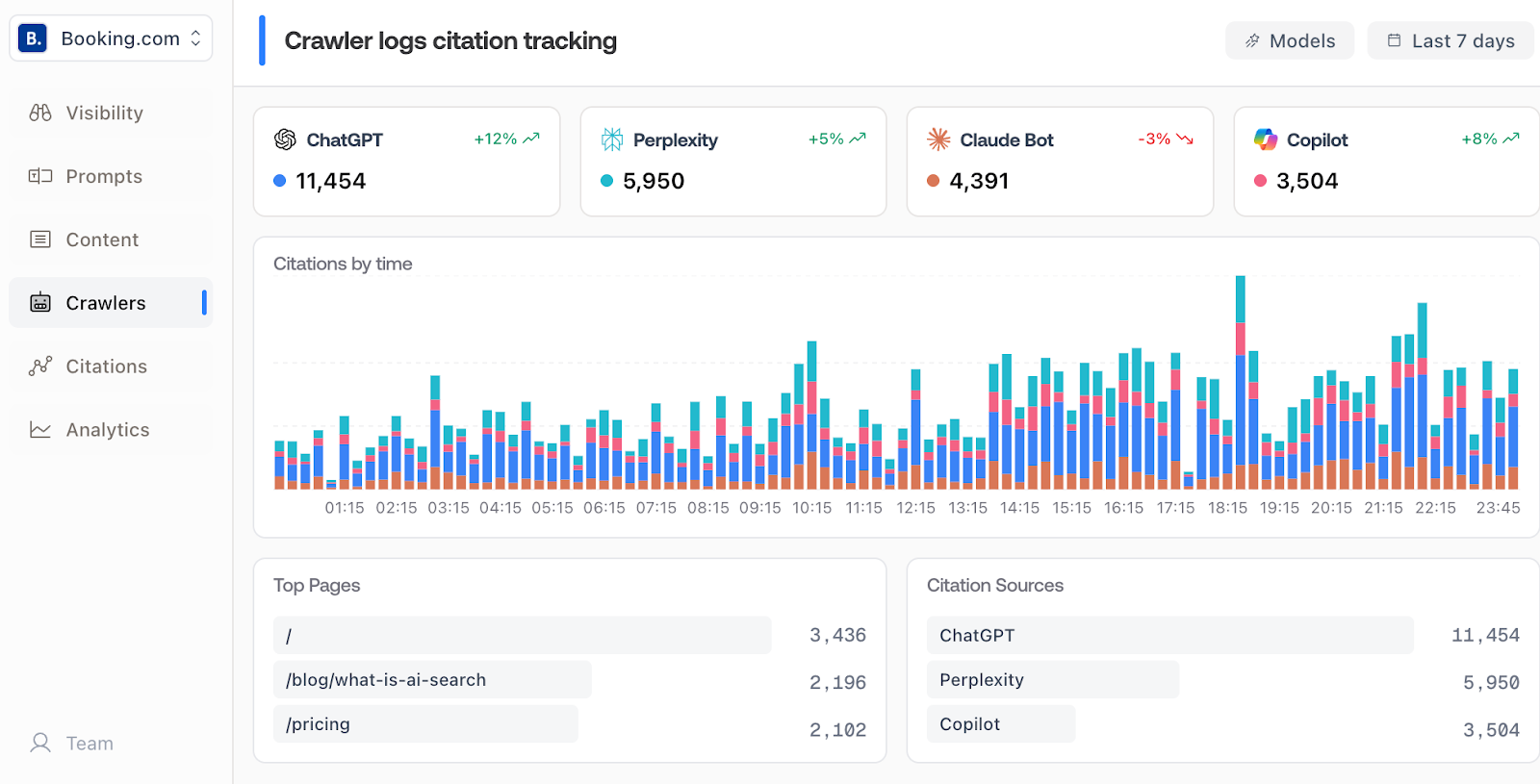
Promptwatch is very focused on prompt-level visibility. It shows exactly when AI models mention a brand, which pages they cite, and how those mentions change over time.
Promptwatch goes deeper into crawler logs, citations, and real AI responses, rather than higher-level visibility summaries. You can see which pages AI crawlers read, when they crawl them, and how that content ends up inside AI answers.
Promptwatch is very practical. You track specific prompts, analyze where your brand or competitors appear, and then get clear signals on what content is missing or unclear. The platform also highlights where to publish or optimize content to improve visibility.
It feels more prompt- and citation-centric, with less focus on enterprise site orchestration like parallel AI versions. It's especially strong for SEO and marketing teams that want concrete data tied to real AI outputs.
Promptwatch offers more depth around citations and crawler-level data, though pricing is higher at the upper tiers.
Features
- Prompt-level AI visibility tracking across ChatGPT, Claude, Gemini, and Perplexity
- Citation analysis showing which pages and sources AI uses
- Real-time crawler logs to see how AI bots access content
- Visibility, position, and sentiment metrics per prompt
- Competitor analysis to identify answer gaps
- Content and optimization insights tied to real AI responses
- Prompt volume tracking and persona-based monitoring
Cons
- Higher pricing at upper tiers
- The interface can feel dense if you only need simple visibility tracking
Pricing
Entry-level plans are reasonable, though costs climb at higher tiers depending on prompt volume.
6. AirOps – AI Visibility + End-to-End Content Execution
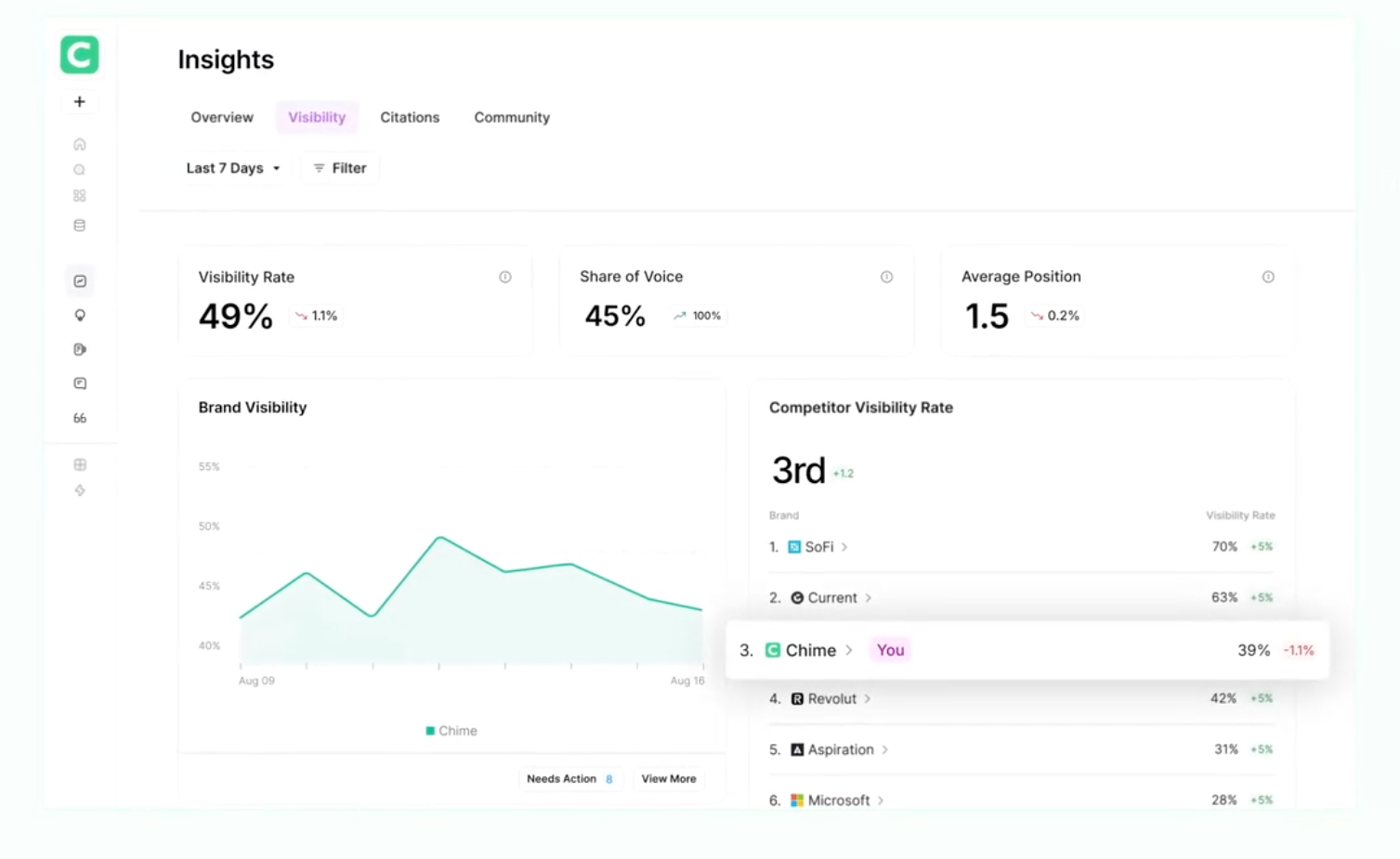
AirOps is not just an AI search visibility tracker. It measures where your brand shows up across AI search and traditional search, but it also gives you a full system to turn those insights into content.
AirOps leans harder into execution. While many tools focus on visibility, rankings, sentiment, citations, and crawler-style signals, AirOps adds workflows that help you refresh, create, publish, and track performance without stitching together multiple tools.
The core idea is simple. AirOps pulls your SEO, AI search, and analytics data (including GA4 signals) into one place, shows you what is driving visibility and trust, and then turns that into a prioritized plan.
From there, you can run production with guardrails like brand kits, knowledge bases, human review steps, and integrations. If the goal is “get seen and cited,” but you also need a repeatable content operation, AirOps fits that use case better than pure visibility dashboards.
Features
- Insights layer that unifies SEO, AI search, and GA4 to show what drives visibility
- Prompt + page tracking to monitor where you brand shows up and where you’re missing
- Page360 view to audit content health and surface opportunities to improve performance
- Opportunity reports that highlight what to refresh, create, and prioritize next
- Action workflows for content creation, refreshes, governance, and human review
- Brand kits + knowledge bases to keep output accurate and on-brand
Cons
- Less “pure AI visibility dashboard” and more “content operating system,” which can be more than you need
- Pricing is not as simple to compare because it depends on content volume and package needs
Pricing
AirOps offers a free plan to get started, with paid tiers that scale based on content volume and package needs.
7. Ahrefs Brand Radar – Massive AI Visibility Research
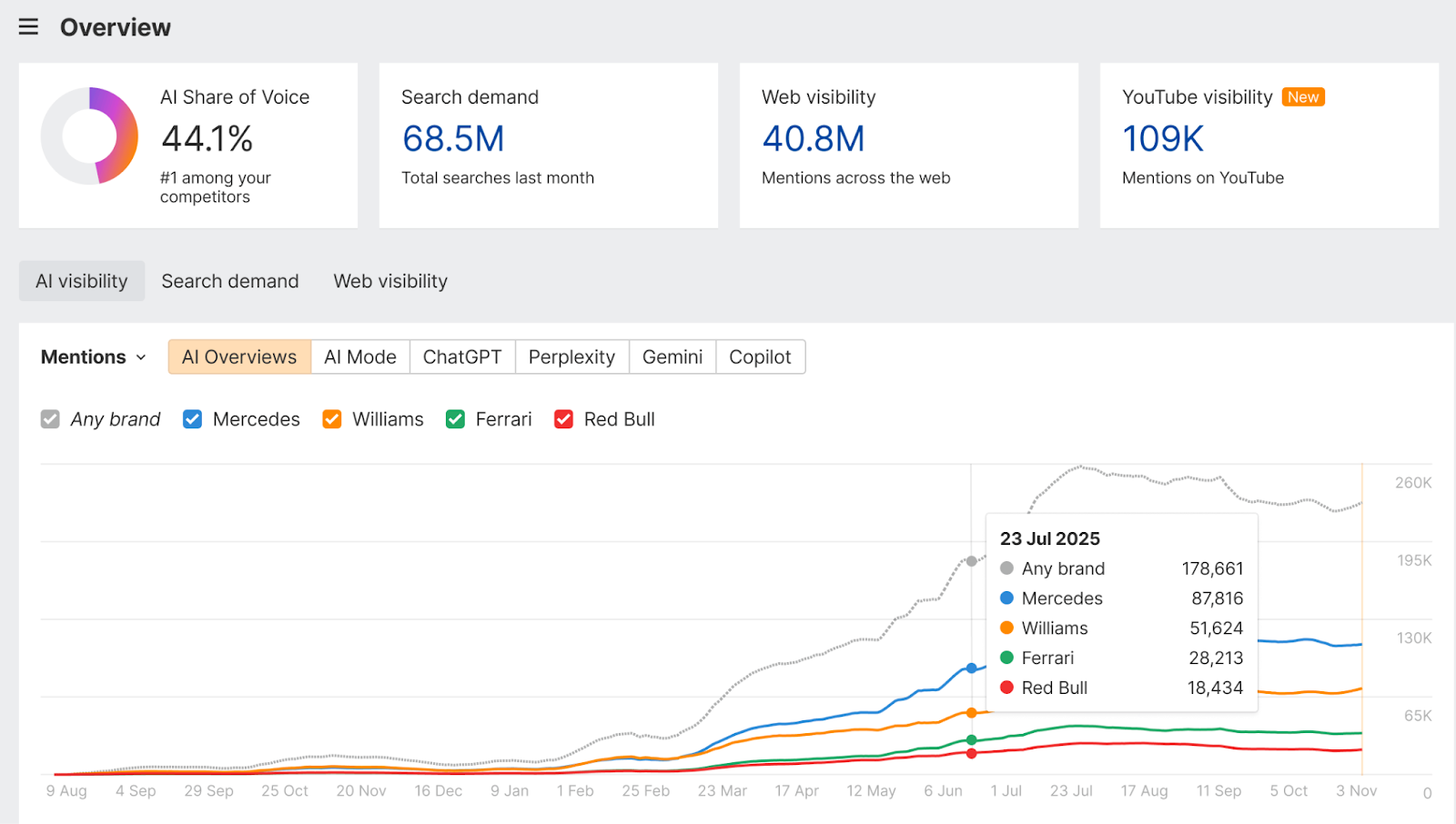
Ahrefs should be on this list because it already sits on a huge pile of search and web data, and Brand Radar is basically their move into the AI search visibility shift.
If you want a tool that lets me research AI visibility fast (without setting up projects, adding prompts, or waiting for dashboards to populate), Brand Radar is built for that.
I can search instantly, analyze any domain, and benchmark AI “share of voice” across models like ChatGPT, Copilot, Gemini, Perplexity, and AI Overviews.
Brand Radar feels more like a research and discovery engine than a “track my prompt list every day” tool. It shines when you need quick competitive intelligence, topic clusters, and citation discovery at scale.
It also goes beyond AI answers with YouTube and Reddit visibility, which can be useful when AI answers keep borrowing from those ecosystems.
The tradeoff is pricing. If you only need ongoing prompt tracking for one brand, Brand Radar can be a lot pricier.
Features
- AI Share of Voice to measure how often AI chats mention a brand
- AI prompt research at scale (search-backed prompts, not synthetic prompts)
- AI visibility gap analysis to spot where competitors show up and you don’t
- Prompt clustering into topics to find content gaps and opportunities
- Citation discovery to identify what sources influence AI answers
- Custom prompt tracking for specific questions you care about
- Extra visibility layers: YouTube mentions and Reddit visibility insights
Cons
- Can get expensive fast
- More “research and intelligence” than “guided optimization workflow,” depending on how you use it
Pricing
Ahrefs lists Brand Radar as a standalone tool available to free and paid users, with separate pricing for access. It can get expensive fast, especially if you need access across multiple AI platforms.
Tool | Features | Best for |
|---|---|---|
ZeroRank |
| Small brands to enterprise teams looking for actionable AI visibility with a free trial to get started |
Profound |
| Larger teams and agencies with bigger budgets that need deep AEO workflows |
Peec AI |
| Marketing teams that want clear reporting without complex setups, at a mid-range price |
Scrunch |
| Large organizations managing multiple brands or properties who need technical depth |
Promptwatch |
| SEO teams that want citation-level data, with reasonable entry plans but higher costs at scale |
AirOps |
| Teams that need visibility insights and a full content workflow |
Ahrefs Brand Radar |
| Brands doing large-scale competitive research that don't mind the higher price tag |
How to Choose the Right AI Search Visibility Tool
AI search is becoming a major discovery channel, and brands that appear in AI-generated answers have a growing advantage over those that don’t.
The tools in this list approach AI visibility from different angles. Some focus on research and analytics, others on citation tracking or enterprise workflows. The right choice depends on whether you want deeper insights, competitive intelligence, or a system to actively improve your presence in AI answers.
If you're looking for a platform that combines visibility tracking, analytics, and actionable recommendations, ZeroRank is a strong place to start.
Get started with a 7-day free trial and see how AI platforms talk about your brand with an instant AI visibility audit.


