AI Visibility Score: How to Measure and Interpret It
AI visibility is becoming a key marketing metric, but measuring it isn't as straightforward as tracking Google rankings. This guide explains how to build the right prompt set, choose the AI platforms that matter, benchmark competitors, and interpret your results to understand how visible your brand really is in AI search.

Key Takeaways
- AI visibility measures how often your brand is mentioned in AI-generated responses for the prompts that matter to your business.
- Start with the right prompts by combining SEO keywords, customer questions, and different stages of the buyer journey.
- Track your prompts across the AI platforms your audience uses.
- Benchmark against the competitors that consistently appear in AI responses, not necessarily the ones that rank highest in Google.
- Interpret your results using metrics like AI visibility, average position, and sentiment to understand where you're performing well and where you're losing visibility.
- AI visibility tracking is only the first step. Turning those insights into prioritized actions is what ultimately helps improve your presence across AI search.
When people ask ChatGPT, Google AI Overviews, Gemini, Claude, or Perplexity for recommendations, is your brand showing up?
Unlike traditional search, there isn't a fixed ranking you can track. AI platforms generate answers dynamically, recommendations vary between platforms, and the same prompt can produce different results over time.
Measuring AI visibility requires a different approach than traditional SEO.
In this guide, I'll show you how to measure your AI visibility, choose the right prompts to track, benchmark against competitors, and interpret the results.
What is AI visibility?
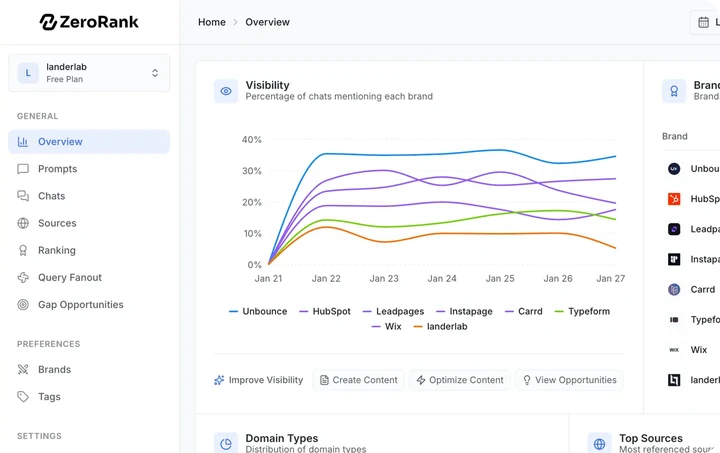
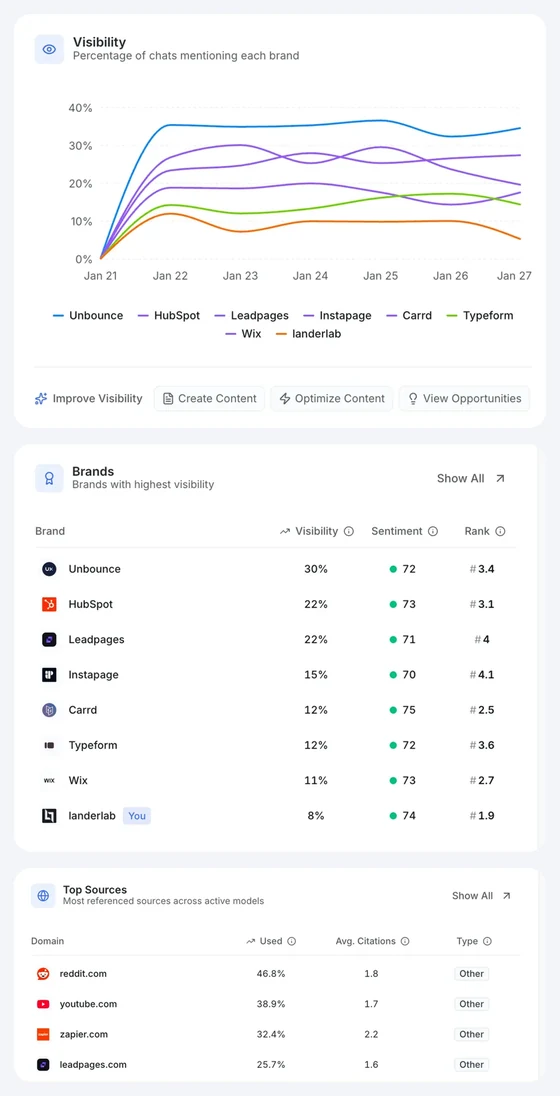
AI visibility measures how often your brand is mentioned in AI-generated answers for the prompts that matter to your business. It's expressed as a percentage (0-100%), making it easy to compare your visibility over time, across AI platforms, and against competitors.
A mention is when your brand appears anywhere in an AI-generated answer. Keep in mind that that a brand mention (opens in a new tab) is different from a citation, which refers to the source AI uses to support its response.
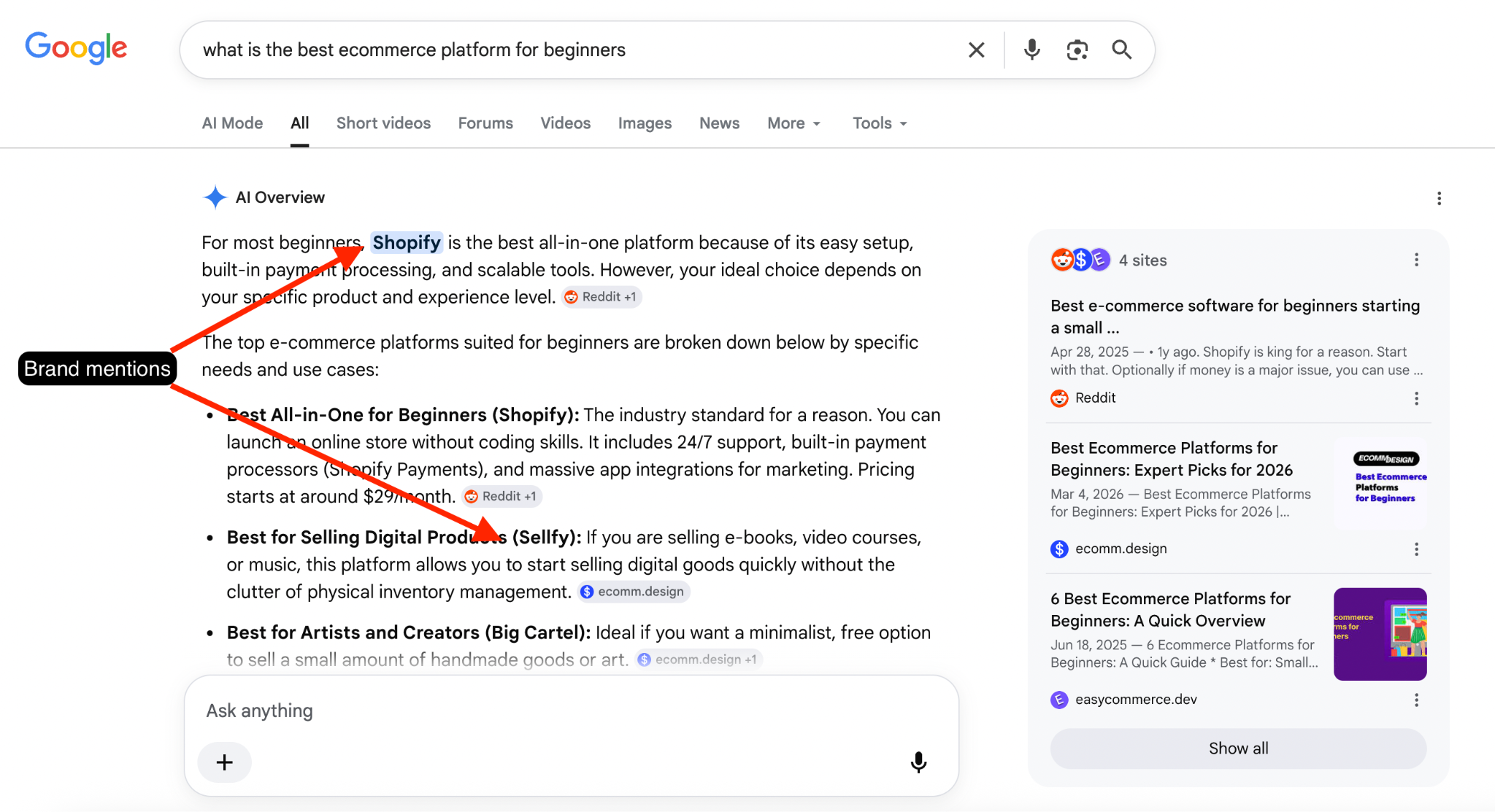
A prompt is simply the question or instruction someone types into an AI platform like ChatGPT, Gemini, Claude, or Perplexity. Think of them as search queries.
For example:
- What are the best CRM tools for a small business?
- How do I measure AI visibility?
- Is Squarespace support reliable?
To measure your AI visibility score, you first create a list of prompts that reflect the questions your potential customers are asking. You then check how often your brand appears in the AI-generated answers for those prompts.
A simple way to calculate it is:
AI Visibility Score = (Number of AI answers where your brand appears ÷ Total number of AI answers you tracked) × 100
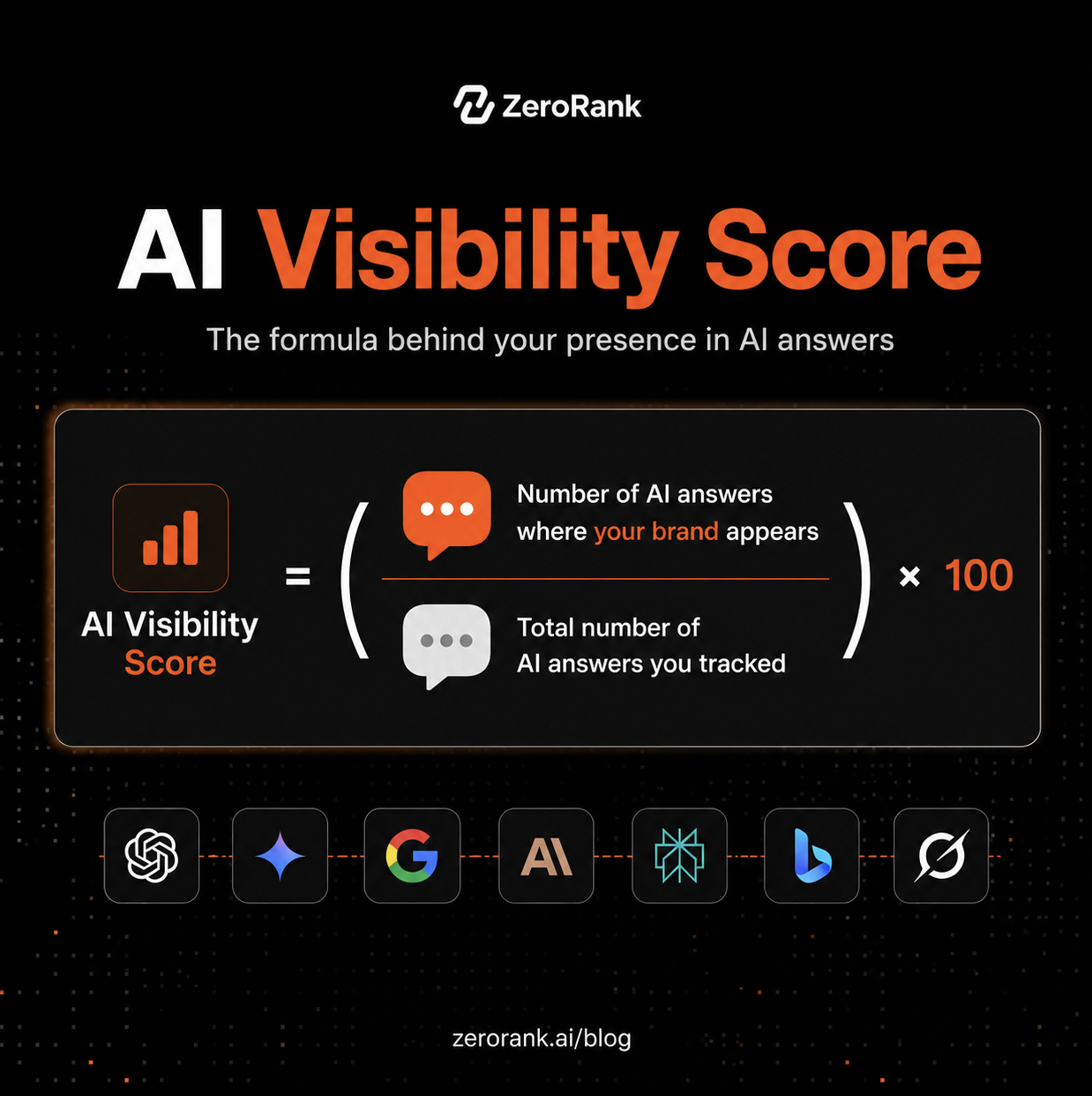
For example, if you track 25 prompts across four AI platforms, you've collected 100 AI-generated answers. If your brand appears in 42 of those answers, your AI visibility is 42%.
The key is choosing prompts that actually represent how your customers search, which is where most of the work and value comes from.
Step 1: Choose the right prompts
Your AI visibility is only as useful as the prompts you track.
If your prompt list doesn't reflect the questions your potential customers are actually asking, your visibility percentage won't tell you much—even if it's high.
A good place to start is with the topics you're already targeting through SEO. Take your most important keywords, especially long-tail keywords, and turn them into natural questions that someone would ask an AI assistant.
For example:
SEO keyword | AI prompt |
|---|---|
AI visibility tools | |
CRM software for startups | What's the best CRM for a startup? |
Email marketing automation | Which email marketing platform has the best automation? |
Don't stop there, though. Some of your most valuable prompts won't come from keyword research at all.
Look at questions your customers ask during sales calls, support tickets, demos, community forums like Reddit, or Google's People Also Ask. These often reveal the exact language people use when researching a solution.
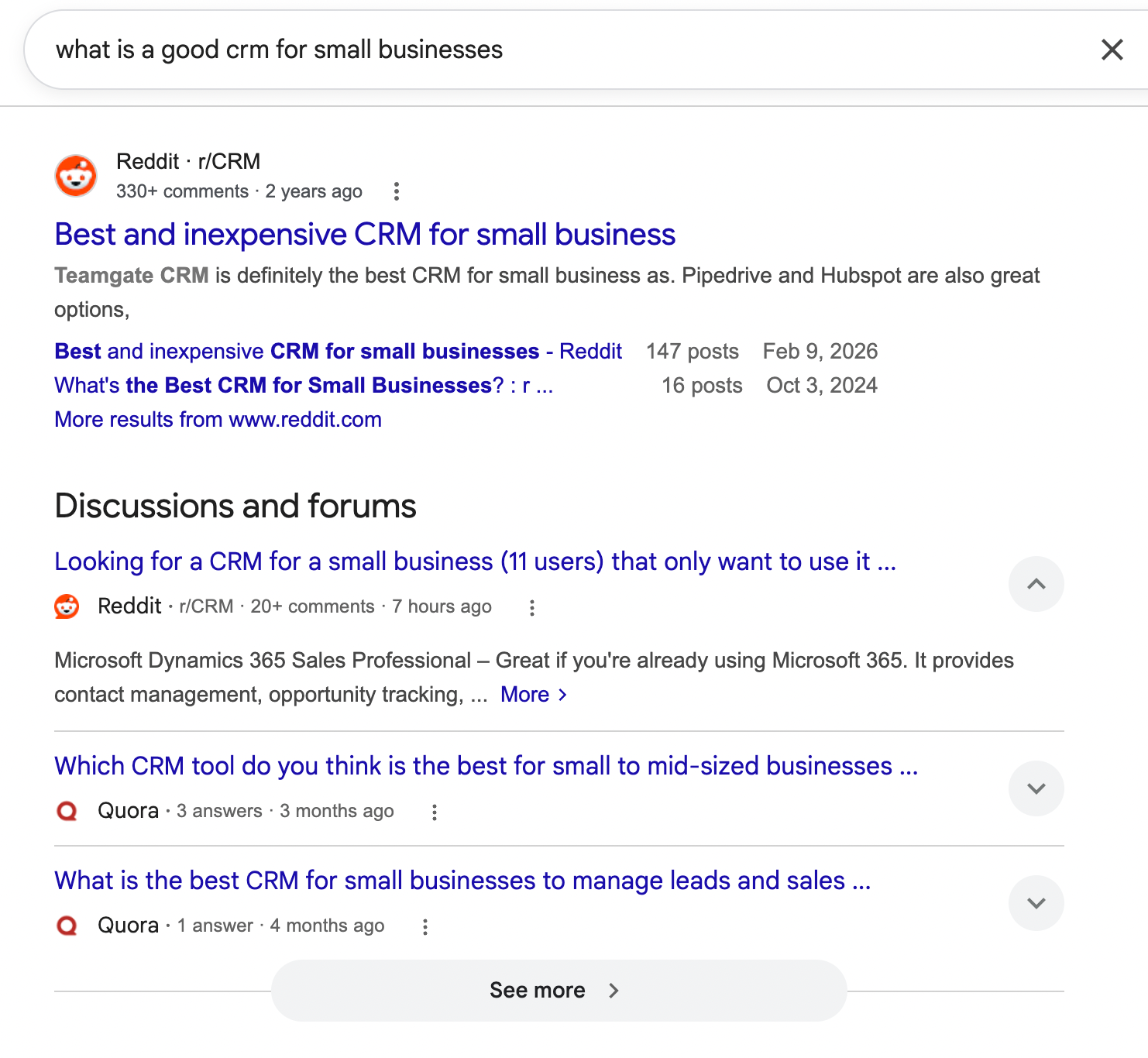
It's also important to include different types of prompts across the customer journey. A balanced prompt set might include:
- Discovery prompts: What are the best AI visibility tools?
- Comparison prompts: ZeroRank AI vs Profound AI
- Problem-solving prompts: How do I measure AI visibility?
- Evaluation prompts: Is ZeroRank AI worth it?
- Branded prompts: ZeroRank AI pricing, ZeroRank AI reviews, How do I connect the ZeroRank MCP?
Finally, resist the temptation to track every variation you can think of. It's better to have 50 well-chosen prompts that represent real customer intent than 500 nearly identical questions that all measure the same thing.
During onboarding, ZeroRank suggests prompts based on the topics most relevant to your business and audience.
The prompts are grouped by topic, making it easy to track different areas of your business, identify gaps in your coverage, and organize your AI visibility monitoring from day one.
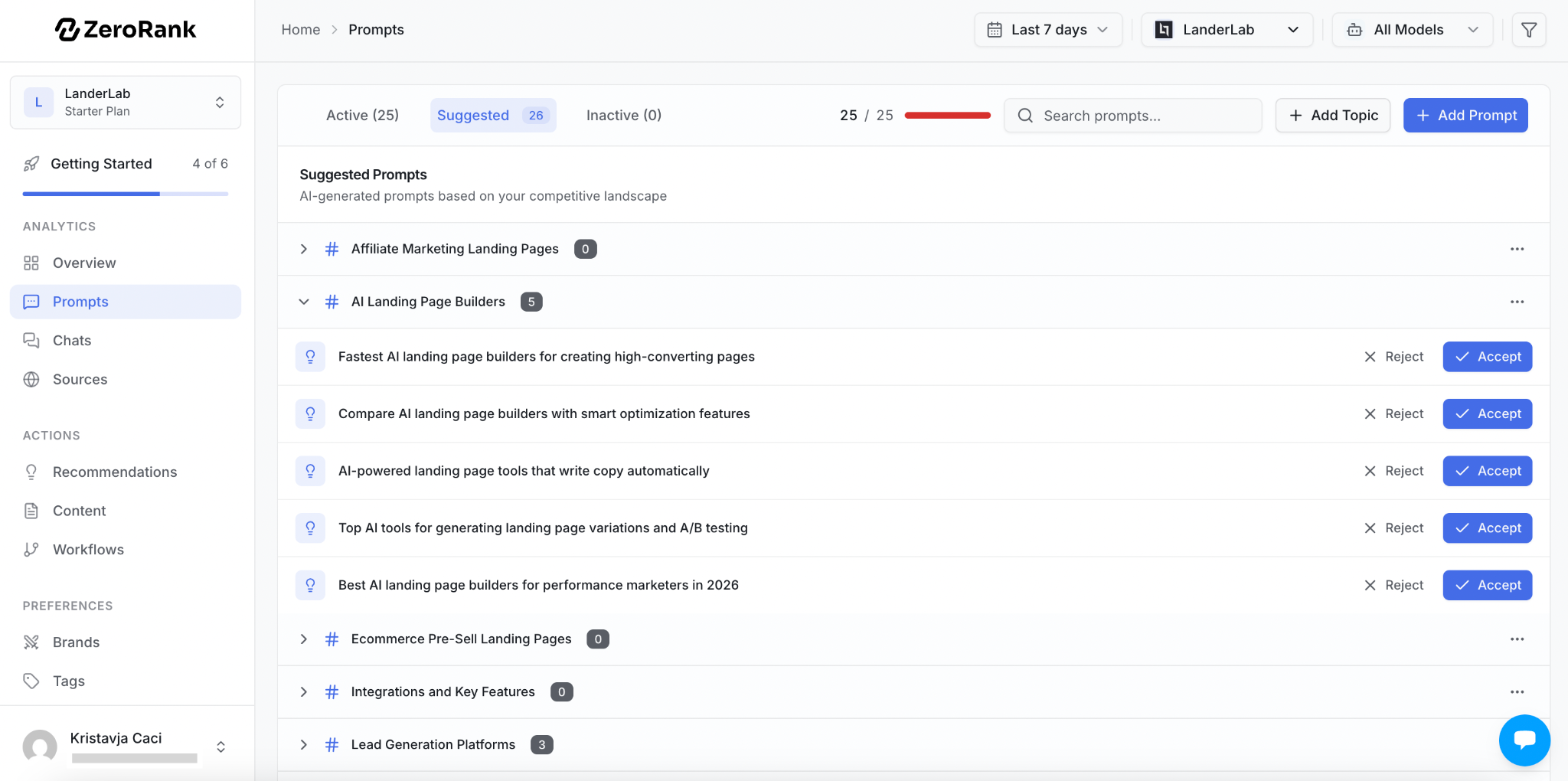
You can always add new prompts manually.
Step 2: Choose the AI platforms to track
Once you've built your prompt list, it's time to decide where you'll run those prompts.
You don't need to track every AI platform available, just the ones that matter to your customers.
A good starting point is:
- ChatGPT – The largest AI assistant by market share and a good baseline for almost every business.
- Google AI Overviews (opens in a new tab) and AI Mode – Essential if Google is already an important acquisition channel for your business.
- Gemini – Google's standalone AI assistant, particularly relevant for users within the Google ecosystem.
- Perplexity – Popular for research, product comparisons, and purchase decisions thanks to its citation-first approach.
- Claude – Widely used by developers, technical professionals, and knowledge workers.
The right mix depends on your audience. For example, a developer tool should almost certainly track Claude, while an ecommerce brand may want to focus more heavily on ChatGPT and Google's AI experiences.
If you're measuring AI visibility manually, run the same prompt across each platform and record the results in a spreadsheet. At a minimum, you should track:
Prompt | Platform | Brand mentioned? | Position | Competitors mentioned | Website cited? | Notes |
|---|---|---|---|---|---|---|
Best AI visibility tools | ChatGPT | ✅ Yes | #2 | Profound, Semrush | ✅ Yes | Mentioned as an affordable option |
Best AI visibility tools | Perplexity | ❌ No | — | Profound, Semrush, Peec AI | ❌ No | No mention |
ZeroRank AI pricing | Gemini | ✅ Yes | #1 | None | ✅ Yes | Pricing information was accurate |
This allows you to measure how often your brand appears, who AI recommends instead of you, where you rank within the response, and whether AI cites your website as a source.
With ZeroRank, this process is automated. Every plan starts with tracking across three AI platforms, and you can expand to as many as 17 platforms as your needs grow.
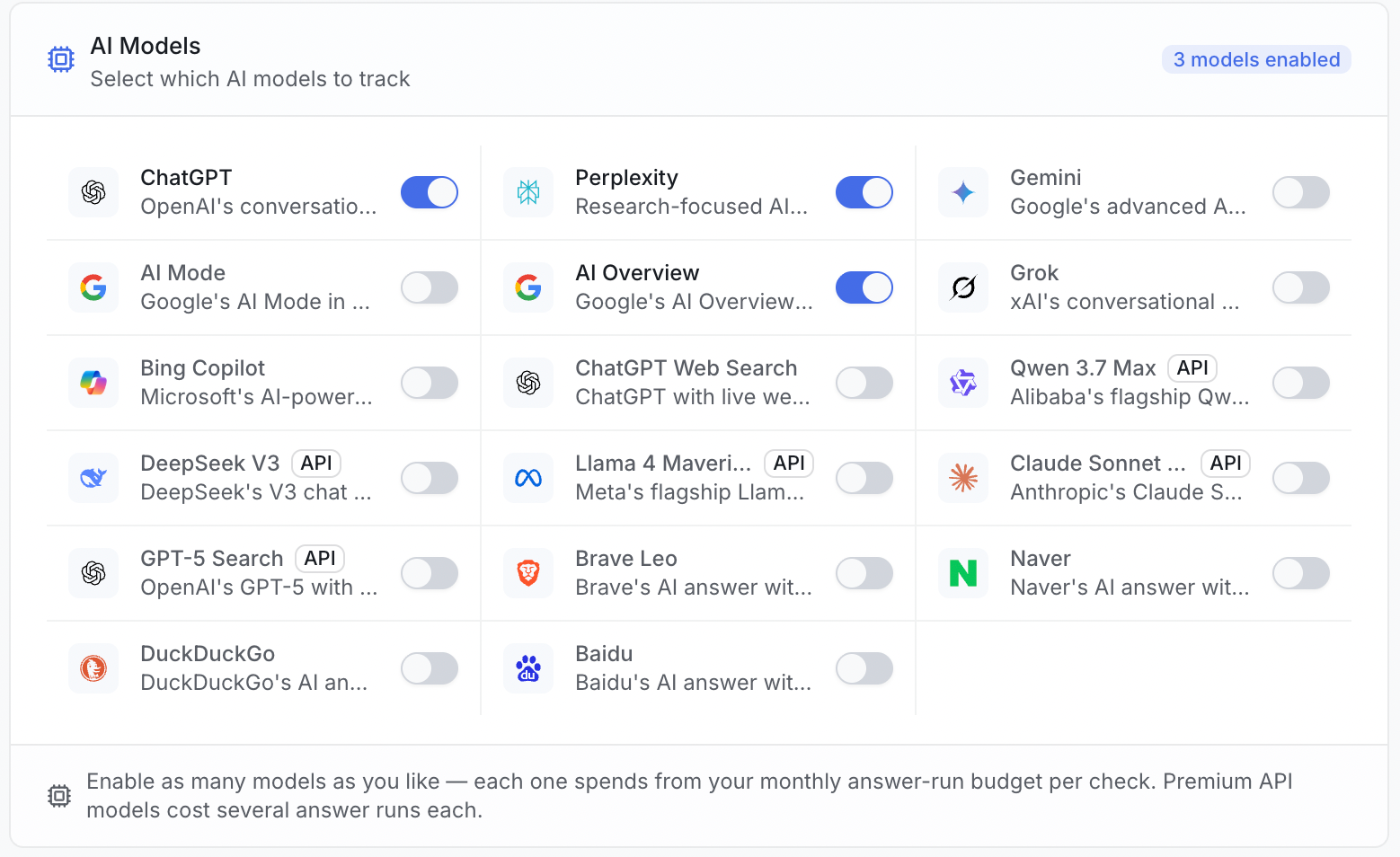
ZeroRank continuously runs your prompt set, records every response, tracks changes over time, and keeps all of your visibility data in one place, eliminating the need to manually rerun prompts or maintain spreadsheets.
Step 3: Identify your competitors
As you review AI-generated answers, don't just note whether your brand appears, pay attention to which competitors are consistently being recommended.
These are the brands you'll want to benchmark against. They provide the context for your AI visibility and help you understand who's winning the recommendations that matter to your business.
ZeroRank automatically identifies the brands that appear most often across your tracked prompts, but you can refine that list to include only your actual competitors.
For example, while a brand like Google might frequently appear for certain prompts, it isn't necessarily part of your competitive landscape.
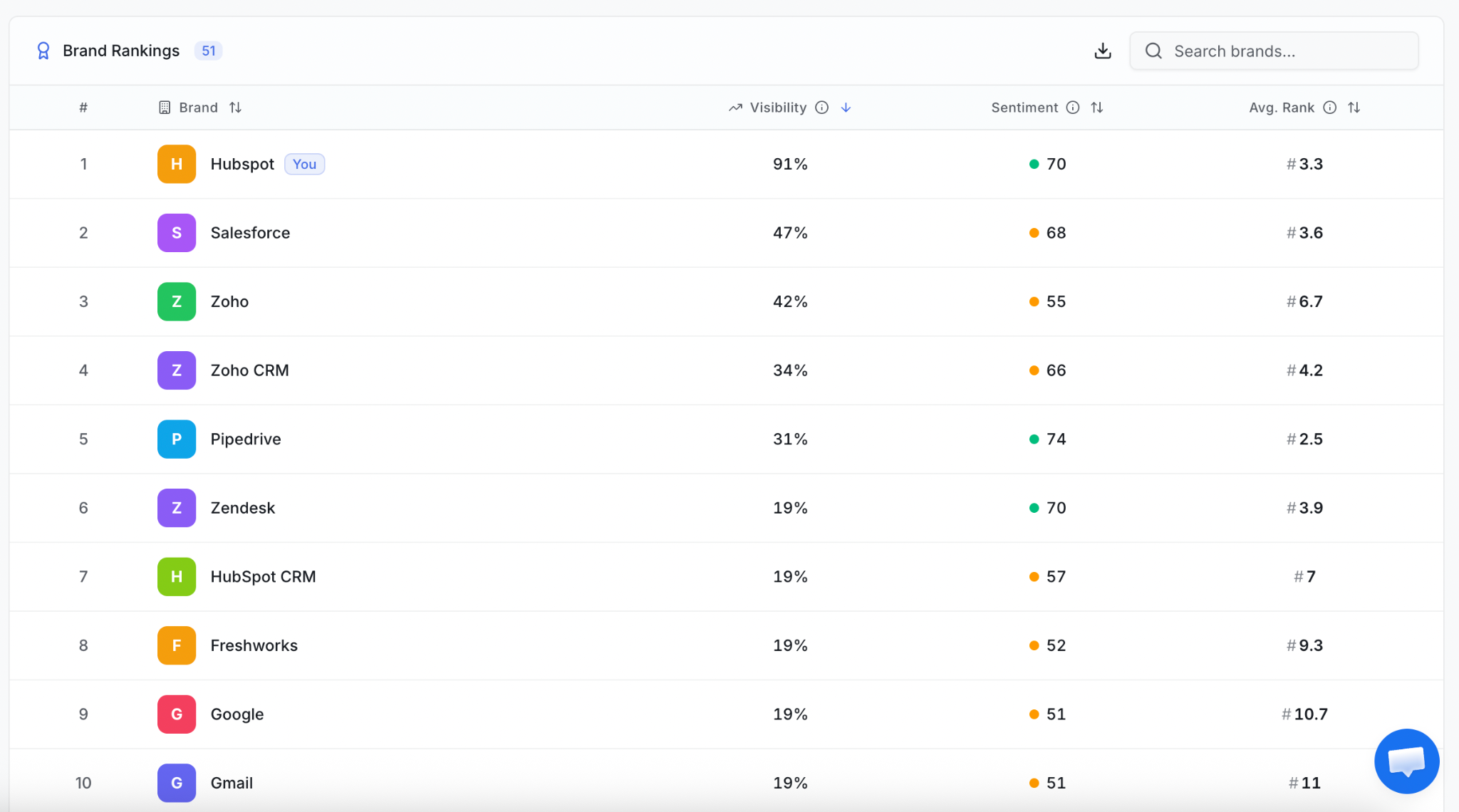
Choosing the right competitors is important because it gives context to your visibility metrics and helps inform the strategy you'll use to improve your AI visibility over time.
Interpret your AI visibility score
Once you've collected enough data, it's time to turn the numbers into insights.
Ask questions like:
- Which competitors are outperforming me?
- Which AI platforms am I strongest and weakest on?
- Which topics have the biggest visibility gaps?
- What should I prioritize fixing first?
Your AI visibility score shouldn't be viewed in isolation. It's equally important to look at supporting metrics like:
- Average position: Are you the first recommendation, or are you consistently appearing further down the list?
- Sentiment: When your brand is mentioned, is it being recommended positively, negatively, or neutrally?
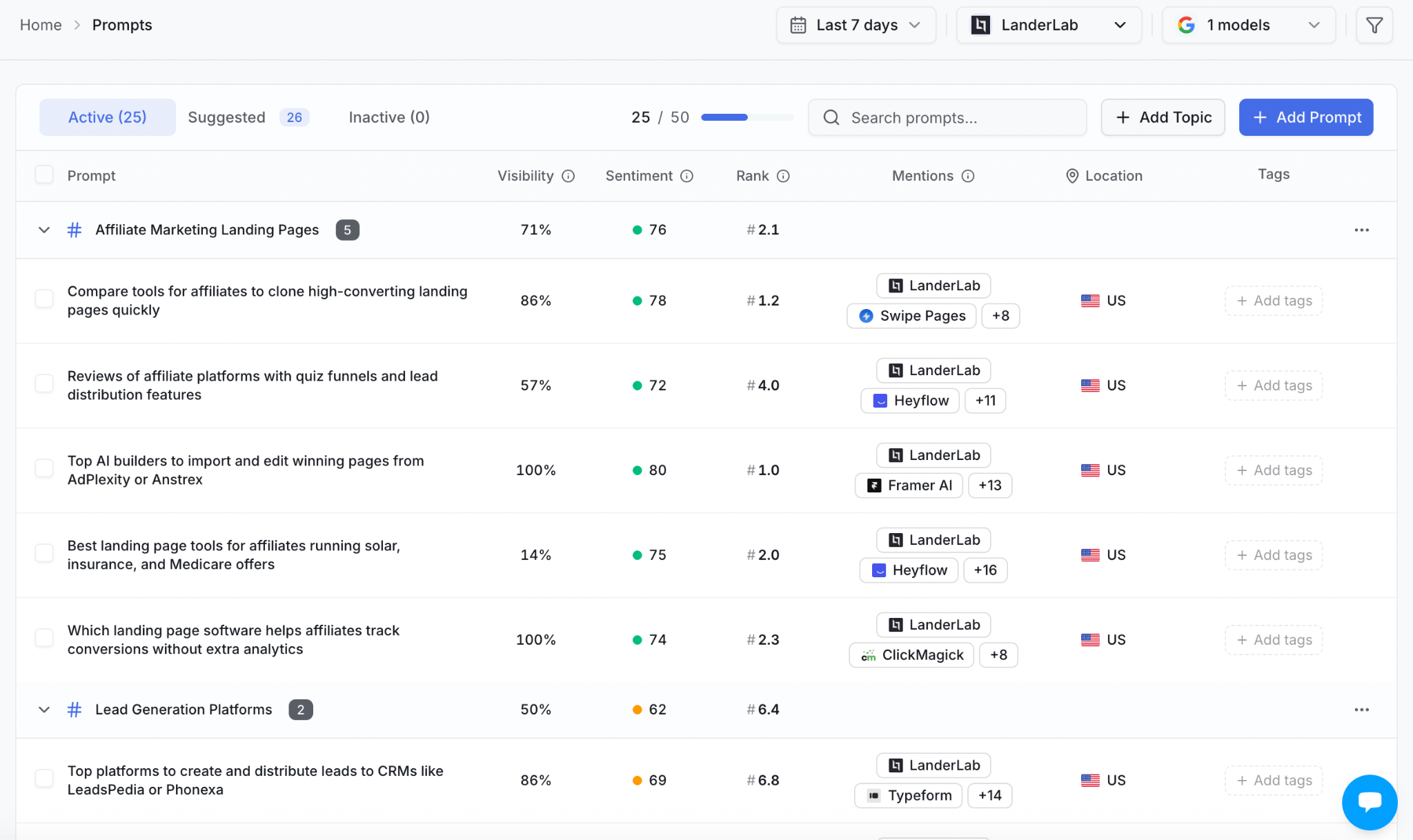
Looking at specific chats can help you put these metrics into perspective. You can replicate your questions over time across different LLMs.
ZeroRank keeps a log of all the chats you get mentioned. You can also see your rank, sentiment, and the sources shaping those answers.
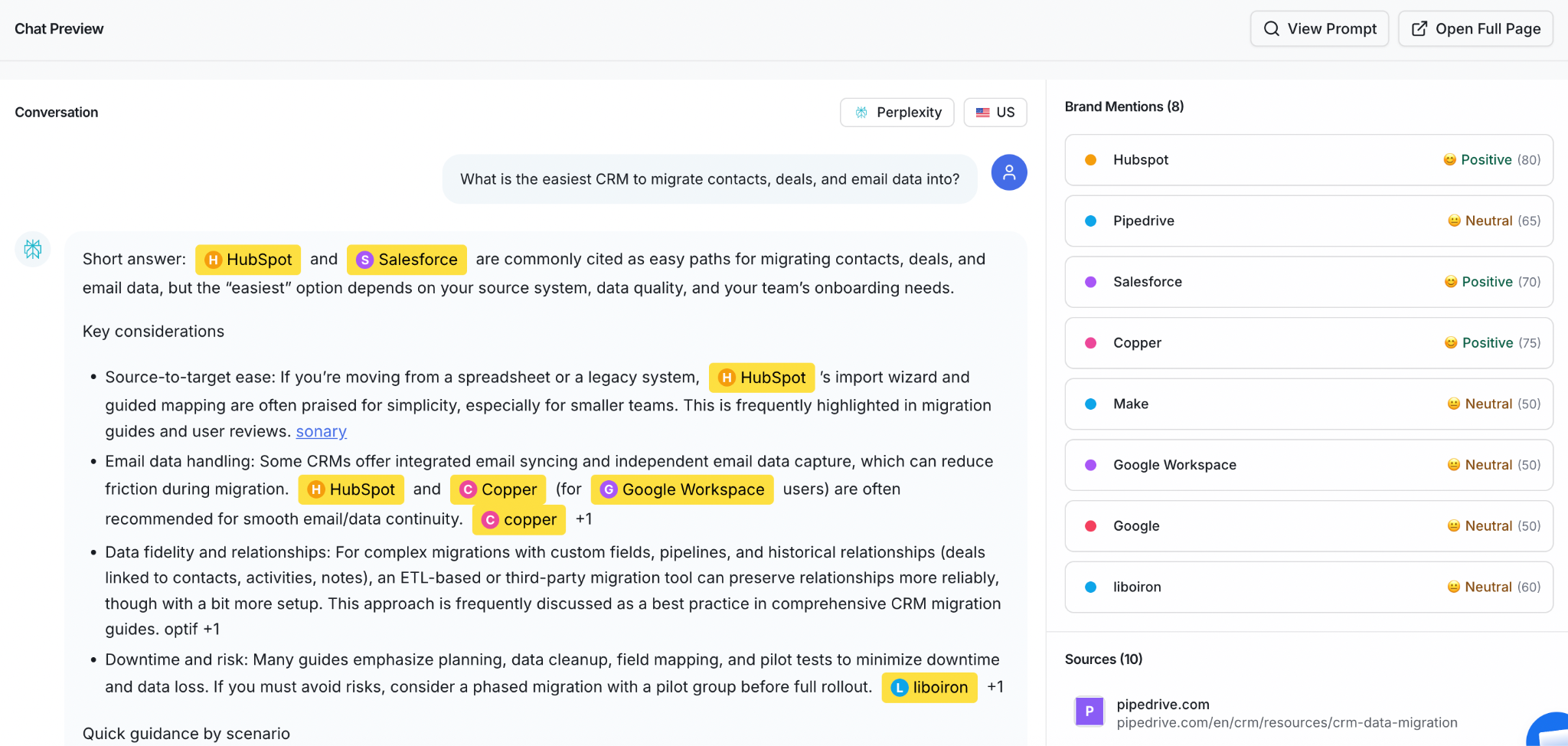
Together, these metrics provide much more context than visibility alone. Especially when you track them over time.
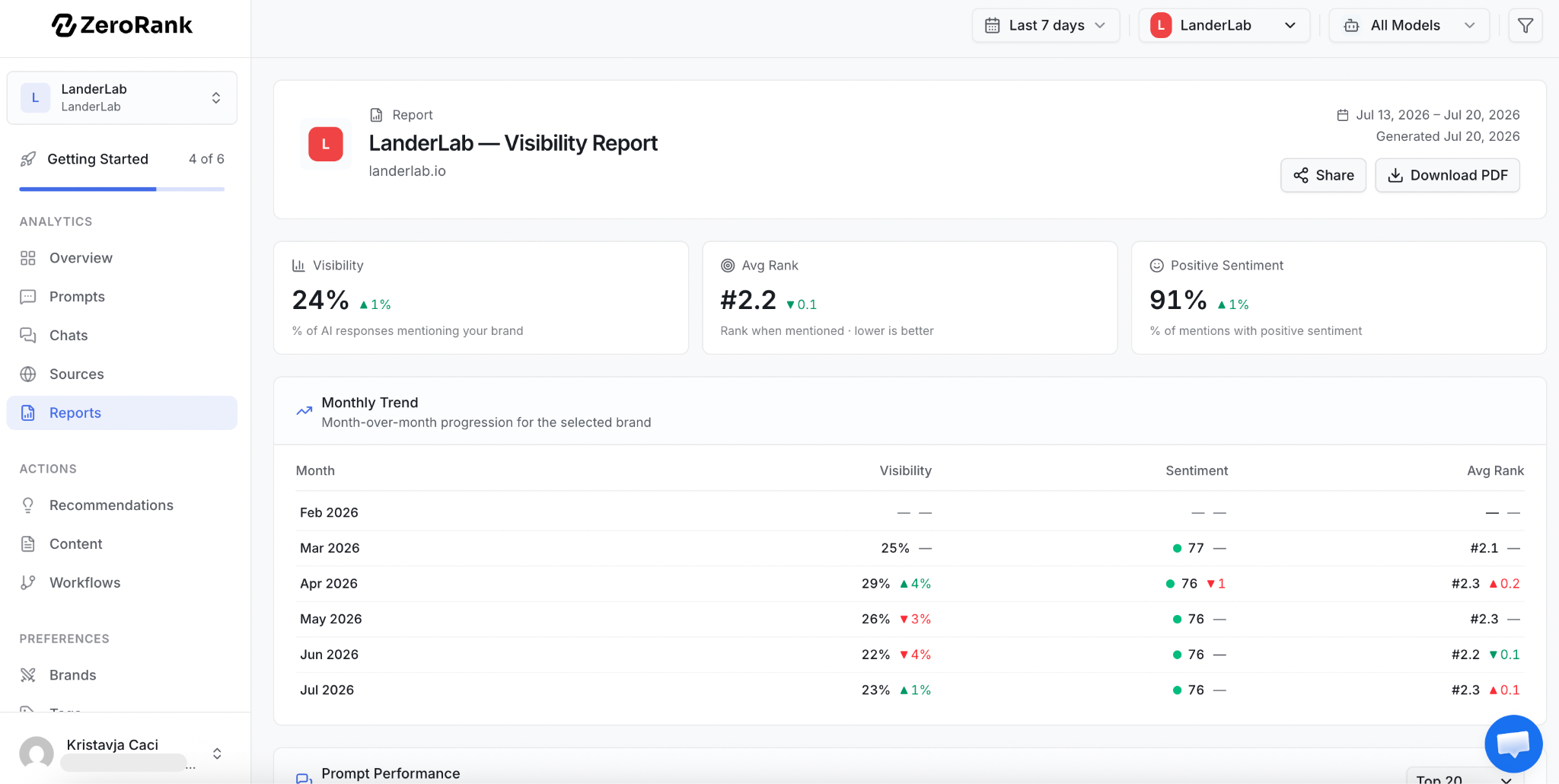
For example, your visibility might increase, but if your average position drops or brand sentiment (opens in a new tab) becomes more negative, that's a sign that your overall performance isn't actually improving.
So make sure to regularly check the Reports in ZeroRank.
Turn your AI Visibility tracking into action
Measuring your AI visibility is only the first step. The real value comes from understanding why you're performing the way you are and knowing what to do next.
That's where ZeroRank goes beyond tracking.
Instead of leaving you to interpret dashboards and spreadsheets, ZeroRank helps you identify the biggest opportunities to improve your visibility. You can see why competitors are being recommended, where you're losing visibility, and which topics deserve your attention first.
From there, ZeroRank helps you take action with prioritized recommendations, AI-powered content generation and automated workflows.
Rather than simply reporting the data, ZeroRank helps you turn AI visibility insights into action and results.
Filed under AI Search Education
Head of content and operations. On a mission to make ZeroRank the go-to platform for AI search visibility.
Keep reading
All posts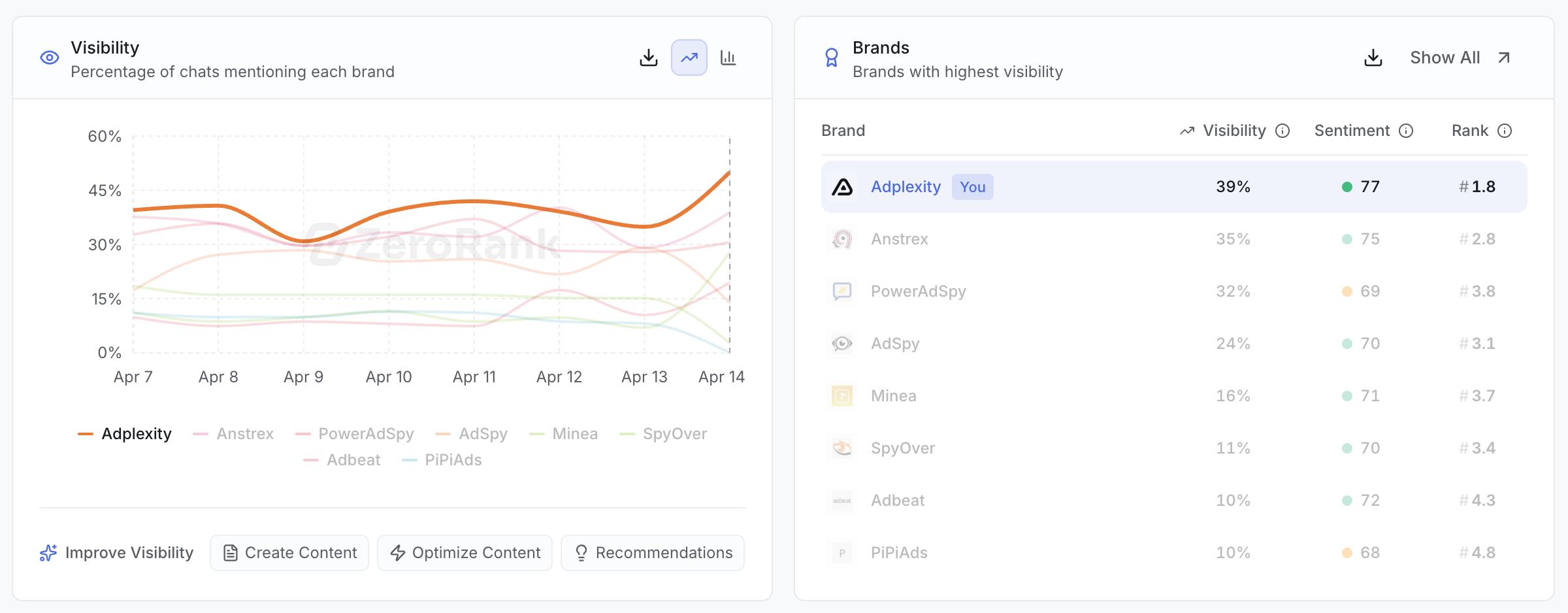 AI Search Education
 AI Search Analytics: What to Track and How to Use the Data
Learn how to use AI search analytics to track visibility, research prompts, analyze sources, and turn your findings into practical improvements.

 AI Search Education
 The 14 Best GEO Agencies for SaaS in 2026 (Pricing and G2 Ratings Verified)
We verified pricing pages, G2 and Clutch ratings, and AI search deliverables for 14 GEO agencies serving SaaS. Six publish no price. See who fits your budget.
 AI Search Education
 GEO vs. SEO: What’s the Difference?
GEO vs. SEO explained with practical examples. Learn how AI search optimization differs from traditional SEO and how to improve your AI visibility.