Data Scraping vs. API Calls: Best Way to Track AI Search Visibility
AI visibility tools use different methods to collect their data. Learn why UI scraping provides a more accurate view of the brand mentions, citations, and sources users see—and when API calls still make sense.

Not all AI visibility tools collect their data in the same way. Some send prompts through model APIs, while others scrape the answers displayed in consumer platforms such as ChatGPT and Perplexity.
The difference matters. If you want to understand what potential customers actually see—including brand mentions, rankings, citations, and sources—scraped answers provide a more accurate picture.
The difference between data scraping and API calls at a glance
Comparison | UI scraping | API calls |
|---|---|---|
What it captures | Answers displayed in the consumer interface | Responses generated through an underlying model’s API |
Real-user accuracy | High—closely reflects what users see | Lower—may differ significantly from the live platform |
Brand mentions | Captures brands shown in actual consumer answers | May return a different set of brands |
Citations and sources | Captures live citations and linked sources | May return fewer, different, or no sources |
Web search behavior | Reflects whether the consumer platform searches the web | May not trigger web search consistently |
Interface elements | Includes formatting, search blocks, lists, and other visible elements | Does not reproduce the full consumer interface |
Response format | Requires extracting and processing interface content | Returns clean, structured data such as JSON |
Speed and cost | Slower and more resource-intensive | Faster and generally cheaper at scale |
Best suited for | Accurate AI visibility and citation tracking | App development, automation, and high-volume testing |
Main limitation | More technically difficult to collect reliably | Does not necessarily represent what customers actually see |
API responses are not the same as consumer AI answers
An API gives developers programmatic access to an underlying model. ChatGPT, however, is more than that model. Its answers are also shaped by system instructions, search behavior, additional data sources, and interface-level logic.
Even if an API uses the same underlying model, it does not necessarily reproduce the answer displayed in ChatGPT.
APIs are useful because they are fast, relatively inexpensive, and return clean, structured data. That makes them well suited to building applications or processing prompts at scale. But convenience does not make their responses an accurate proxy for AI search visibility.
How different are scraped and API results?
Research from Surfer (opens in a new tab) compared 1,000 ChatGPT prompt executions using scraped interface answers and API responses. The differences were significant:
- API answers averaged 406 words, compared with 743 words for scraped answers.
- Scraped answers contained an average of 16 sources, compared with seven through the API.
- APIs returned no sources in approximately 25% of cases.
- Only 24% of the brands found in API and scraped answers overlapped.
The study found a similar pattern on Perplexity, where only 8% of sources overlapped between API and user-interface answers.
This means an API-based tool may report brands and sources that customers rarely see or miss the ones influencing the actual consumer experience.
Why scraping is better for AI visibility tracking
UI scraping records the answer as it appears to the user. That can include:
- Brand mentions (opens in a new tab)and their position within the answer
- Live citations and linked sources
- Search-generated content
- Formatting and recommendation lists
- Interface elements unavailable through the API
As ZeroRank’s CEO explains:
“We take your prompt, run it against ChatGPT and the other LLMs, and scrape the exact content they’re providing. One to one. As close as it can get to what actual users are seeing.”
– Kelvin Cobanaj
ZeroRank uses this approach because AI visibility tracking should not measure an approximation produced through an underlying model’s API.
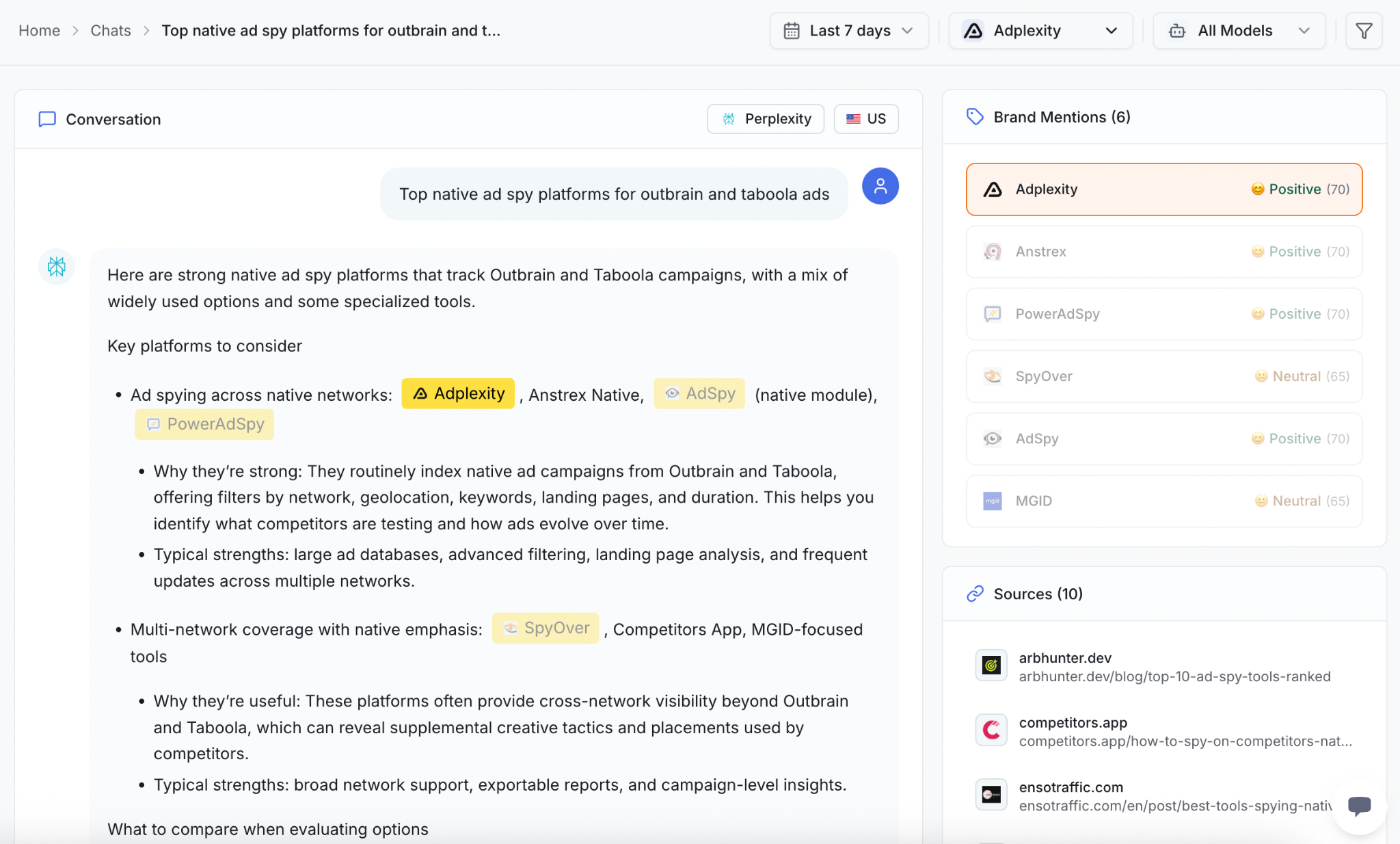
We keep track of the exact responses, which you can view in the Chats tab.
Are API calls ever the better choice?
Yes, depending on the goal. APIs offer clear advantages for software development, high-volume testing, automation, and use cases where consistent JSON output matters more than reproducing the consumer interface.
But AI search visibility is specifically concerned with what users see when they ask ChatGPT, Perplexity, or another AI platform a question. For that purpose, speed and convenience should not come at the expense of fidelity.
Check how your AI visibility data is collected
Before choosing an AI visibility platform, ask whether it collects answers from the live consumer interface or sends prompts through an API.
API data may look convincing inside a dashboard, but if it does not match the brands, citations, and sources appearing in real conversations, you could end up optimizing for the wrong results.
With ZeroRank, prompts are run across the actual AI platforms and the answers are scraped as users see them, giving you a more reliable view of where your brand truly stands.
Filed under AI Search Education
Head of content and operations. On a mission to make ZeroRank the go-to platform for AI search visibility.
Keep reading
All posts AI Search Education
 The 14 Best GEO Agencies for SaaS in 2026 (Pricing and G2 Ratings Verified)
We verified pricing pages, G2 and Clutch ratings, and AI search deliverables for 14 GEO agencies serving SaaS. Six publish no price. See who fits your budget.

 AI Search Education
 GEO vs. SEO: What’s the Difference?
GEO vs. SEO explained with practical examples. Learn how AI search optimization differs from traditional SEO and how to improve your AI visibility.
 AI Search Education
 AI Visibility Score: How to Measure and Interpret It
AI visibility is becoming a key marketing metric, but measuring it isn't as straightforward as tracking Google rankings. This guide explains how to build the right prompt set, choose the AI platforms that matter, benchmark competitors, and interpret your results to understand how visible your brand really is in AI search.