How to Optimize for AI Search With ZeroRank
A practical walkthrough of how to use ZeroRank to track AI visibility, identify gaps across prompts and sources, and prioritize the actions that improve your chances of appearing in AI answers.

If you’re reading this, you already know how important it is to show up in AI search.
Instead of browsing search results, people now ask platforms like ChatGPT, Gemini, and Perplexity for recommendations. Google is also pushing AI Overviews directly into search results.
If your brand doesn’t appear in these answers, you’re invisible to a growing share of potential customers.
That’s where ZeroRank comes in.
ZeroRank helps you track how your brand appears in AI answers, identify visibility gaps, and take action to improve your presence across AI platforms.
In this guide, I’ll walk you through how to use ZeroRank to:
- track the prompts that matter in your category
- identify where competitors are outperforming you
- understand which sources influence AI answers
- turn those insights into concrete optimization actions
To keep things practical, I’ll use LanderLab, an AI landing page builder, as an example throughout the guide.
By the end, you’ll understand how to turn AI visibility insights into a clear optimization workflow.
1. Track the prompts that matter
The first step is setting up prompt tracking.
When you sign up, ZeroRank suggests prompts that are relevant to your brand and industry.
I recommend starting with 20–25 prompts. This is enough to understand how AI platforms position your brand without creating unnecessary noise. You can always add more prompts later.
Under the Suggested Prompts tab, you’ll see that ZeroRank groups the prompts into specific Topics.
For example, for LanderLab, the tool recommends prompts related to categories like:
- Affiliate Marketing Landing Pages
- AI Landing Page Builders
- Ecommerce Pre-Sell Landing Pages
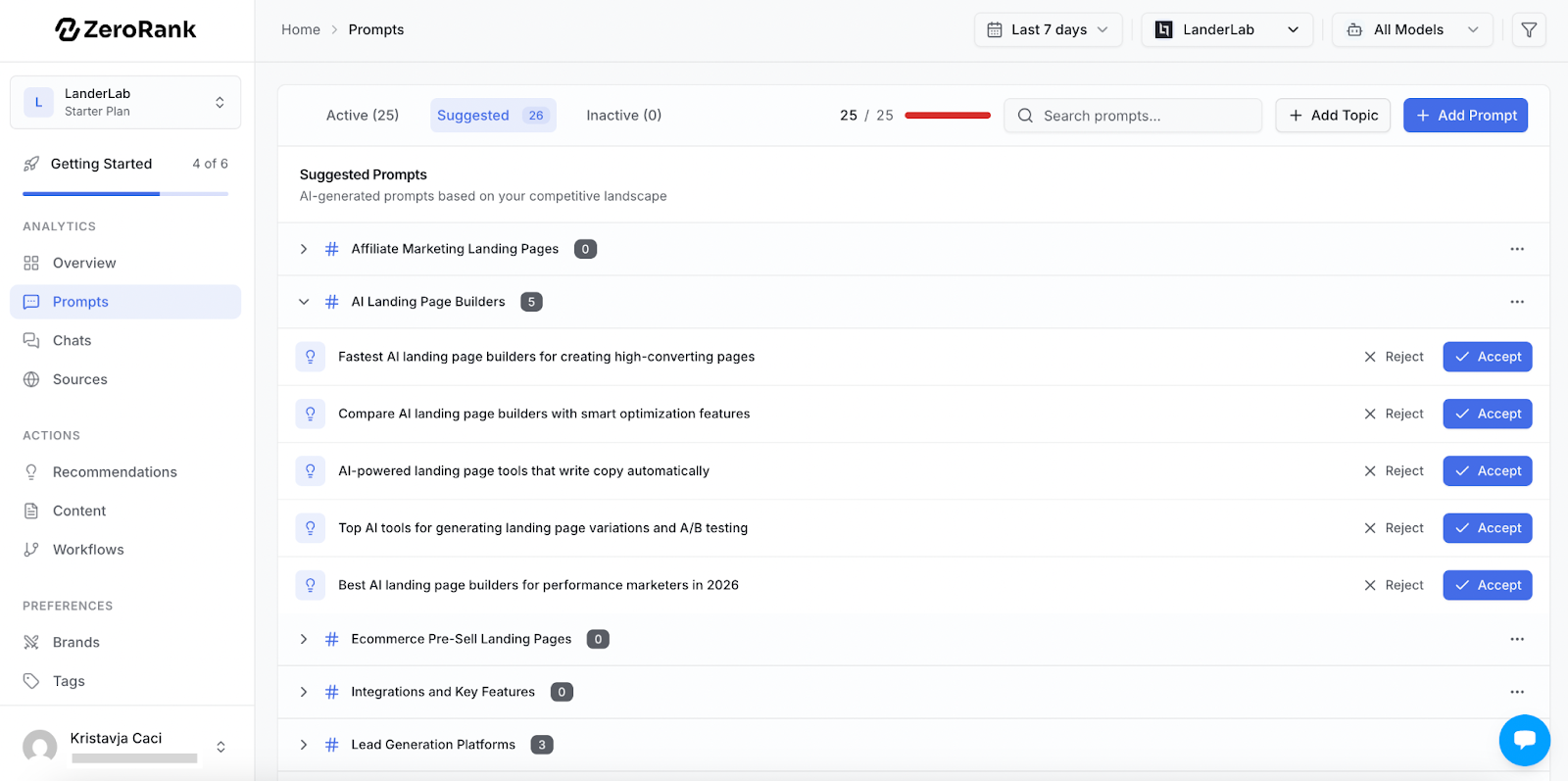
Under each theme, you will find the specific prompts which you can choose to Accept or Reject, based on how relevant they are to your brand.
These prompts represent the actual types of questions people ask AI.
And as you can see in the above screenshot, AI users tend to ask longer, more specific questions.
For example:
Instead of asking: “best landing page builder”
Users now ask:
- “AI powered landing page tools that write copy automatically”
- “Best AI landing page builders for performance marketers in 2026”
This gives you the baseline for your AI visibility and takes us to the next step.
2. Spot visibility gaps
Once your prompts start running, the next step is identifying where your brand is missing and why.
ZeroRank allows you to analyze visibility from three angles:
- overall visibility vs competitors
- prompt-level performance
- sources influencing AI answers
This helps you identify exactly where to focus your optimization efforts.
Benchmark your overall visibility
Start in the Overview tab.
Here you can see your AI Visibility Score, which measures how often your brand appears across all tracked prompts.
The score ranges from 0 to 100%. Higher scores indicate stronger presence in AI answers.
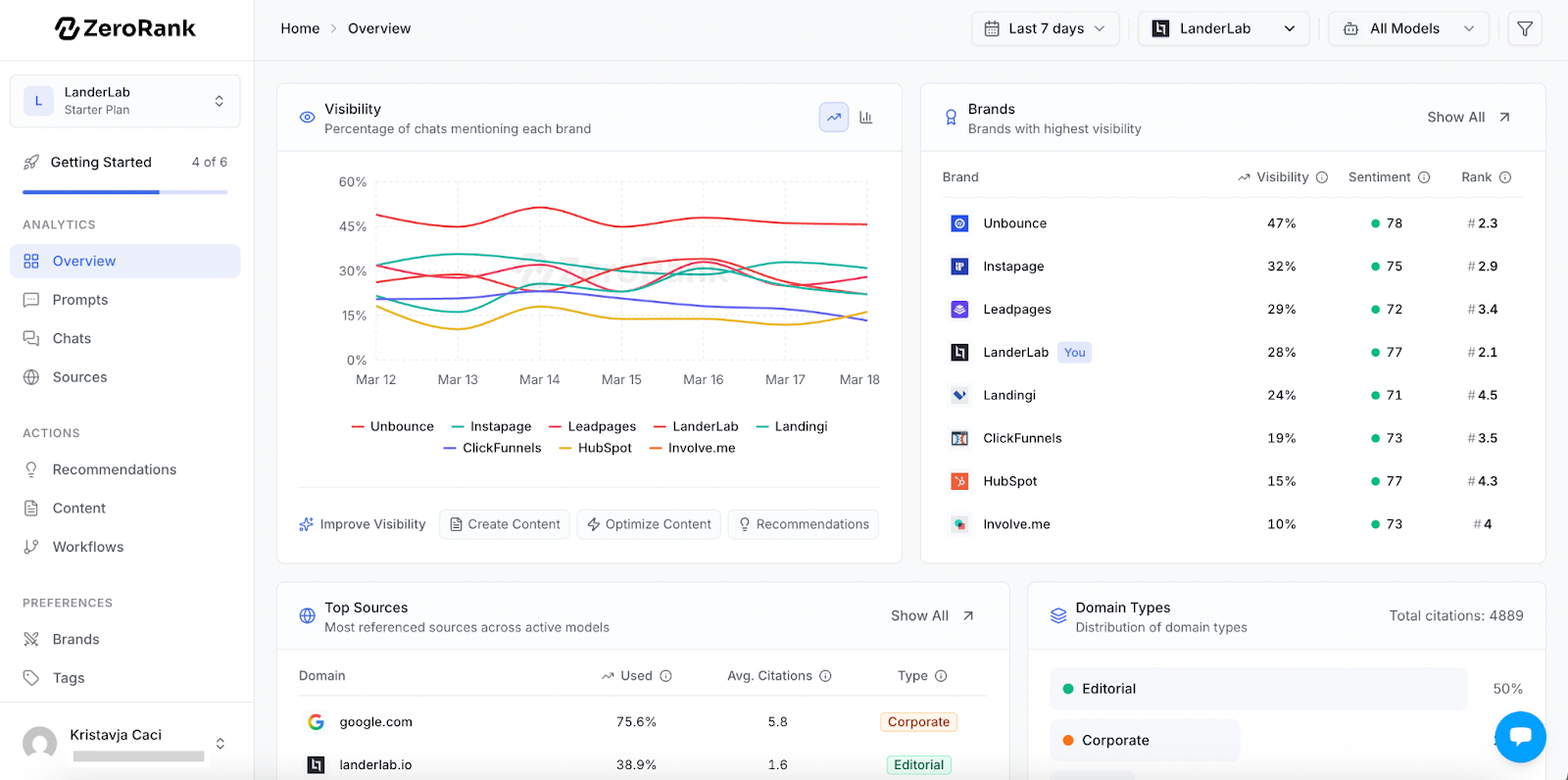
I recommend setting a visibility KPI so you can track improvement over time.
Also check how your brand is perceived in AI answers.
ZeroRank analyzes sentiment and shows whether your brand is mentioned negatively, neutrally, or positively.
Your sentiment scores ranges from 0-100. The higher the score, the better your brand is perceived.
For example, an AI model might say: “LanderLab is a newer AI landing page builder focused on affiliate marketers.”
This is a positive contextual mention, even if the visibility score is still low.
The goal is not just to appear in answers, but to be recommended positively.
Look at your prompt performance
Next, go to the Active Prompts tab.
This shows how your brand performs for each tracked prompt.
I recommend looking for prompts where:
- competitors appear frequently
- your brand has low or zero visibility
Below you can see that LanderLab has 0% visibility into the “Which AI landing page tool is fastest for creating responsive pages without coding” prompt.
That’s a clear visibility gap.
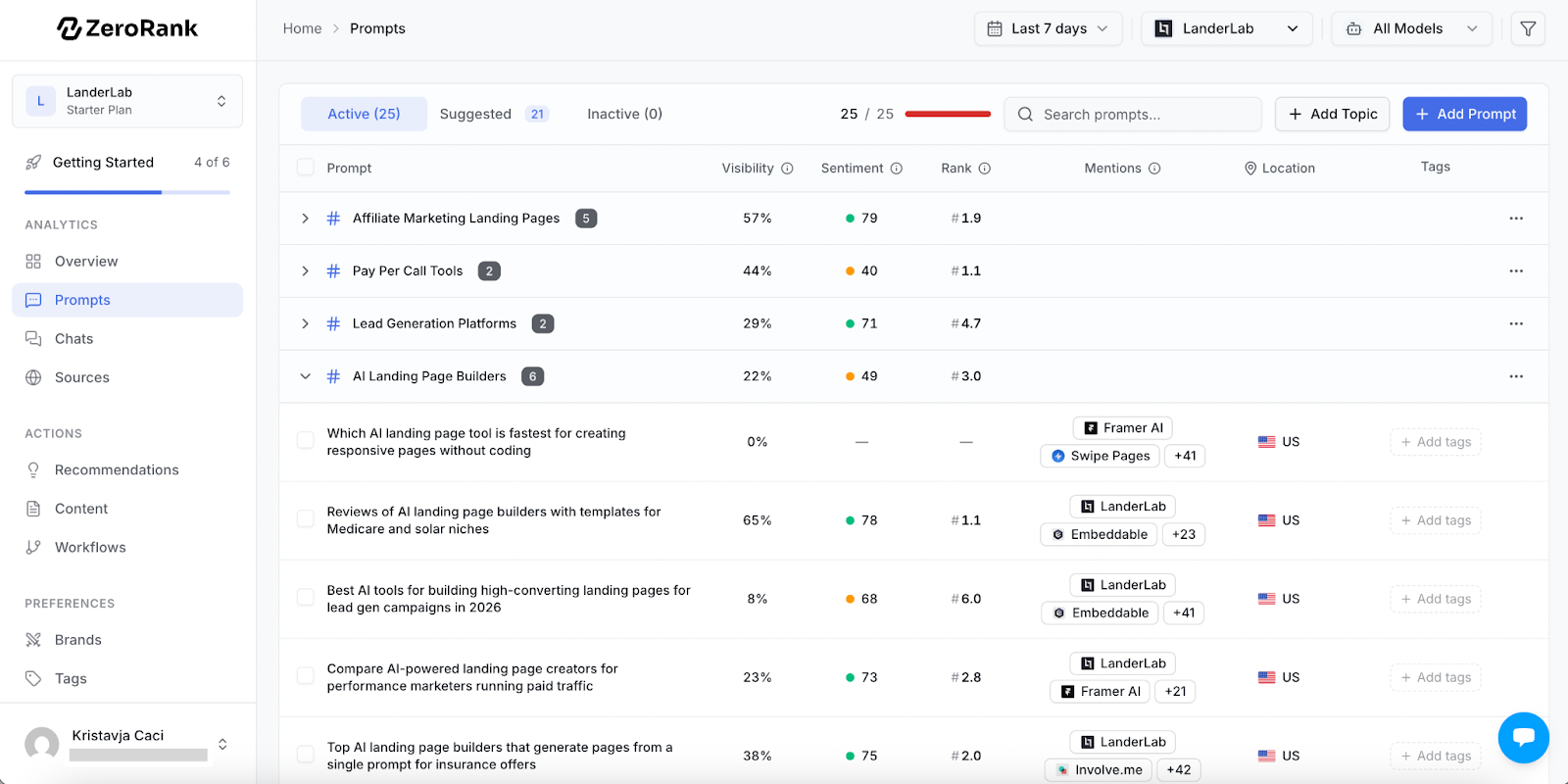
Such cases mean AI models recommend competitors but do not associate your brand with that use case yet.
Analyze sources influencing the answer
Click on a prompt to investigate further.
ZeroRank shows which brands appear and which sources the AI answer relies on, including:
- editorial articles
- user-generated content (forums, Reddit)
- review sites
- Videos
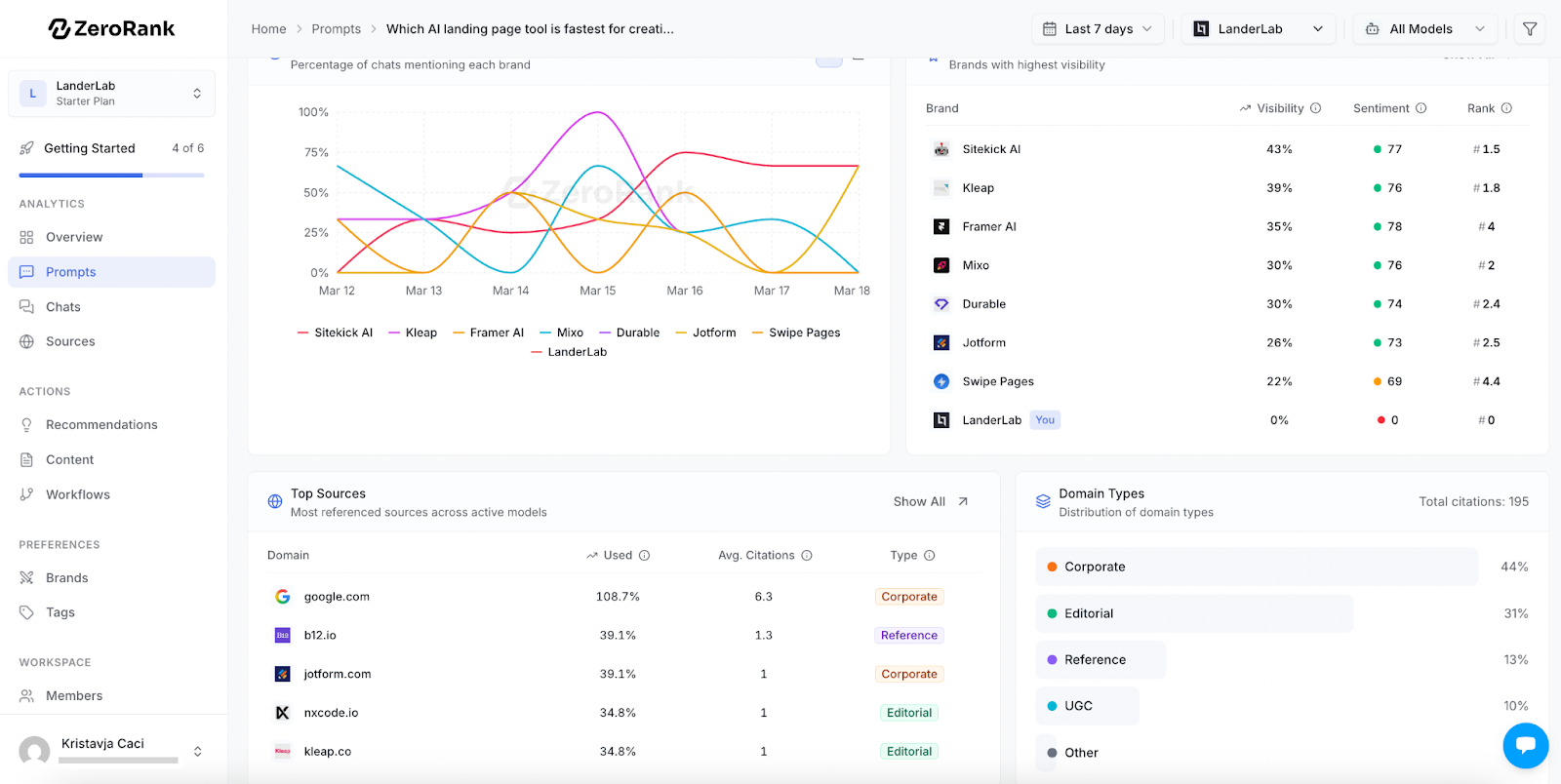
If your brand is missing across these sources, the AI model simply has fewer signals to reference.
By clicking on the Top Sources, you can see the exact URLs AI pulls from.
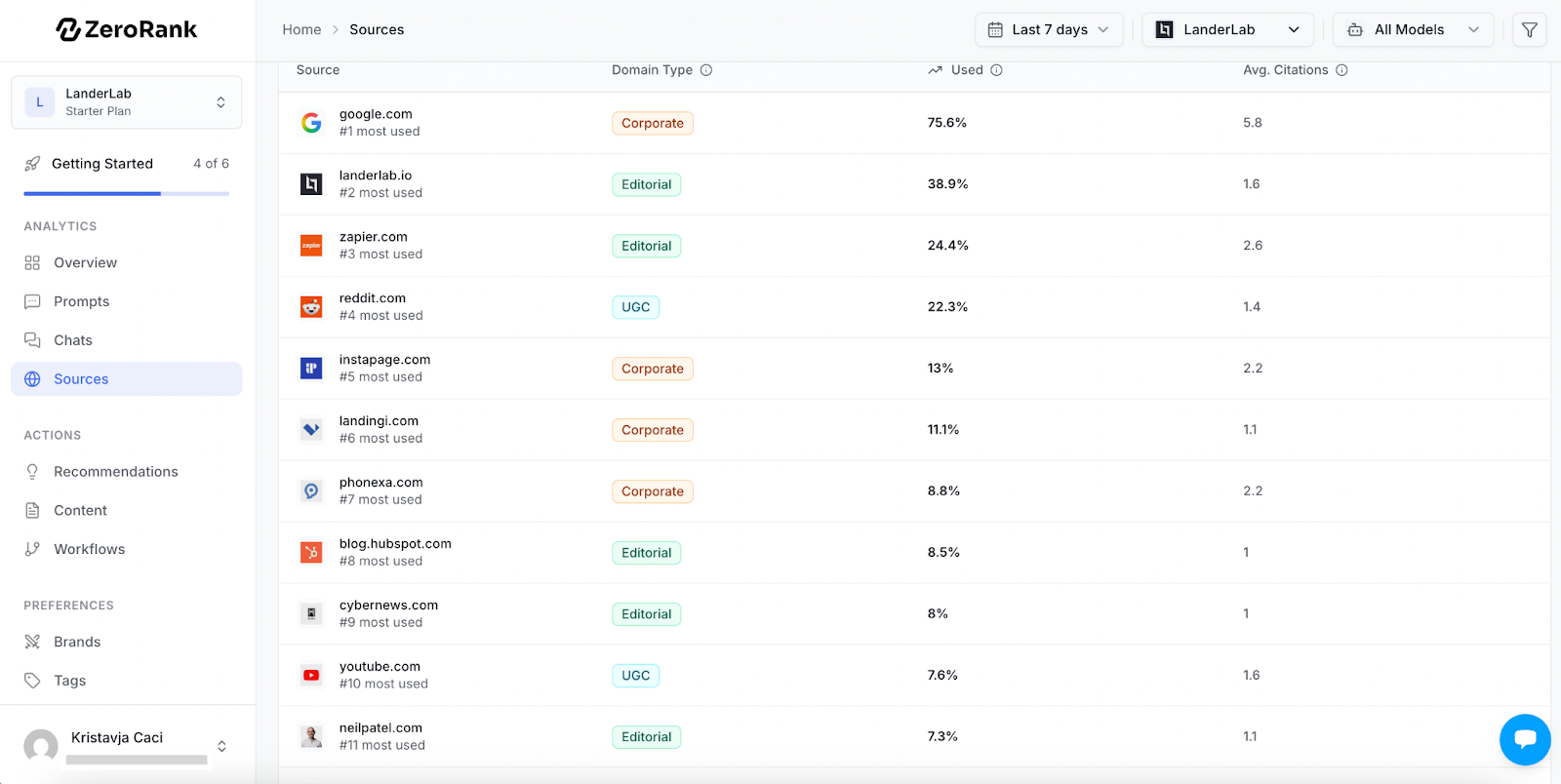
If your brand doesn’t appear in those types of pages, that’s a visibility gap.
Understanding these patterns helps you prioritize where to focus your efforts.
3. Take action to boost your AI visibility
Once you identify where your visibility gaps are, the next step is turning those insights into action.
ZeroRank helps with this through the Recommendations tab, which surfaces on-page, off-page, and technical improvements based on your tracked prompts and AI answers.
This section is where visibility insights become a practical optimization plan.
Off-page recommendations: get mentioned in the sources AI already trusts
AI models often rely heavily on third-party sources when recommending tools.
In the Off-page recommendations section, ZeroRank identifies specific opportunities where your brand can be mentioned.
These typically include:
- Reddit discussions
- forum threads
- editorial comparison articles
- blog roundups
You’ll see specific URLs where your brand could appear.
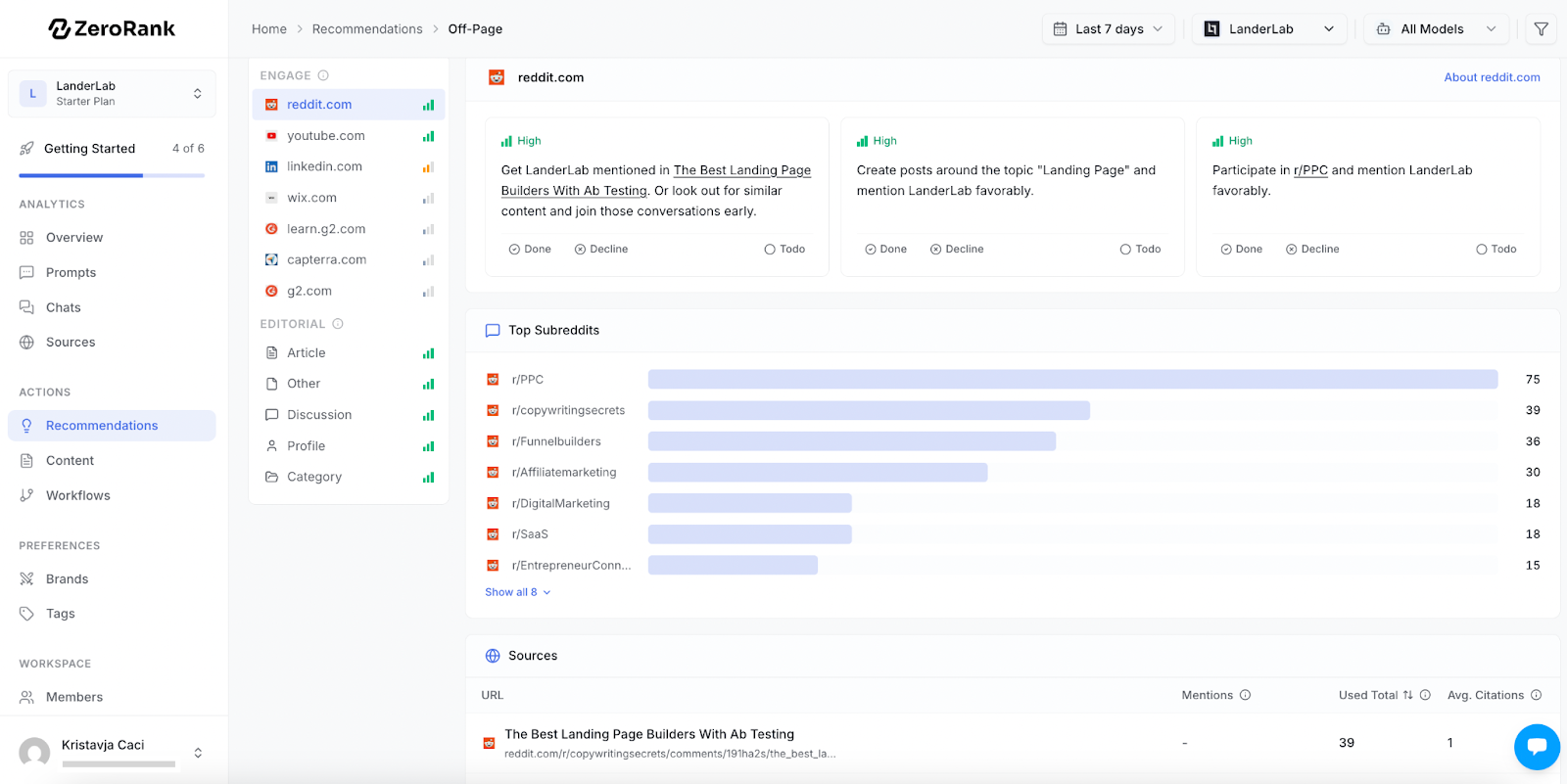
For example, if AI frequently cites a Reddit discussion about landing page builders, ZeroRank may suggest that thread as an opportunity.
So, instead of searching manually, you can immediately engage in conversations that already influence AI answers.
Another common opportunity is editorial pages, such as comparison articles and industry roundups.
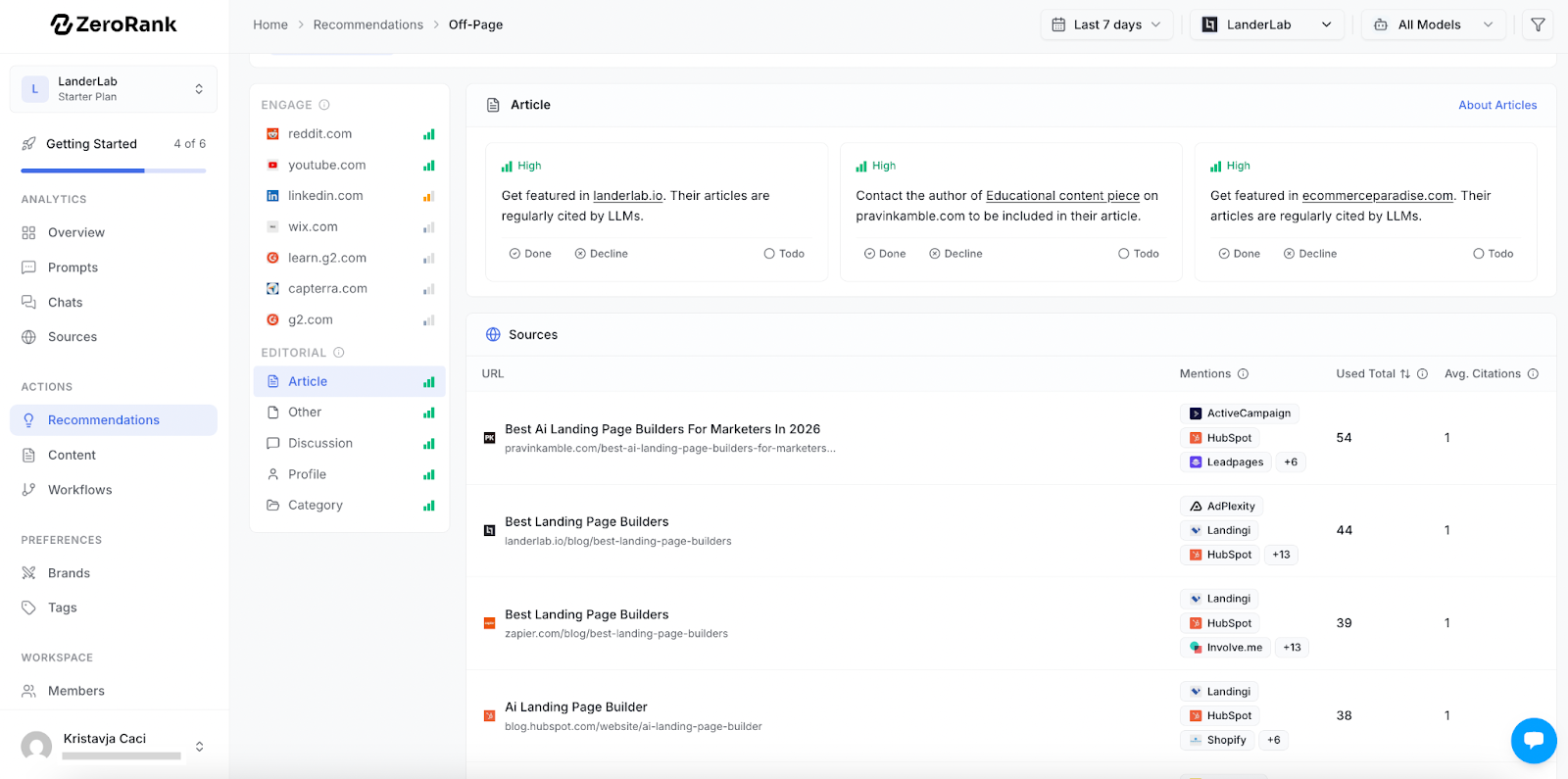
For example, if an article lists competitors but doesn’t mention LanderLab, this is a clear opportunity to reach out to the publisher and request inclusion.
These are the types of sources AI models reference most often.
The goal is simple: get your brand mentioned in the sources AI already uses.
On-page recommendations: create the content AI cites
AI models frequently rely on specific content formats when generating answers.
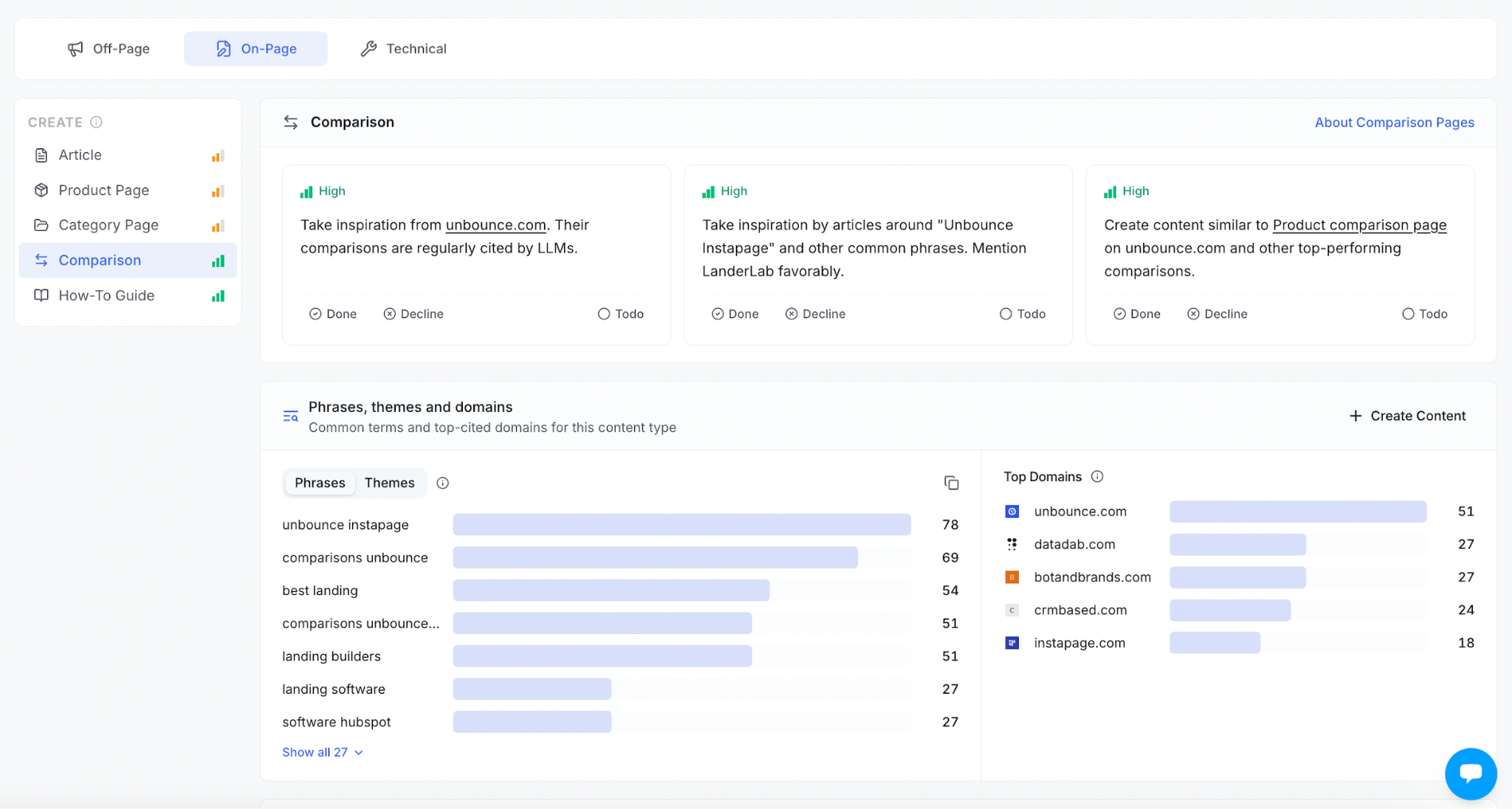
The On-page recommendations section shows which types of pages are cited most often for your tracked prompts.
Common examples include:
- listicle roundups
- comparison pages
- product pages
- alternatives pages
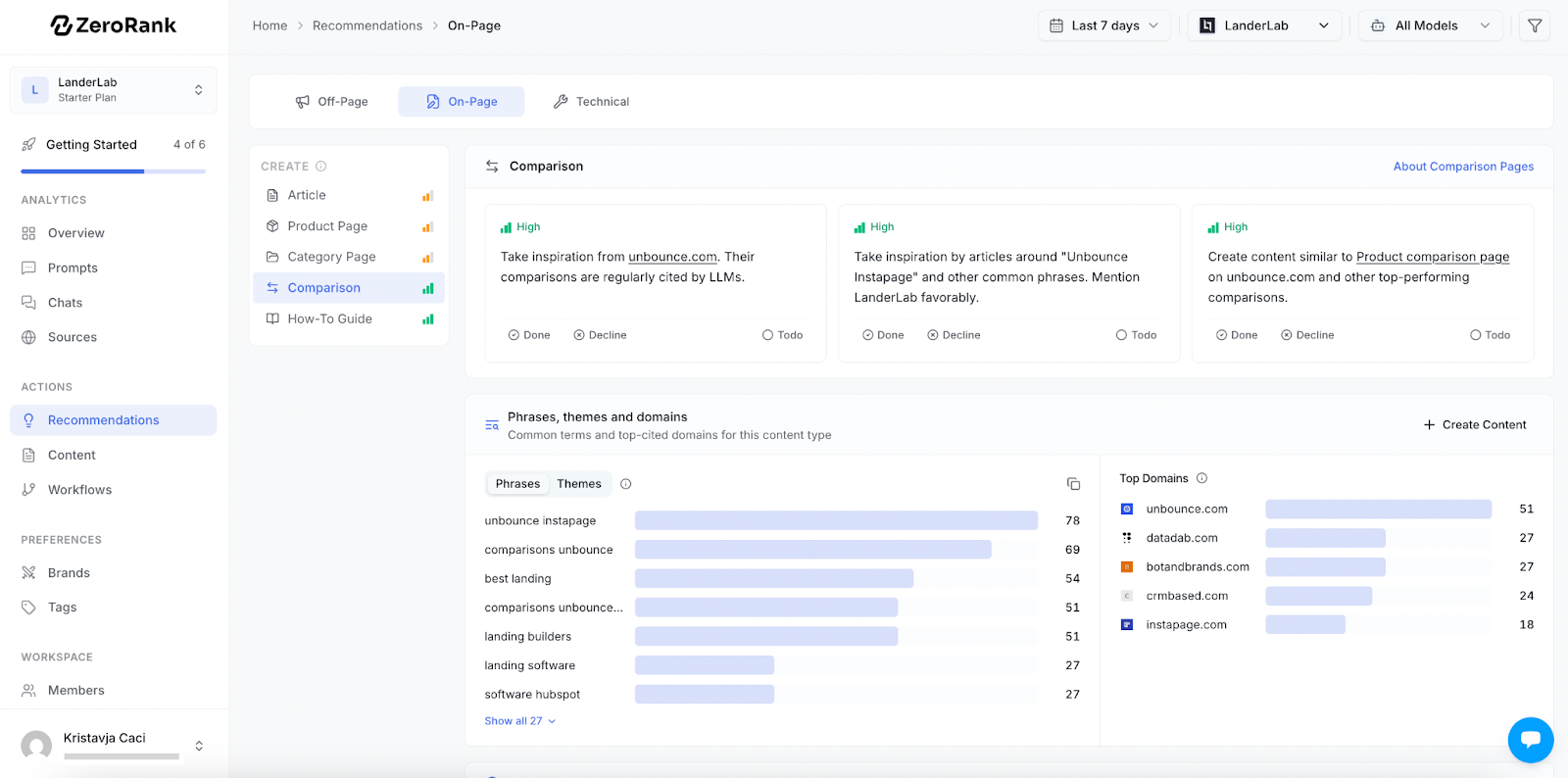
If AI answers frequently cite “best tools” articles for your category, ZeroRank may recommend creating comparison pages.
Instead of guessing what to create, you can base your content strategy on what AI models already reference.
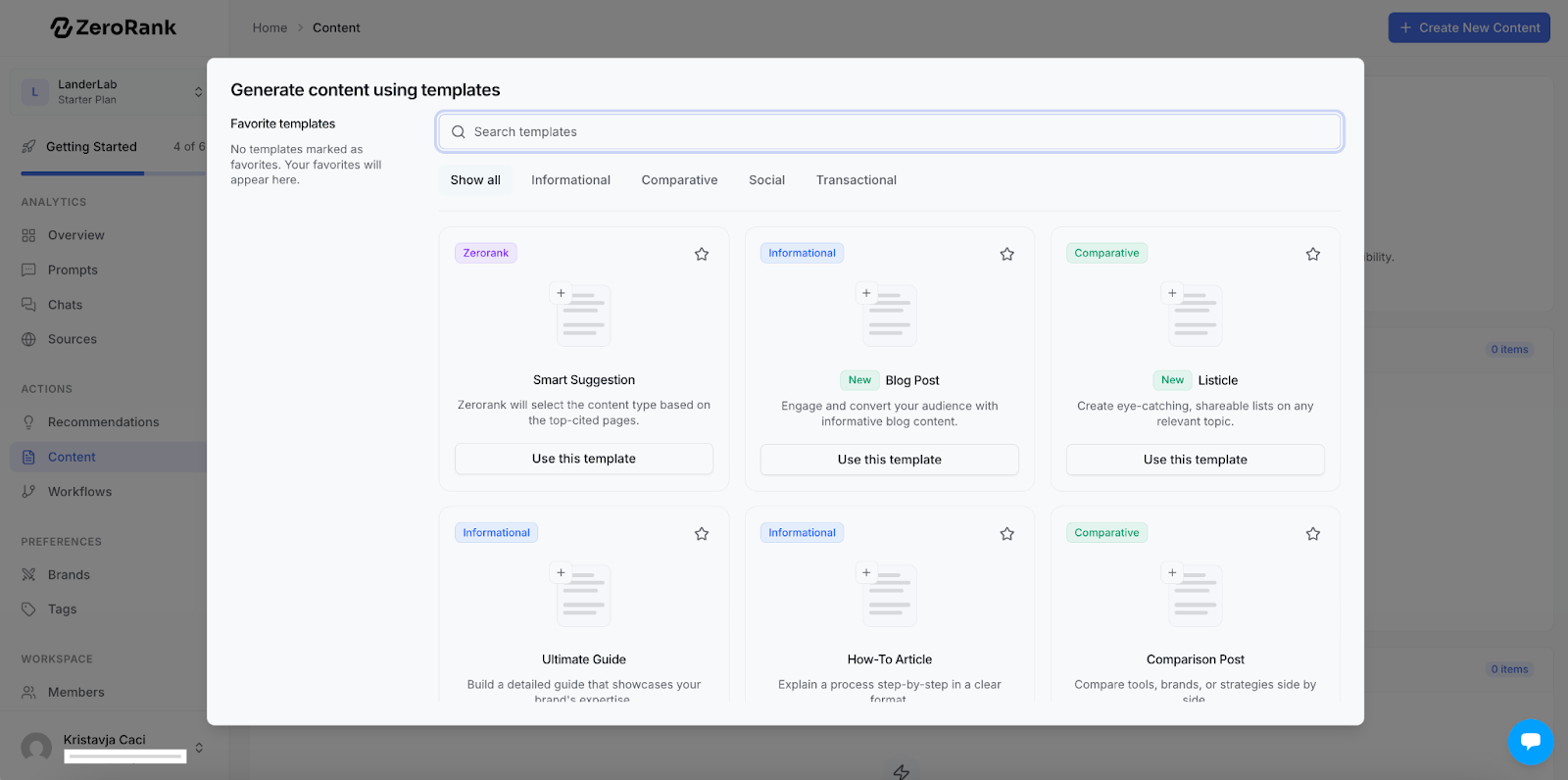
You can also click Create Content directly inside ZeroRank.
This helps generate structured drafts based on the recommended content format, making it easier to publish pages that align with AI-preferred content structures. And you have ready-made templates to get started.
Technical recommendations: make your content easier for AI systems to process
The final part of the Recommendations tab focuses on technical improvements.
Even though AI search is different from traditional search engines, technical signals still play an important role.
ZeroRank identifies technical gaps such as:
- missing schema markup
- weak E-E-A-T signals
- slow page speed
- missing structured content elements
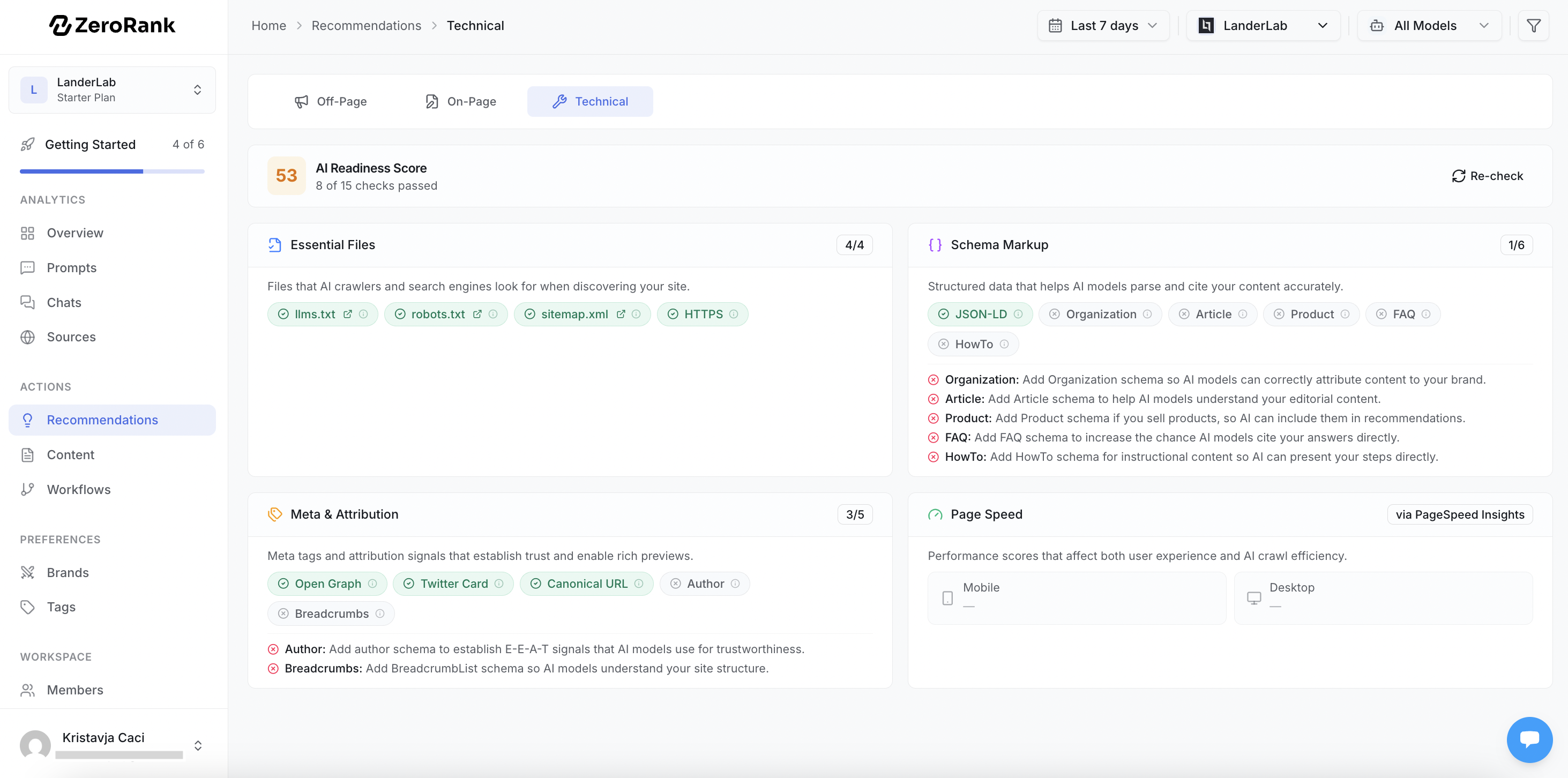
You will get an AI Readiness Score which checks your technical foundation.
These improvements help AI systems better understand and extract information from your content.
The easier it is for AI systems to parse your pages, the more likely they are to reference them in answers.
4. Set up automated workflows
AI visibility optimization is an ongoing process.
One of the advantages of ZeroRank is the ability to build automated workflows that connect insights with execution.
ZeroRank includes integrations and workflow templates that help automate tasks such as:
- refreshing your existing pages
- creating content briefs
- generating schema markup
- analyzing competitor mentions
- generating new content ideas based on prompts
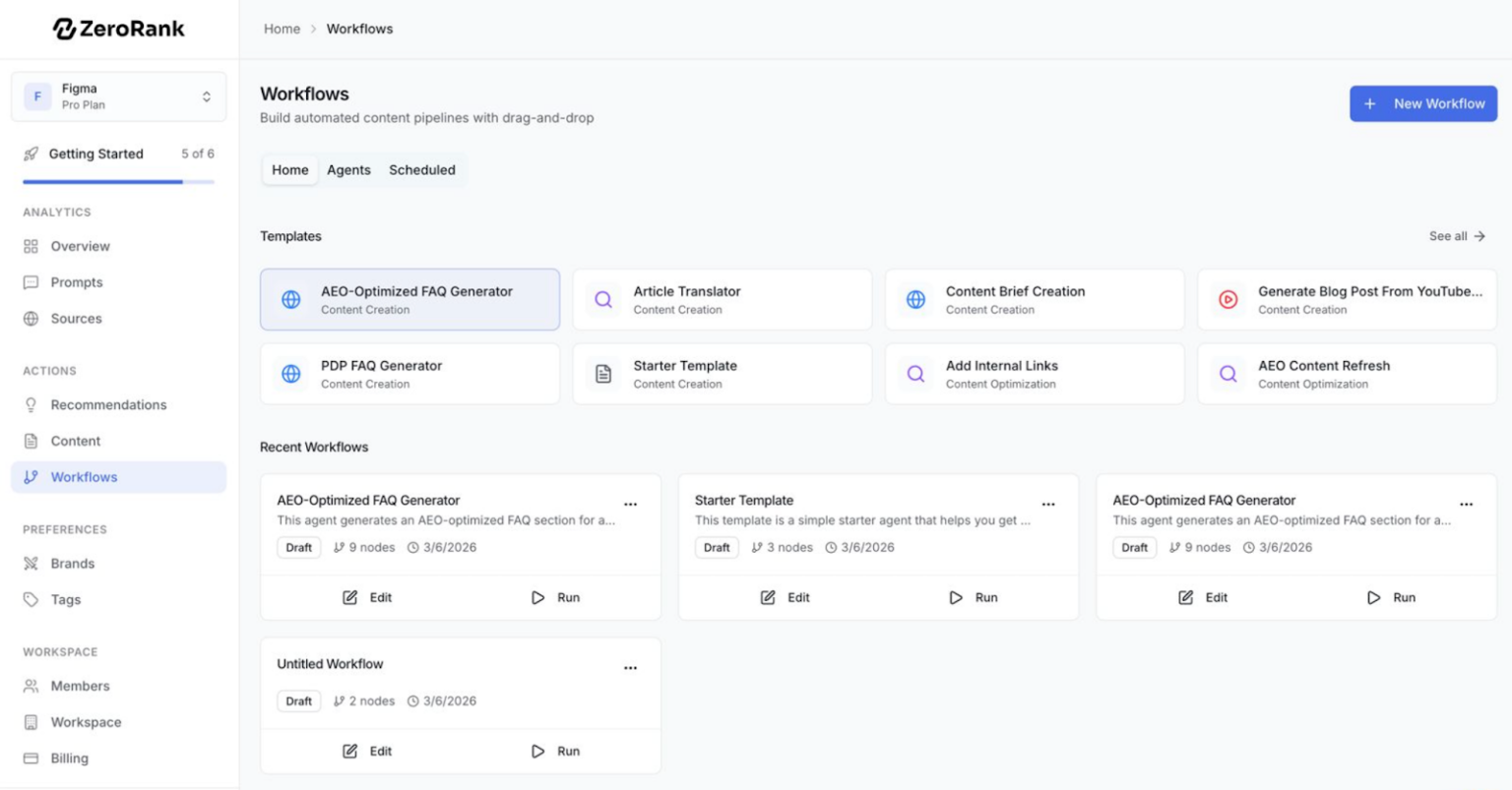
You can connect ZeroRank with tools like:
- WordPress
- Slack
- Content management systems (CMS)
- APIs, and many more..
This allows you to turn AI visibility insights into repeatable optimization processes.
Final thoughts
Improving your AI search visibility is not a one-time task. AI answers change constantly as models update, new content gets published, and different sources gain authority.
The key is to treat AI visibility as an ongoing process.
With ZeroRank, the workflow becomes straightforward:
- Track the prompts that matter to your category.
- Identify visibility gaps by analyzing prompts, competitors, and sources influencing AI answers.
- Turn insights into action through on-page, off-page, and technical improvements.
Over time, this allows you to systematically improve how often your brand appears in AI answers—and how it is perceived.
I recommend checking your visibility regularly, adding new prompts as your category evolves, and continuously improving your presence in the sources AI models rely on.
If you’d like help getting started, you can also book a demo with our CMO, who can walk you through the platform, help you set up your first prompts, and show you how to turn AI visibility insights into a practical optimization strategy.
Filed under Product
Head of content and operations. On a mission to make ZeroRank the go-to platform for AI search visibility.
Keep reading
All posts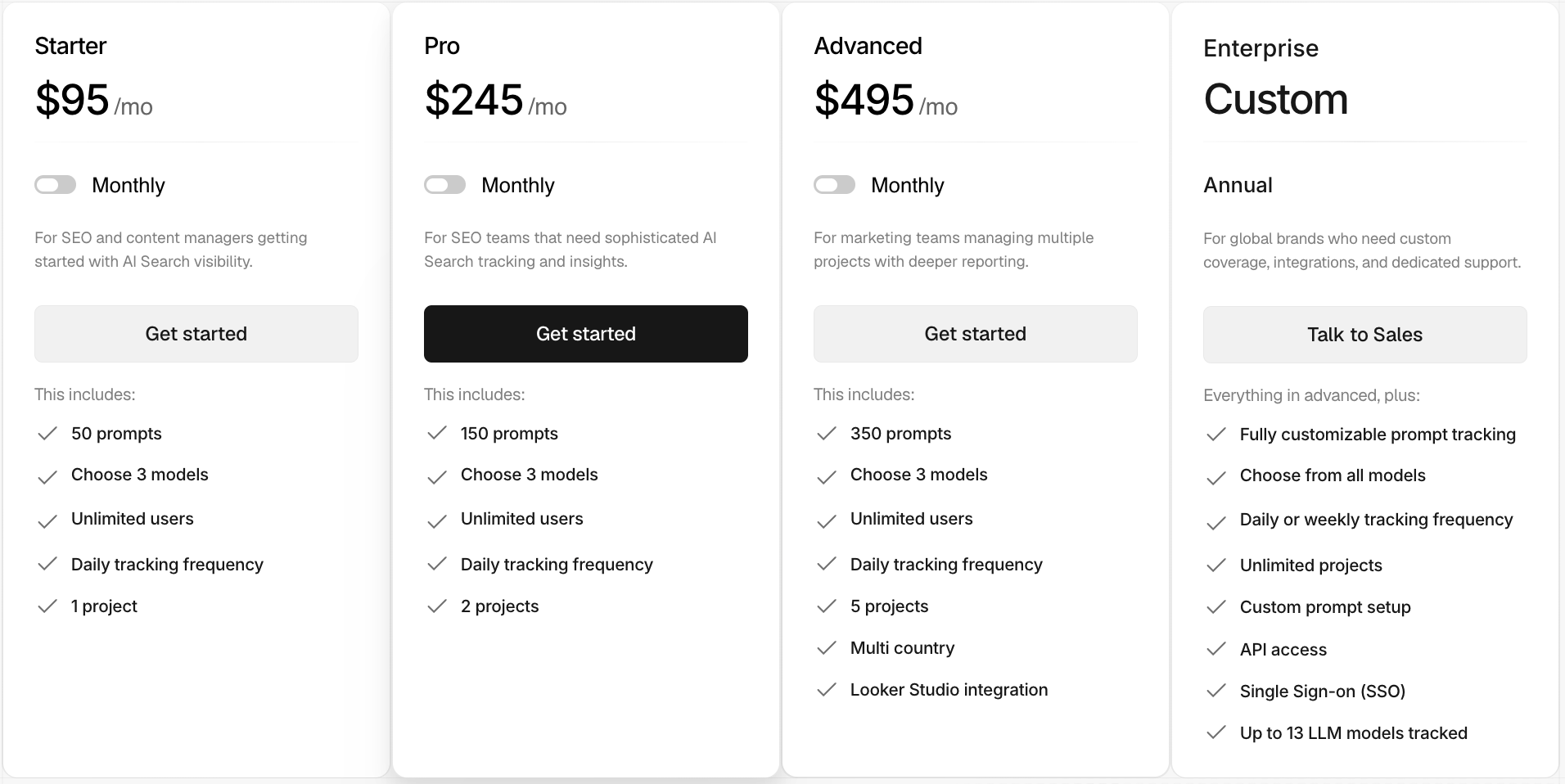 AI Search Tools
 Peec AI Pricing: What You Get for Your Money in 2026
What does Peec AI actually give you for the price? We break down its plans, tracking limits, model add-ons, and agency pricing, then compare the value with ZeroRank AI to help you choose the right tool for your budget.

 AI Search Education
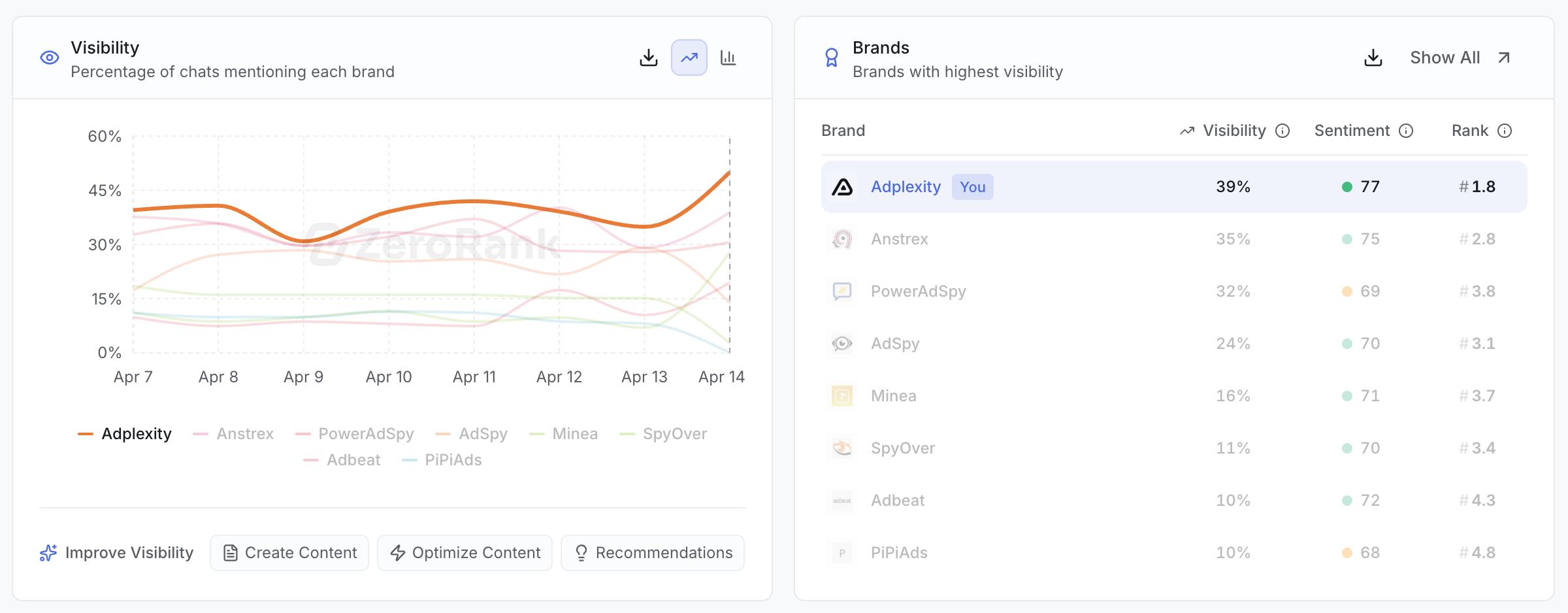
 AI Search Analytics: What to Track and How to Use the Data
Learn how to use AI search analytics to track visibility, research prompts, analyze sources, and turn your findings into practical improvements.
 AI Search Strategies
 Answer Engine Optimization (AEO) Checklist
Use this AI search optimization checklist to improve your content, build brand credibility, and fix technical issues so you can get found in AI answers.