What Gets Cited and Recommended in AI Search?
Three practitioner studies reveal why your website, external coverage and community discussions play different roles in AI search—and why a citation does not always mean a recommendation.

Key Takeaways
- Company websites supplied most citations in two B2B samples, but those websites included competitors.
- The source mix changed by engine: Milya’s B2B SaaS sample showed 96% brand-site citations in ChatGPT and 45% in AI Overviews.
- Two brands each appeared in 21% of Ran’s sampled answers; their recommendation rates were 20% and 5%.
- Choose content and outreach work from your own buyer questions, cited pages and recommendation context.
Your AI search strategy can get expensive very quickly. One study says to invest in Reddit. Another says to buy listicle placements. A third says the answer is already on your own website.
Before choosing a channel, ask two questions: which pages supply the answers your buyers see, and which brands do those answers actually recommend?
Three practitioner studies from Milya Kotlyarova and Ran Yosef help explain why those questions belong together. Their findings point to a practical starting place: inspect your own category, split the results by engine, and read the recommendation behind each mention.
Note: These are separate observational studies, with different samples; we have not combined them into a market-wide benchmark.
Where do AI citations come from?
In Ran’s source study (opens in a new tab), he examined 23,676 citations across two B2B categories during the preceding 30 days. Business-owned sites accounted for 78% of citations in one category and 65% in the other. Discussion platforms contributed a much smaller share in both.
That is a useful challenge to the idea that every company should start its AI search work with a community campaign. It also leaves an important question open: whose company website is being cited?
A competitor’s comparison article is still a company website. A vendor’s educational guide can describe several products. A large share for this source category does not mean your own site is earning that share.
Reported source type | B2B category 1 | B2B category 2 |
|---|---|---|
Business websites | 78% | 65% |
Editorial sources | 8% | 15% |
Reddit and forums | 5% | 7% |
The original post does not identify the categories or provide separate citation counts for each. Ran also clarified in a reply that the figures combine results from multiple engines. The listed source types do not total 100%, so the table shows only the categories he reported.
For your business, the useful next step is to separate your domain from competitors’ domains, then inspect the actual cited URLs. Our AI citation gap analysis guide (opens in a new tab) explains how to turn those missing sources into specific page improvements or relevant outreach.
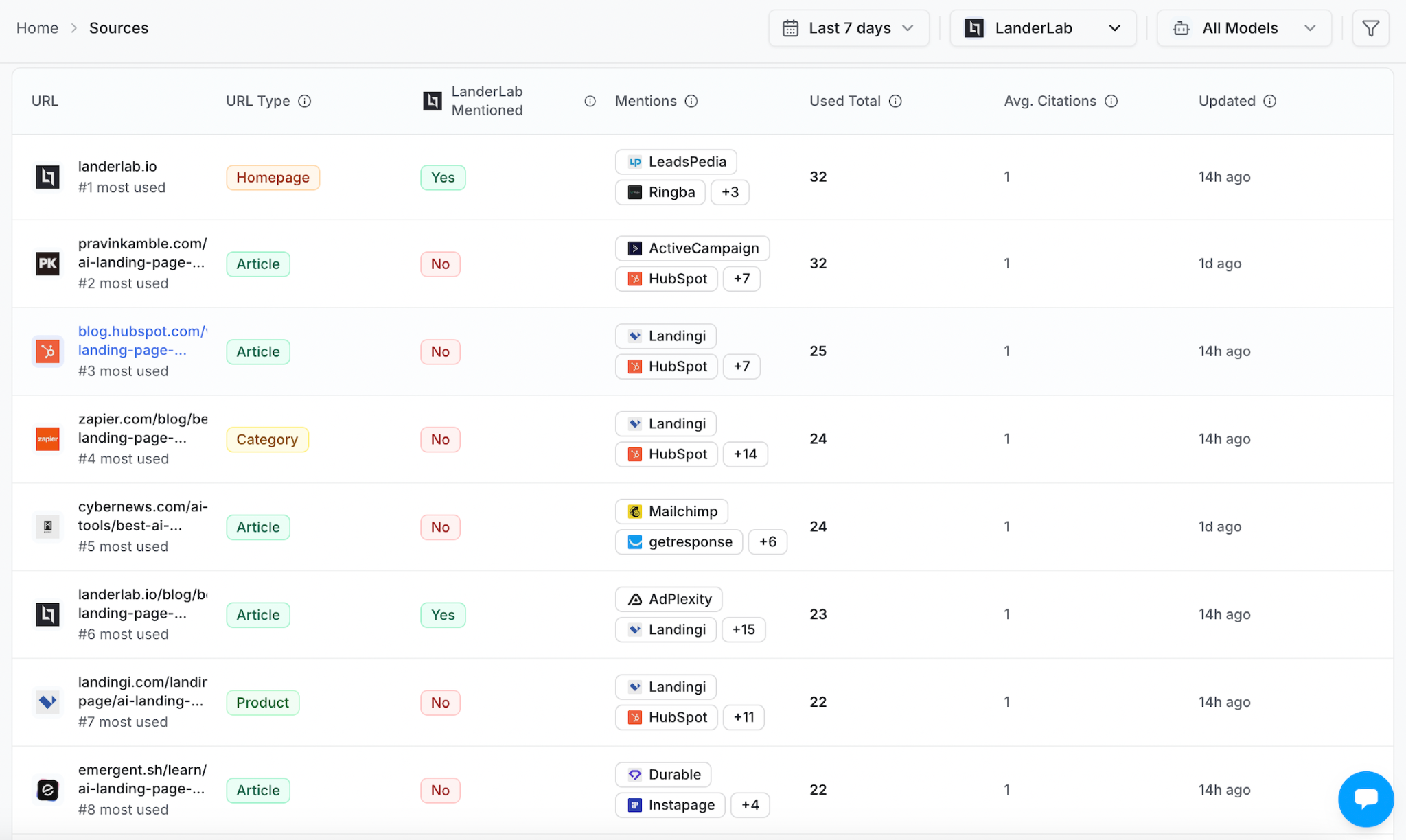
In this example Sources view, a company homepage sits alongside publisher articles and other vendors’ pages. The URL type and brand-mention columns help distinguish the source of an answer from the brand named in it.
The engine can change where you should invest
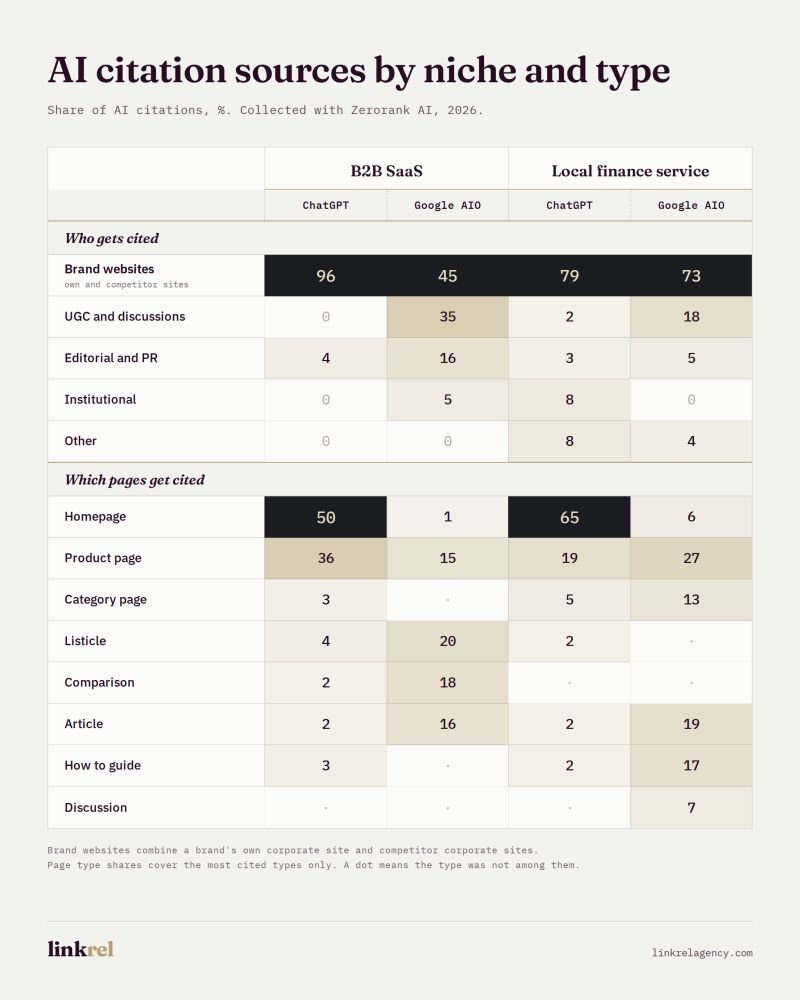
Milya’s study (opens in a new tab) looks at two niches—B2B SaaS and a local finance service—and separates ChatGPT from Google AI Overviews.
The share attributed to brands’ own and competitors’ sites ranged from 45% to 96%. The largest difference appeared in B2B SaaS: ChatGPT’s share was more than double the share in AI Overviews.
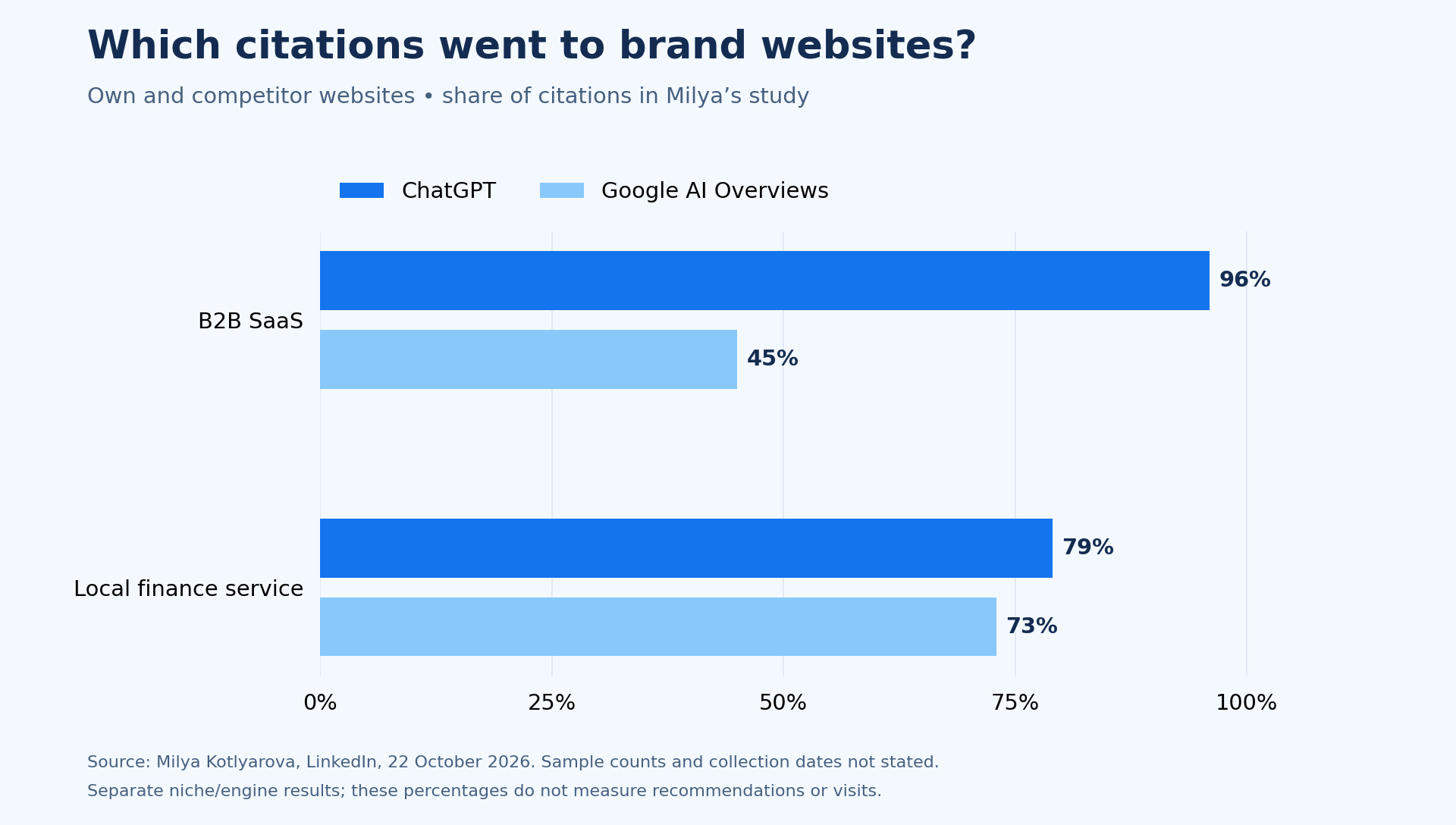
Her post does not state the sample counts, collection dates or full selection method. These figures describe her tracked examples. They are useful hypotheses to test in your own results, rather than estimates of every brand’s opportunity.
The lower business-site share in the B2B AI Overviews sample also matters. User-generated content accounted for 35% there, while editorial and PR sources accounted for 16%. That is a very different planning signal from the ChatGPT sample.
Those results do not support abandoning external coverage. They support checking the engine and buyer questions before deciding what kind of coverage deserves time or money.
Which pages deserve attention first?
Milya also examined the types of pages being cited. In ChatGPT, homepages accounted for 50% of citations in the SaaS niche and 65% in local finance, with product pages next. AI Overviews distributed citations across a broader set of formats.
For SaaS in AI Overviews, the reported mix included listicles at 20%, comparisons at 18% and articles at 16%. For local finance, product pages accounted for 27%, articles 19% and how-to guides 17%.
Domain ownership and page format describe different things. A listicle can live on a vendor’s site; a product review can live on a publisher’s site. Record both when classifying sources.
“Plan it after your own pages answer the questions.”
— Milya Kotlyarova, on the role of PR in her original research post (opens in a new tab).
The practical application is straightforward. Check whether your homepage explains the category, customer, core use case and evidence. Then inspect whichever product, comparison or educational pages appear for your buying questions.
A SaaS comparison should help a buyer check integration fit, plan limits and implementation effort. A local service page should establish what the service covers, where it is available and what a customer needs to proceed. Those are editorial choices based on the buyer’s task—not a promise that a particular format will earn citations.
Read Milya’s original study on LinkedIn (opens in a new tab).
Being a source does not mean being the recommendation
The third study changes how to read the first two.
In Ran’s 1,232-answer analysis (opens in a new tab), two brands appeared in the same proportion of sampled answers: 21%. Yet one was recommended in 20% of answers and the other in 5%.
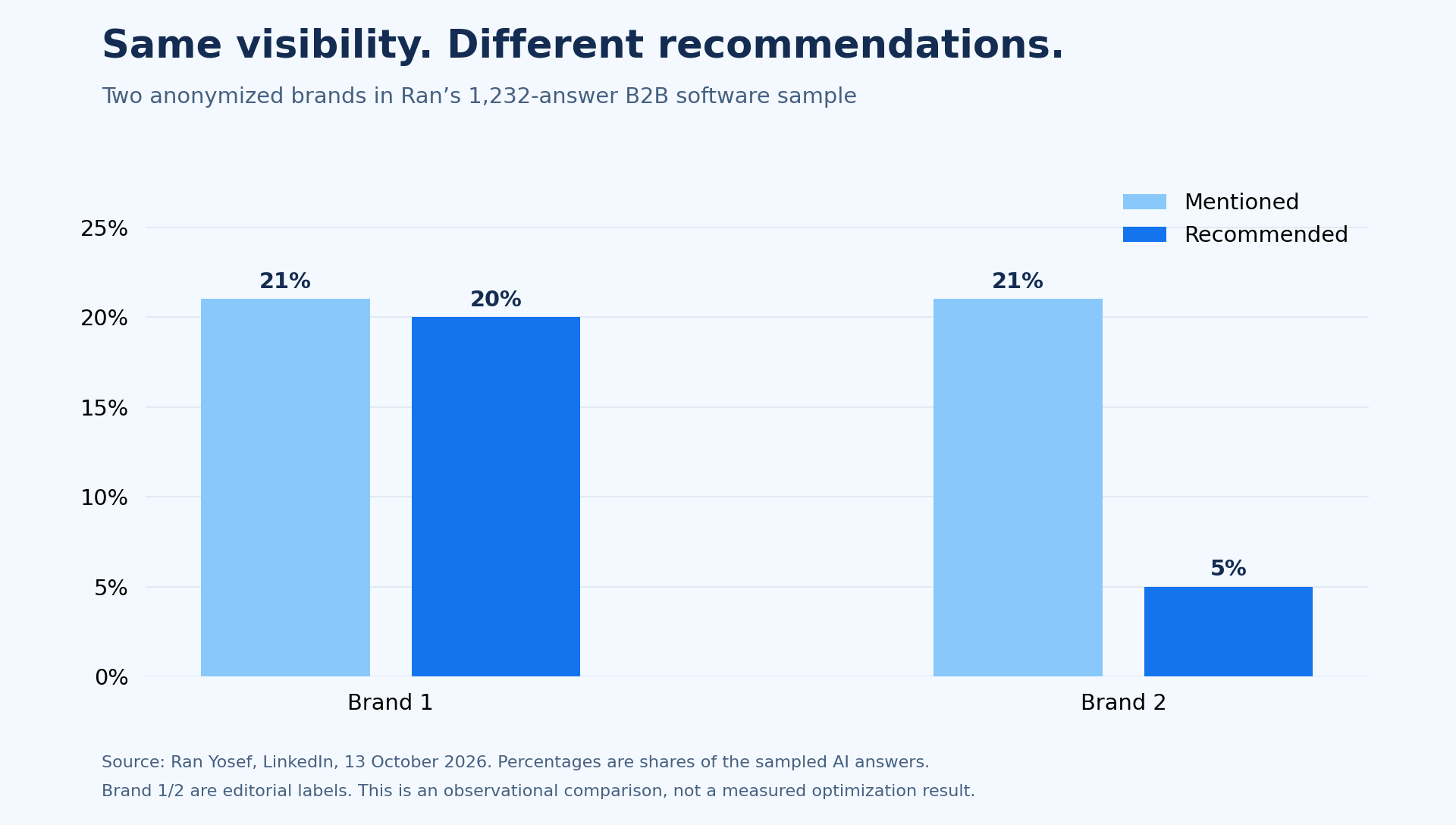
The gap came from reading what the answers actually did with each brand. In a separate finding from the same post, around 70% of one anonymized brand’s mentions were neutral. Roughly four-fifths of those neutral mentions supplied information within an answer favoring a competing product.
That creates a difficult situation for a marketing team: its research can become evidence for someone else’s sales pitch. A citation can still have value, but it does not automatically show that the answer positions the company as a suitable choice.
“Are you the answer, or a footnote in someone else’s?”
— Ran Yosef, in his recommendation study (opens in a new tab).
The study covers one B2B software category; it does not establish a universal recommendation rate or prove that a specific content change improves it. Its strongest contribution is the distinction between appearing in an answer and being selected for the buyer’s need.
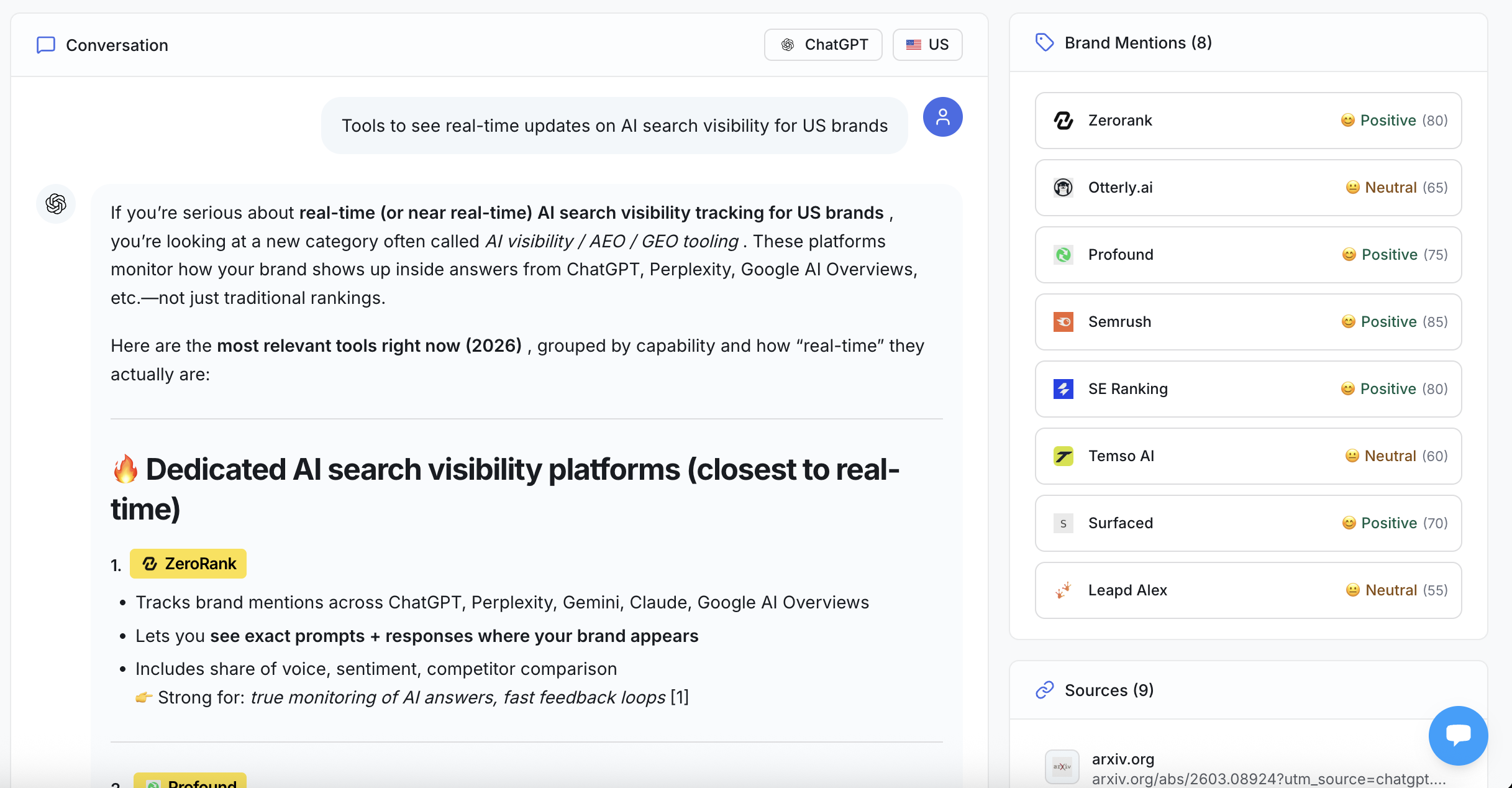
This ZeroRank answer view places the response alongside brand mentions and sentiment. Use those signals to find answers worth reading. A positive sentiment label alone does not establish a recommendation: check whether the answer actually suggests the product for the stated job.
Our AI search metrics guide (opens in a new tab) helps separate mentions, citations and business outcomes when reporting these findings.
Read Ran’s original recommendation analysis on LinkedIn (opens in a new tab).
How to decide between your website, publishers and communities
Start with a small set of buying questions that describe the customers you want and the problems you solve. Keep branded questions separate from questions where the buyer has not named a vendor. Compare the same questions across the engines relevant to your market.
For each answer, record the engine, country, date, cited URL, source owner, page type, brands mentioned and brands recommended. Save the answer as evidence, so a teammate can check the classification.
Then choose the action that matches the gap:
What the answer shows | Useful next action |
|---|---|
Competitor-owned pages answer the buying question | Improve your equivalent page with specific fit, limits and evidence. |
A publisher’s relevant comparison is cited repeatedly | Check the article’s audience and criteria; propose an accurate contribution. |
Community discussions supply the buyer’s missing context | Contribute expertise where you can answer the question substantively. |
Your data is cited but another product is selected | Review whether your product’s relevant use case and proof are easy to find. |
An old source repeats incorrect product information | Correct the source, document the change and recheck the same questions. |
A source’s citation frequency can help you choose what to inspect. Before paying for coverage, also consider the publication’s audience, relevant visits, editorial fit and reuse terms. Citation counts alone do not tell you whether a placement will send customers.
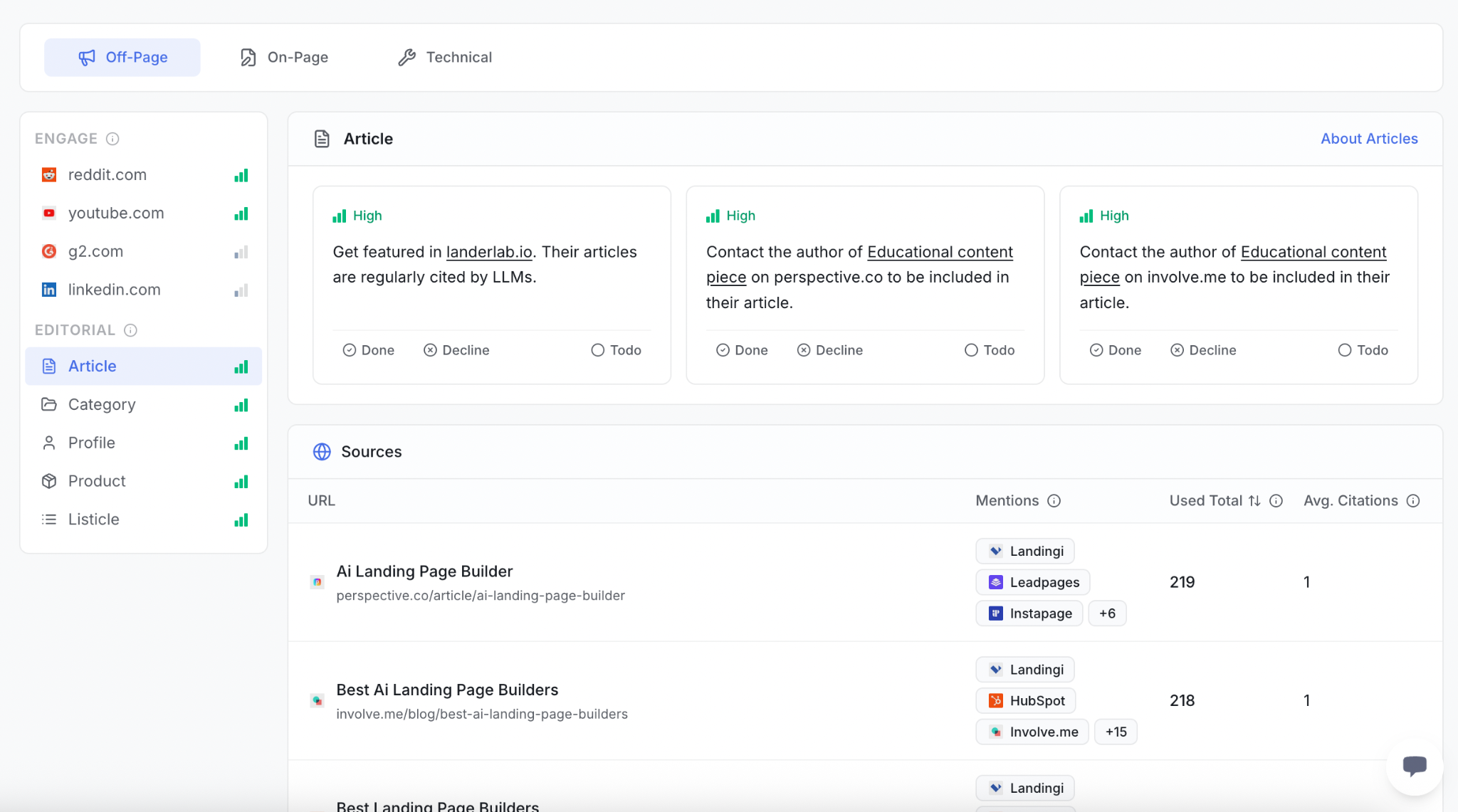
ZeroRank’s off-page recommendations connect potential placements with cited pages. Review the actual article and its fit before contacting the publisher.
Ran’s blended source study gives a reason to check company pages first. Milya’s engine-level breakdown gives a reason to keep communities and external articles in that review. The recommendation study explains what you should look for in the answer once you find those sources.
Make the page useful and accessible
Once you choose a page, correct the specific weakness. Add the missing comparison, clarify an integration limit, update an outdated product detail or show evidence for a claim. Avoid adding a generic FAQ simply because another site has one.
For Google’s AI features, there is also a clear technical baseline. Google Search Central’s guidance (opens in a new tab) says a page must be indexed and eligible for a search snippet to appear as a supporting link in AI Overviews or AI Mode. Its existing SEO practices still apply: crawl access, internal links, important information in text and structured data that agrees with the visible page.
Meeting those conditions does not guarantee inclusion. They make the page eligible to compete; its usefulness for the question still matters.
After publication, repeat the same prompt set and review patterns over several checks. Record the date and substance of each change. An answer moving after an edit is an observation to investigate, not proof that the edit caused it.
Find the next page worth improving
Choose one buying question that matters to your business. In ZeroRank, inspect the answer, identify the cited pages and check which brand the response recommends.
If competitors’ pages supply the answer, compare what those pages explain that yours does not. If an external article shapes the shortlist, assess whether your product belongs in it. If your own research supports someone else’s recommendation, make your product’s relevant use case easier to evaluate.
ZeroRank turns these insights into actionable on-page, off-page, and technical recommendations and gives you the tools to implement them.
Filed under Zero-Click Search
CMO. On a mission to make ZeroRank the go-to platform for AI search visibility.
Keep reading
All posts Zero-Click Search
7 AI Search Visibility KPIs That Matter
AI search visibility is about more than whether your brand appears in an answer. Learn the seven KPIs that reveal how often you appear, where you rank, how AI describes you, whether your content gets cited, and how that visibility contributes to demand.
 Zero-Click Search
How Teams Are Measuring SEO ROI When Clicks Keep Falling
If traffic is no longer the best indicator of SEO success, what should you track instead? Five SEO and growth experts share the metrics they're using to measure business impact in a post-click world.
 Zero-Click Search
What is Zero-Click? Solving AI Search Visibility
Zero-click search sessions have quickly moved into the default user experience of the internet. This guide quickly educates how teams can shift strategy for visibility in AI Overviews and chat facing AI interfaces like Chat-GPT and Perplexity customers are researching and comparing products at scale.